


Quick answer: Mortgage points (also called discount points) are an upfront fee you pay at closing to get a lower interest rate. One point costs 1% of your loan amount, so on a $400,000 mortgage one point is $4,000. How much the rate drops per point varies by lender and market; the Consumer Financial Protection Bureau (CFPB) uses about 0.25 percentage points as an illustration. To decide whether points pay off, divide the cost of the points by the monthly payment savings. That gives your break-even point in months. If you’ll keep the loan longer than that, points can save you money. If you might sell or refinance sooner, they usually don’t.
With the average 30-year fixed rate at 7.32% in Freddie Mac’s survey for the week of October 22, 2026, many buyers are being offered points to bring their rate down. This guide explains how mortgage points work, shows the math with real dollar figures, and covers the IRS rules for deducting them. If you are comparing other borrowing costs too, our breakdown of the buy now, pay later debt trap shows how small fees add up over time.
What are mortgage points?
A mortgage point is a fee equal to 1% of the loan amount. According to the CFPB, lenders may also charge fractions of a point, such as 0.375 points (that’s $375 on a $100,000 loan). Points show up on your Loan Estimate and Closing Disclosure, and the CFPB says points listed there must be connected to a reduced interest rate.
In effect, you are prepaying some interest. You pay more now, and in return your monthly payment is lower for the life of the loan.
Discount points vs. origination fees
Some lenders use the word “points” for any upfront fee calculated as a percentage of the loan, even if it doesn’t lower your rate. An origination fee covers the lender’s cost of making the loan. A discount point buys down the rate. When a lender quotes you “points,” ask which kind they mean and exactly how much each one lowers your rate.
What are lender credits?
Lender credits are the reverse of points. You accept a higher interest rate, and the lender gives you money to cover part of your closing costs. The CFPB notes that credits are calculated the same way as points and sometimes appear as “negative points” on a lender’s rate sheet. Credits can make sense if you’re short on cash at closing or expect to move or refinance within a few years.
How much does one mortgage point cost?
The cost is simple: multiply your loan amount by 1% for each point.
| Loan amount | 0.5 point | 1 point | 2 points |
|---|---|---|---|
| $200,000 | $1,000 | $2,000 | $4,000 |
| $300,000 | $1,500 | $3,000 | $6,000 |
| $400,000 | $2,000 | $4,000 | $8,000 |
| $500,000 | $2,500 | $5,000 | $10,000 |
Points are based on the loan amount, not the home price. On a $500,000 home with 20% down, you’re borrowing $400,000, so one point is $4,000.
How much does a point lower your rate?
There is no fixed rule. The CFPB says the reduction “varies” by lender, loan type and market conditions. In its 2024 data report on discount points, the CFPB used an example where one point on a $400,000 loan might reduce the rate by 0.25 percentage points, while stressing that lenders value points differently. Freddie Mac stopped publishing average fees and points in its weekly survey in November 2022, so there’s no official national average to compare against. The only reliable way to know is to ask each lender for a quote with and without points on the same day.
Worked example: Is buying 1 point worth it on a $400,000 loan?
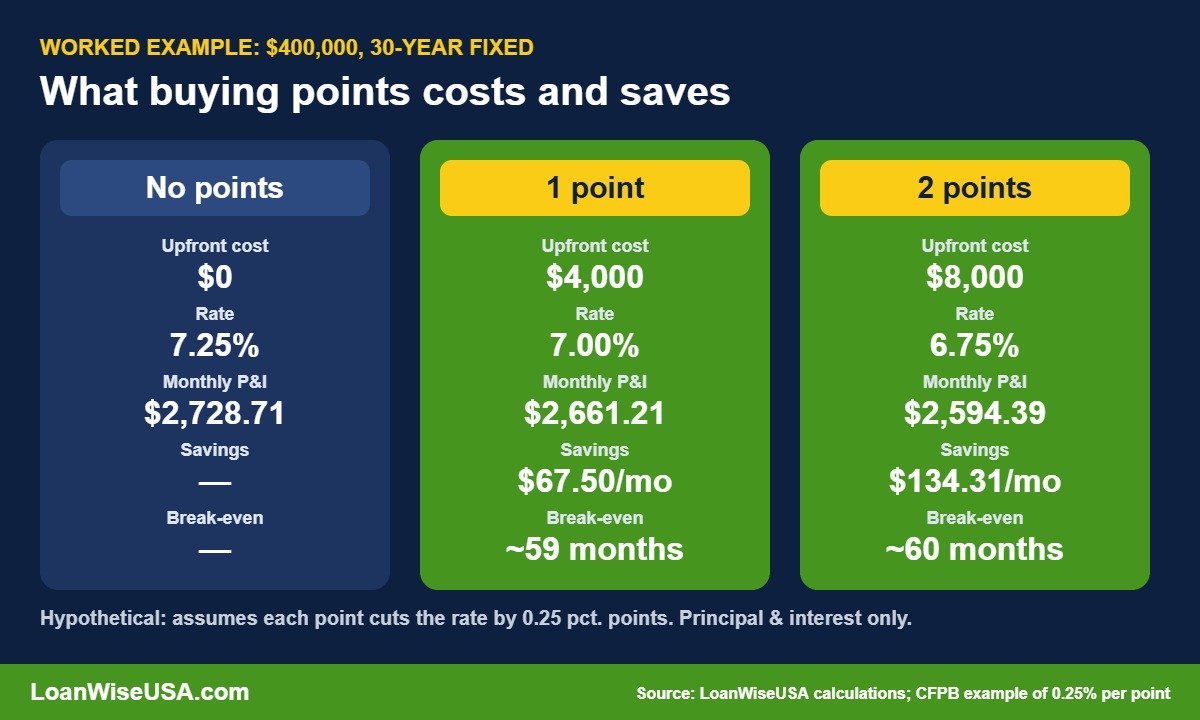
Let’s use a hypothetical 30-year fixed loan of $400,000. Assume the lender offers 7.25% with no points and lowers the rate by 0.25 percentage points per point. (Principal and interest only; taxes and insurance aren’t included.)
| Option | Upfront cost | Rate | Monthly P&I | Monthly savings | Break-even |
|---|---|---|---|---|---|
| No points | $0 | 7.25% | $2,728.71 | — | — |
| 1 point | $4,000 | 7.00% | $2,661.21 | $67.50 | ~59 months (4.9 years) |
| 2 points | $8,000 | 6.75% | $2,594.39 | $134.31 | ~60 months (5 years) |
Here’s the break-even math for one point: $4,000 ÷ $67.50 = about 59 months. If you keep the loan for at least five years, you come out ahead. Over the full 30 years, one point saves about $24,300 in payments for a $4,000 cost.
What if the point is worth less?
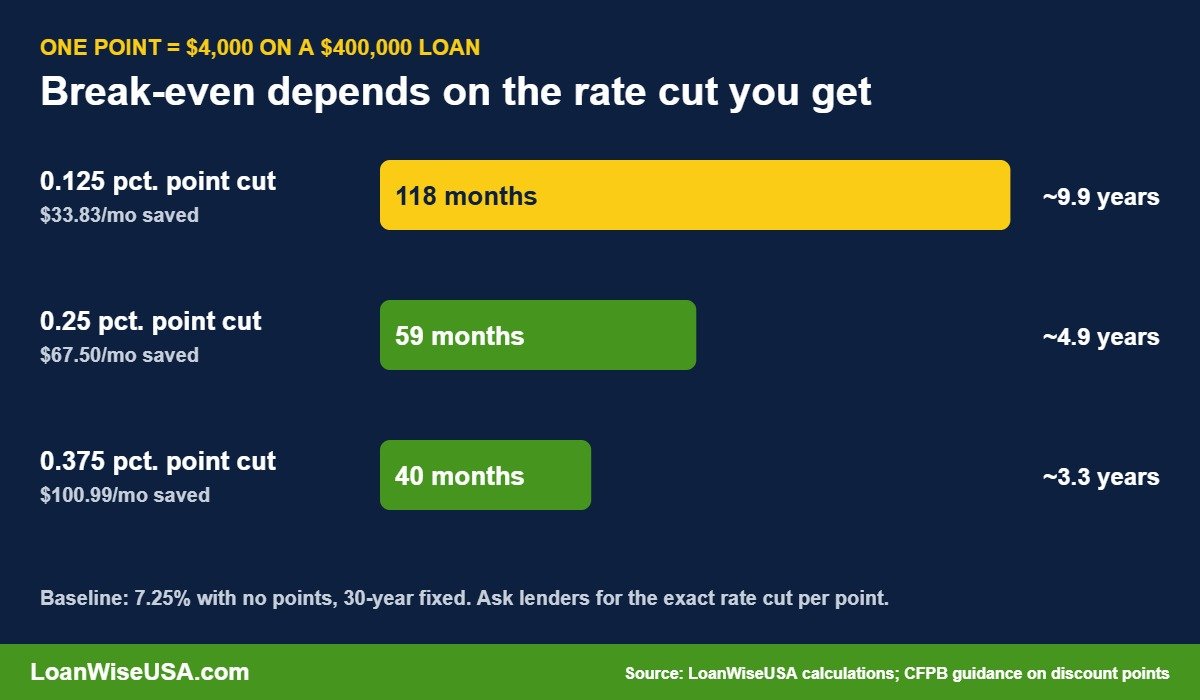
The size of the rate cut changes everything. Using the same $400,000 loan and $4,000 for one point:
| Rate cut for 1 point | New rate | Monthly savings | Break-even |
|---|---|---|---|
| 0.125 percentage points | 7.125% | $33.83 | ~118 months (9.9 years) |
| 0.25 percentage points | 7.00% | $67.50 | ~59 months (4.9 years) |
| 0.375 percentage points | 6.875% | $100.99 | ~40 months (3.3 years) |
A point that only buys one-eighth of a percentage point takes almost 10 years to pay off. That’s why comparing the exact rate cut matters more than the number of points.
How long will you really keep the loan?
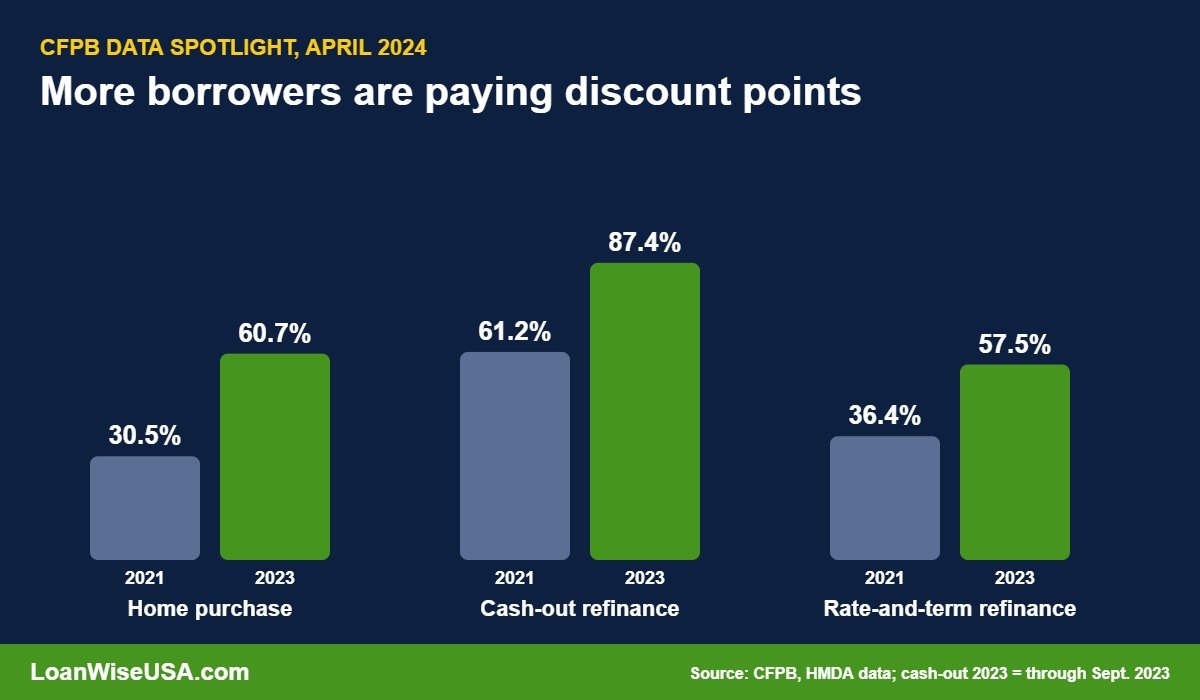
The break-even only counts if the loan lasts that long. You stop benefiting from points the moment you sell or refinance. The CFPB’s data report found that the share of home buyers paying points roughly doubled from 30.5% in 2021 to 60.7% in 2023 as rates rose. Many of those borrowers were betting they would keep their loans for years. If rates fall and you refinance in two years, the money you spent on points is mostly lost. A similar break-even logic applies to student loans; see our guide on the best time to refinance student loans.
When do mortgage points make sense?
| Points may make sense if… | Points may not make sense if… |
|---|---|
| You plan to stay in the home well past the break-even date | You may move for work or family within a few years |
| You have cash left over after your down payment and emergency fund | Paying points would drain your savings or reduce your down payment below 20% |
| You don’t expect to refinance soon | You expect rates to fall and plan to refinance |
| The lender’s rate cut per point is generous | Each point buys only a small rate reduction |
| A seller has agreed to pay concessions you can apply to points | You’re stretching to qualify and need cash for closing |
Think of it like the logic in our cost-per-wear math: a higher upfront price is only a bargain if you use it long enough.
Rates are elevated right now: the 30-year average was 7.32% in Freddie Mac’s Oct. 22 survey, and the Fed held its benchmark steady on Oct. 28. Our breakdown of what the Fed decision means for mortgage rates explains why fixed rates don’t move in lockstep with the Fed.
Are mortgage points tax deductible?
They can be, but only if you itemize deductions on Schedule A. For 2026, the standard deduction is $16,100 for single filers, $32,200 for married couples filing jointly and $24,150 for heads of household. Many homeowners take the standard deduction instead, in which case points provide no tax benefit.
Points on a home purchase
According to IRS Topic 504, you can generally deduct points in full in the year you pay them if all of these apply:
- The loan is used to buy, build or improve your main home, and the home secures the loan.
- Paying points is an established business practice in your area, and the amount is not more than what’s generally charged there.
- You use the cash method of accounting (most individuals do).
- You provided at least as much money at or before closing as the points charged, and that money did not come from the lender or broker.
- The points were computed as a percentage of the loan’s principal.
- The amount is clearly shown as points on your settlement statement.
Points the seller pays can also count as paid by you, as long as you reduce your home’s cost basis by that amount.
Points on a refinance
Points paid to refinance are generally deducted over the life of the new loan, not all at once. On a 30-year refinance, $3,600 in points works out to $120 a year. IRS Publication 936 says that if part of the refinance money is used to substantially improve your main home, the share of points tied to that improvement can be deducted in the year paid. If the loan ends early, you can generally deduct the remaining undeducted points that year, unless you refinance with the same lender, in which case you spread the remainder over the new loan.
Mortgage interest, including deductible points, is limited to interest on up to $750,000 of home acquisition debt ($375,000 if married filing separately) for loans taken out after December 15, 2017. The 2025 tax law known as the One Big Beautiful Bill Act made that limit permanent. For other tax changes this year, see our explainer on Trump Accounts and new payroll tax rules.
How to decide whether to buy mortgage points: step by step
- Get at least three Loan Estimates on the same day. Rates change daily, so same-day quotes are the only fair comparison.
- Ask each lender for a no-points quote and a one-point quote. Also ask for the lender-credit option. Write down the rate and the dollar cost for each.
- Confirm what the points are. Look at page 2 of the Loan Estimate, section A, “Origination Charges.” Ask whether the points are discount points that lower the rate.
- Calculate the monthly savings. Subtract the lower monthly principal-and-interest payment from the no-points payment.
- Find your break-even. Divide the cost of the points by the monthly savings. The result is the number of months until you profit.
- Compare to your timeline. Be honest about how long you’ll keep both the house and the loan. The CFPB suggests comparing costs over the shortest, longest and most likely time you expect to keep the loan.
- Check your cash cushion. Don’t let points eat into your emergency fund or push your down payment below a level that triggers private mortgage insurance.
- Talk to a HUD-approved housing counselor if you’d like a free second opinion before you sign.
Common mistakes to avoid
- Comparing rates without comparing points. A lender advertising a lower rate may simply be charging more points. Compare the APR and the dollar cost on page 2 of the Loan Estimate.
- Ignoring the refinance risk. If rates drop and you refinance before break-even, you lose most of what you paid.
- Assuming points are always tax deductible. If you take the standard deduction, points give you no tax break.
- Confusing origination fees with discount points. Only discount points lower your rate.
- Financing the points. Rolling points into the loan means paying interest on them and makes the purchase-year deduction harder to claim, since the IRS requires that you provide enough funds yourself at closing.
- Forgetting about seller concessions. In some markets, sellers will cover part of your closing costs, and that money can be used to buy points.
Frequently asked questions
How much is one mortgage point?
One point equals 1% of your loan amount. On a $350,000 loan, one point costs $3,500.
How much does one point lower my mortgage rate?
It varies by lender and market. The CFPB has used 0.25 percentage points per point as an example, but some lenders offer more or less. Always ask for the exact rate with and without points.
Can I buy half a point?
Yes. Lenders often price points in fractions, such as 0.25, 0.375 or 0.5 points.
Are points worth it if I might refinance?
Usually not. Points only pay off once you pass the break-even month. If you expect to refinance within a few years, a no-points loan or a lender credit is often the safer choice.
Can the seller pay for my points?
Yes, if your loan program allows seller concessions. The IRS treats seller-paid points as paid by you for deduction purposes, but you must reduce your home’s cost basis by that amount.
Do points work the same on FHA and VA loans?
Points can be paid on FHA, VA and conventional loans. The CFPB found that in 2023 about 65% of FHA, 62% of VA and 57% of conventional home buyers paid points. Program rules on fees and seller concessions differ, so check with your lender.
This guide is general information, not financial, tax or legal advice. Mortgage pricing varies by lender and borrower, and tax rules can change. Consider speaking with a licensed loan officer, tax professional or HUD-approved housing counselor about your situation. Read our full disclaimer and editorial policy.
Share this infographic
Find this break-even example useful? You are welcome to share it on your website or blog. Copy the code below and paste it into your page, keeping the credit link to LoanWiseUSA.
<a href="https://loanwiseusa.com/how-mortgage-points-work/"><img src="https://loanwiseusa.com/wp-content/uploads/2026/10/mortgage-points-break-even-400k-example.jpg" alt="Mortgage points break-even example on a $400,000 loan" width="1200" /></a><br />Source: <a href="https://loanwiseusa.com/how-mortgage-points-work/">LoanWiseUSA – How Mortgage Points Work: Cost, Break-Even Math and When They Pay Off</a>Related reading on LoanWiseUSA
- Best Time to Refinance Student Loans Before Year-End 2026
- Trump Accounts & New Payroll Tax Rules: What High Earners Should Know
- BNPL Debt Trap: Why More Americans Are Getting Stuck
- The Cost-Per-Wear Maths: Why One $250 Jacket Beats Four $60 Ones
Sources
- CFPB – What are discount points and lender credits and how do they work?
- CFPB – Data Spotlight: Trends in discount points amid rising interest rates (April 2024)
- IRS – Topic No. 504, Home mortgage points
- IRS – Publication 936, Home Mortgage Interest Deduction
- Freddie Mac – Primary Mortgage Market Survey (week of Oct. 22, 2026)
- Journal of Accountancy – IRS inflation adjustments for tax year 2026


[…] rates are one reason lenders keep offering to buy down mortgage rates, so it helps to understand how mortgage points work before you pay for them. Charles […]
[…] is worth the extra 20 minutes. The same break-even thinking applies to home loans: our guide to how mortgage points work shows how to tell whether paying more upfront for a lower rate actually pays […]
[…] How Mortgage Points Work: Cost, Break-Even Math and When They Pay Off […]
[…] months before any big application, especially a mortgage. If you’re house hunting, also read how mortgage points work to see the other main lever you have over your […]