
How to Get a Personal Loan With Bad Credit: Options, Real Costs and a Step-by-Step Plan

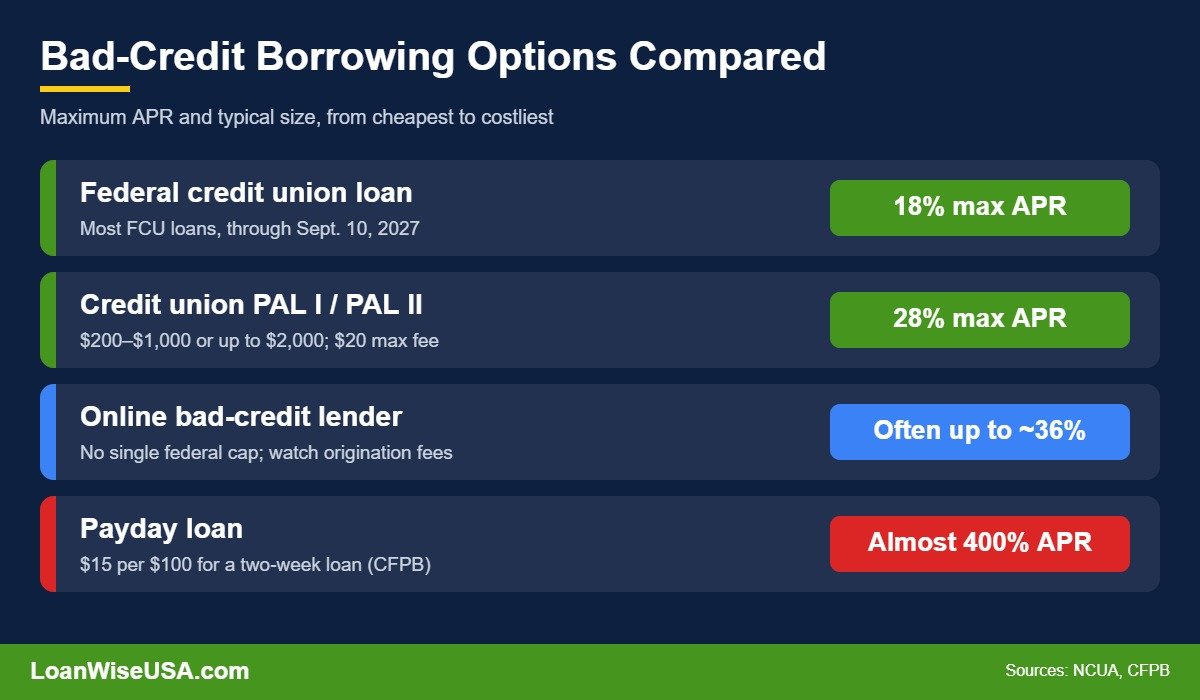
Quick answer: You can get a personal loan with bad credit (generally a FICO score below 580, or “fair” credit from 580 to 669), but you will pay more and need to shop carefully. Start by checking your credit reports for errors, then compare prequalified offers from credit unions, online lenders and your own bank, which usually rely on a soft credit check. If your credit is very thin or damaged, a credit union payday alternative loan (capped at 28% APR), a co-signer or a secured loan can cut your cost sharply. Avoid payday loans: a typical two-week payday loan costs about $15 per $100 borrowed, which the CFPB says works out to an APR of almost 400%.
A personal loan is one of the most common ways to cover an emergency, consolidate high-interest debt or pay for a large expense. When your credit score is low, though, the same $5,000 loan can cost you three times as much in interest as it would cost someone with good credit. This guide shows how lenders judge bad-credit applicants, which loan types to consider first, real dollar examples of what different APRs cost, and a step-by-step plan to improve your odds of approval at a fair price.
What counts as “bad credit” for a personal loan?
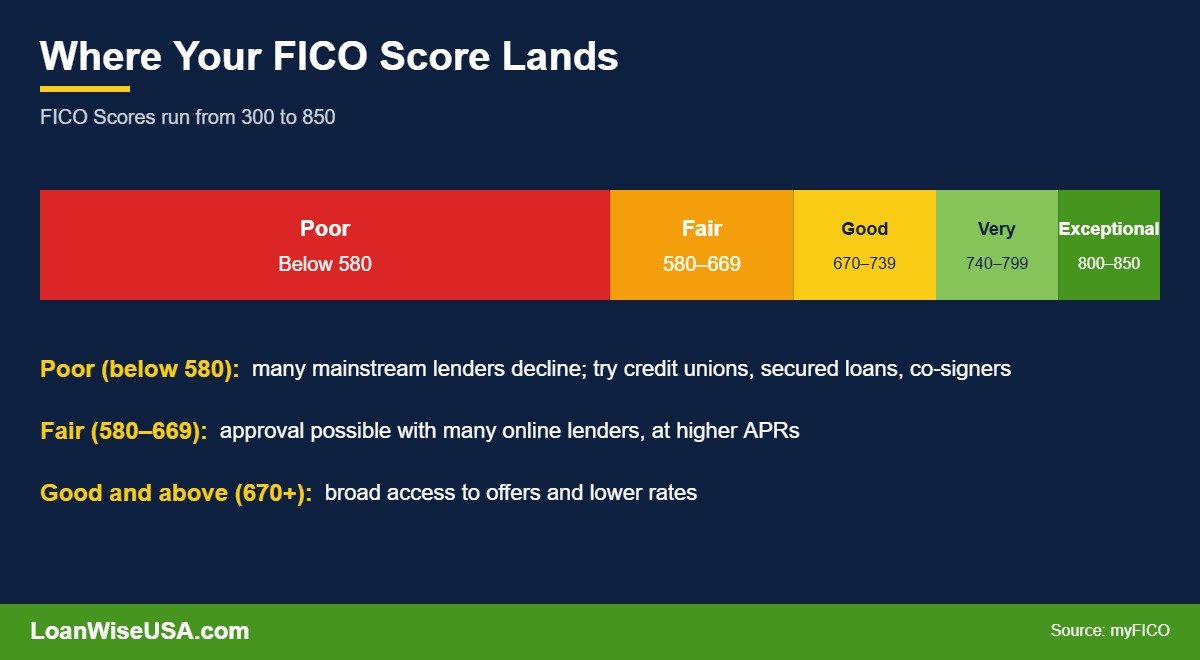
Most lenders use FICO scores, which run from 300 to 850. According to myFICO, scores fall into five bands:
| FICO score | Rating | What it usually means for a personal loan |
|---|---|---|
| Below 580 | Poor | Many mainstream lenders decline; credit unions, secured loans and co-signers matter most |
| 580–669 | Fair | Approval is possible with many online lenders, usually at higher APRs |
| 670–739 | Good | Broad access to offers and mid-range rates |
| 740–799 | Very good | Competitive rates |
| 800 and above | Exceptional | Lenders’ best advertised rates |
Your score is not the only factor. Lenders also look at your income, your debt-to-income ratio (how much of your monthly income already goes to debt payments), your employment history and whether you have recent late payments, collections or a bankruptcy. A borrower with a 590 score and steady income can sometimes get a better offer than a borrower with a 640 score and a high debt load. If a mistake on your report is dragging your score down, our guide on how to dispute a credit report error shows how to fix it for free before you apply.
Which loans are realistic options with bad credit?
Not every “bad credit loan” is a good deal. Here is how the main options compare.
| Option | Typical amount | Cost limits | Best for |
|---|---|---|---|
| Credit union payday alternative loan (PAL I) | $200–$1,000, 1–6 months | APR capped at 28%; application fee up to $20 | Small emergencies; requires at least one month of membership |
| Credit union payday alternative loan (PAL II) | Up to $2,000, 1–12 months | APR capped at 28%; application fee up to $20 | Slightly larger needs; available once you join |
| Federal credit union personal loan | Varies by credit union | Most federal credit union loans capped at 18% APR (through Sept. 10, 2027) | Members with fair credit and stable income |
| Online lender personal loan | Often $1,000 and up | No single federal cap; many lenders top out around 36% APR | Fast funding and debt consolidation |
| Secured personal loan | Based on savings, CD or vehicle used as collateral | Usually lower than unsecured loans | Borrowers with assets but weak credit |
| Payday loan | Usually $500 or less, due in about two weeks | About $15 per $100 borrowed, which the CFPB says equals an APR of almost 400% | Generally not recommended |
Why start with a credit union?
Federal credit unions are not-for-profit and face a legal interest rate ceiling. The Federal Credit Union Act sets a general 15% cap, and the National Credit Union Administration (NCUA) board has extended a temporary 18% ceiling for most federal credit union loans through September 10, 2027. Payday alternative loans (PALs) are allowed a higher maximum of 28% APR, which is still a fraction of what payday lenders charge. State-chartered credit unions follow state rules, so check the terms directly.
What about online lenders that advertise “bad credit OK”?
Some online lenders approve borrowers with fair or poor credit, and many let you prequalify to see an estimated rate with a soft credit check that does not affect your score. Read the offer carefully. Many charge an origination fee that is subtracted from your loan amount, so a 6% fee on a $5,000 loan means only $4,700 reaches your bank account while you repay the full $5,000 plus interest. For active-duty service members and their dependents, the federal Military Lending Act caps most consumer loans at a 36% military annual percentage rate, which includes most fees.
How much does a bad-credit personal loan really cost?
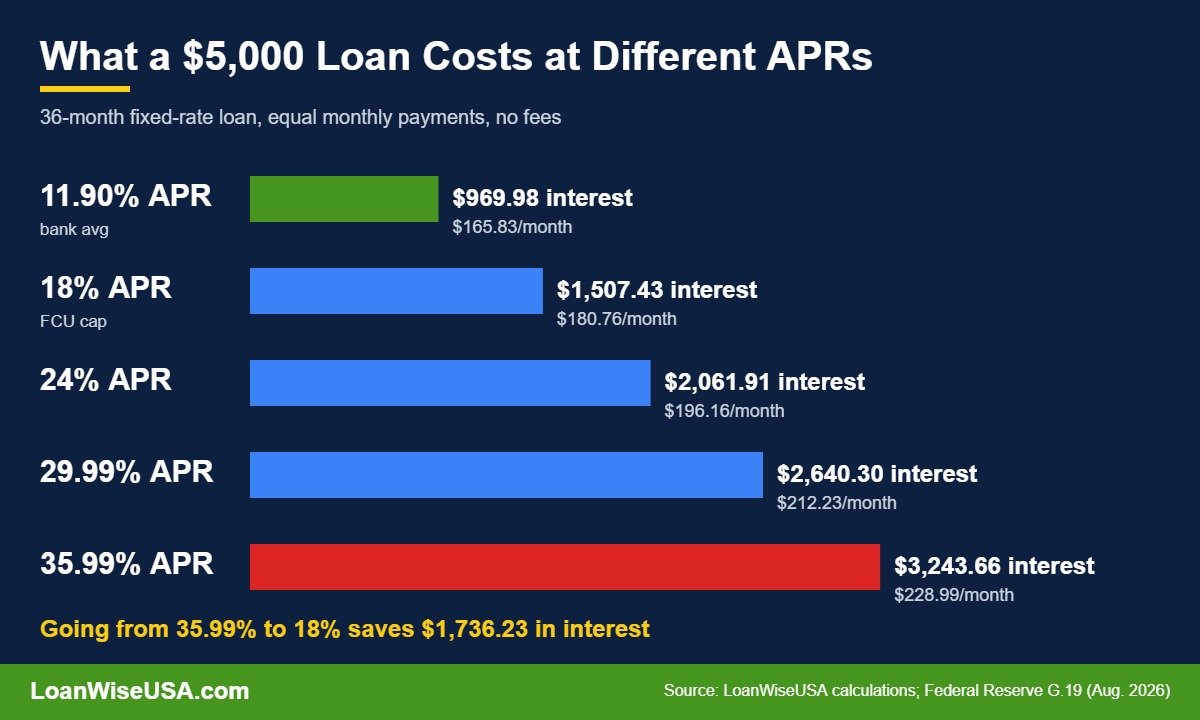
The APR you are offered has a huge effect on what you repay. For context, the Federal Reserve reports that the average rate on a 24-month personal loan at commercial banks was 11.90% in August 2026, and those loans go mostly to borrowers with good credit. Here is what a $5,000 loan repaid over 36 months costs at different APRs (fixed rate, equal monthly payments, no fees):
| APR | Monthly payment | Total interest | Total repaid |
|---|---|---|---|
| 11.90% (bank average, Aug. 2026) | $165.83 | $969.98 | $5,969.98 |
| 18% | $180.76 | $1,507.43 | $6,507.43 |
| 24% | $196.16 | $2,061.91 | $7,061.91 |
| 29.99% | $212.23 | $2,640.30 | $7,640.30 |
| 35.99% | $228.99 | $3,243.66 | $8,243.66 |
Moving from a 35.99% offer to an 18% offer saves $1,736.23 in interest on the same $5,000 loan. That is why shopping, adding a co-signer or improving your score even a little can be worth real money.
Does a longer term lower the cost?
A longer term lowers the monthly payment but raises the total cost. At 35.99% APR, a $5,000 loan costs $295.21 a month and $2,085.05 in interest over 24 months, but $197.86 a month and $4,497.20 in interest over 48 months. Choose the shortest term whose payment you can comfortably afford.
How does a payday loan compare?
Suppose you borrow $500 from a payday lender at $15 per $100. The fee is $75 for two weeks. If you cannot repay and roll the loan over four times, you will have paid $375 in fees over about 10 weeks and still owe the original $500. By contrast, a $1,000 PAL at 28% APR repaid over six months costs about $180.54 a month and roughly $83 in total interest.
How to get a personal loan with bad credit: step by step
- Pull your credit reports. You can get free reports from Equifax, Experian and TransUnion at AnnualCreditReport.com, the only site authorized by federal law for free reports. Dispute errors such as accounts that are not yours or late payments reported incorrectly.
- Know your number. Check your score through your bank, card issuer or a credit monitoring service so you know which band you are in before you apply.
- Calculate what you can afford. Add up your current monthly debt payments and divide by your gross monthly income. The lower this ratio, the better your odds. Decide on a maximum monthly payment before you see offers.
- Borrow only what you need. A smaller loan is easier to approve and cheaper to repay.
- Check a credit union first. If you are not a member, see whether you qualify through your employer, location or a family member. Ask about PALs for amounts up to $2,000.
- Prequalify with several lenders. Use soft-pull prequalification to compare APR, origination fees, term and monthly payment side by side. Compare APR, not just the interest rate, because APR includes most fees.
- Strengthen your application. Consider a creditworthy co-signer or a secured loan backed by savings or a CD. A co-signer is legally responsible for the debt if you do not pay, so both of you should understand the risk.
- Read the full loan agreement. Look for origination fees, late fees, prepayment penalties and whether the rate is fixed.
- Set up autopay and pay on time. On-time payments on a new loan can help rebuild your credit over time, and some lenders offer a small rate discount for autopay.
What are the most common mistakes to avoid?
- Paying an upfront fee to “guarantee” approval. Legitimate lenders deduct fees from the loan or add them to the balance. A demand for a fee before you receive any money, often by gift card or wire transfer, is a common scam warning sign flagged by the FTC.
- Applying to many lenders with hard inquiries. Use prequalification first and submit a full application only for the offer you want.
- Focusing only on the monthly payment. A low payment on a long term can more than double your interest cost.
- Ignoring the origination fee. It reduces the cash you receive, so borrow enough to cover what you need, but no more.
- Rolling over payday or title loans. Repeated rollovers can cost more than the original loan amount.
- Taking a consolidation loan without changing spending. If you consolidate credit card debt and then run the cards back up, you end up with more debt than before. The same risk applies to stacking several buy now, pay later plans.
Are there alternatives to a personal loan?
Before borrowing, consider whether a cheaper option exists. If the money is meant to cover a tax bill, an IRS payment plan usually costs far less than a high-APR loan. Other options include:
- Ask the creditor for a payment plan. Hospitals, utilities and many lenders offer hardship or installment plans with little or no interest.
- Talk to a nonprofit credit counselor. A counselor can review your budget and may offer a debt management plan that lowers card interest rates.
- Look at federal student loan options first. If student loan payments are the strain, income-driven repayment or deferment may help more than new debt. See our guide to student loan defaults and your options.
- Use a secured credit card or credit-builder loan to raise your score for a few months, then apply for a larger personal loan at a better rate.
Does the Fed’s rate decision affect personal loan rates?
Indirectly, yes. Most personal loans have fixed rates set when you borrow, and lenders price them partly off their own funding costs, which follow the broader rate environment. With the Federal Reserve holding its benchmark range at 3.75% to 4% at its October 2026 meeting, average personal loan rates are unlikely to fall quickly. Read our breakdown of what the Fed’s October 2026 decision means for your borrowing costs. Your own credit profile still matters more than the Fed for the rate you are offered.
Frequently asked questions
What is the minimum credit score for a personal loan?
There is no universal minimum. Some lenders consider scores in the 500s, while others require 600 or higher. Credit unions may weigh your membership history and income more heavily than your score.
Will checking my rate hurt my credit score?
Prequalification typically uses a soft inquiry, which does not affect your score. A formal application usually triggers a hard inquiry, which can lower your score slightly for a short time.
Can I get a personal loan with no credit history?
Yes, but options are narrower. A credit union PAL, a secured loan or a co-signer are the most common paths. A credit-builder loan can help you establish history first.
Is a 36% APR loan a good deal?
It is far cheaper than a payday loan, but it is expensive. On $5,000 over 36 months, a 35.99% APR costs $3,243.66 in interest. Use it only for a real need and repay early if your loan has no prepayment penalty.
Can a bad-credit personal loan improve my credit?
It can if you make every payment on time, because payment history is the biggest factor in FICO scores. Late payments will do the opposite.
This article is general information, not financial advice. Loan terms, rates and eligibility vary by lender and state. Consider speaking with a qualified financial professional or nonprofit credit counselor about your situation.
Share this infographic
Found the APR cost chart useful? You are welcome to share it on your site or blog. Copy the code below and keep the link back to this guide as the source.
<a href="https://loanwiseusa.com/personal-loan-with-bad-credit/"><img src="https://loanwiseusa.com/wp-content/uploads/2026/10/cost-of-5000-personal-loan-by-apr.jpg" alt="What a $5,000 personal loan costs at different APRs" width="1200" /></a><br />Source: <a href="https://loanwiseusa.com/personal-loan-with-bad-credit/">LoanWiseUSA – How to Get a Personal Loan With Bad Credit</a>Related reading on LoanWiseUSA
- BNPL Debt Trap: Why More Americans Are Getting Stuck
- Fed Holds Rates at 3.75%–4%: What It Means for Your Mortgage, Credit Cards and Savings
- Student Loan Defaults Are Back: What Borrowers Need to Know Now
- How Mortgage Points Work: Cost, Break-Even Math and When They Pay Off
Sources
- Consumer Financial Protection Bureau – What is a payday loan?
- NCUA – NCUA Board Extends Loan Interest Rate Ceiling (2026)
- NCUA MyCreditUnion.gov – Payday Alternative Loans
- NCUA – Payday Alternative Loans (PAL II) Final Rule, 2019
- Federal Reserve (via FRED) – Finance Rate on Personal Loans at Commercial Banks, 24-Month Loan
- myFICO – What Is a FICO Score?
- AnnualCreditReport.com – Free credit reports
- Federal Trade Commission – What To Know About Advance-Fee Loans
- CFPB – Military Lending Act

[…] of what you owe. If you are juggling several plans and your credit has taken a hit, our guide on how to get a personal loan with bad credit compares cheaper options like credit union […]
[…] also drag down your credit score, so if you need to borrow for an emergency in the meantime, read how to get a personal loan with bad credit before turning to a payday […]
[…] If you’re working to rebuild your score so you can borrow again, cleaning up errors is the cheapest first step. It pairs well with the strategies in our guide on how to get a personal loan with bad credit. […]
[…] If you’re weighing a private loan to do this, compare the real cost first. Our guide to personal loans with bad credit explains the APRs you’re likely to see. Swapping a federal loan for private debt also gives […]