

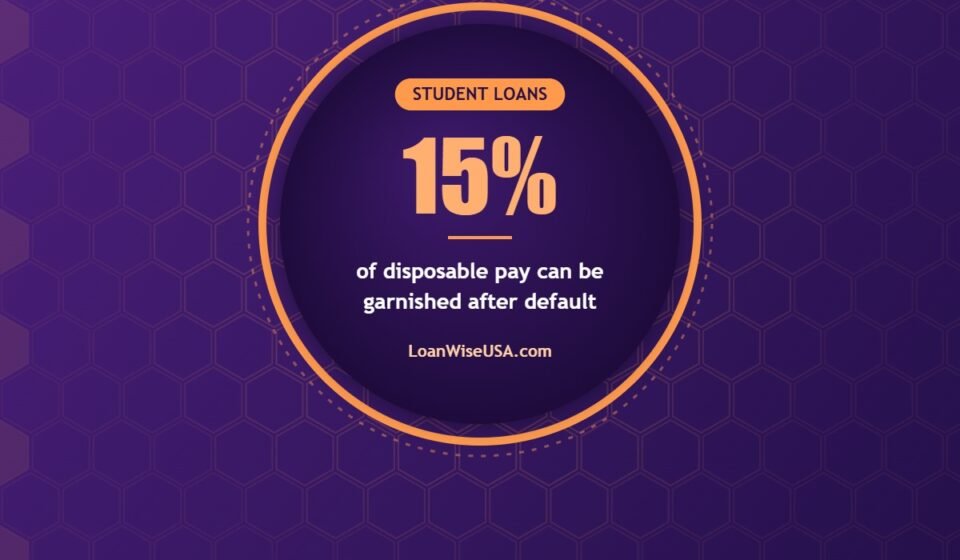
Student Loan Wage Garnishment Is Coming Back: How to Stop It Before Up to 15% of Your Pay Is Taken

Quick answer: If your federal student loans are in default, the government can order your employer to withhold up to 15% of your disposable pay without going to court, take your federal tax refund, and offset part of your Social Security check. Late-October reports say Treasury is preparing to hire private collectors to restart this push for nearly 10 million defaulted borrowers, though the Education Department has denied the reports and no official start date has been announced. You can still stop or shrink garnishment by acting fast: answer the notice within 30 days, request a hearing, or get out of default through rehabilitation, consolidation or payment.
What’s happening with student loan collections right now?
Involuntary collections on defaulted federal student loans were paused in March 2020 and have been threatened, delayed and partly restarted several times since. In late October 2026, reporting first published by The Washington Sun and picked up by Forbes and Newsweek said the Treasury Department is preparing to bring in private debt collection agencies for the defaulted portfolio it now helps manage, possibly as soon as November. Newsweek’s report cites nearly 10 million borrowers in default and says broader involuntary collections could ramp up into 2027.
An Education Department spokesperson denied the reports, according to Forbes. So the honest summary is this: no official garnishment start date has been published, but the legal tools are fully in place, and notices can arrive with little warning. If you already got a “final notice” letter, treat it as real.
This is different from the SAVE plan wind-down, which affects borrowers who are not in default. If you’re still current on your loans but were on SAVE, see our guide on the SAVE plan ending and RAP vs. IBR payments.
When is a student loan in default?
A federal Direct Loan is generally in default once it is 270 days (about nine months) past due. Before that, it is “delinquent,” and servicers report delinquencies to the credit bureaus once you are 90 days behind. Once you default, the entire balance can be declared due, collection costs can be added, and you lose eligibility for deferment, forbearance and new federal student aid until you resolve it. For background on how defaults came back after the pandemic pause, read student loan defaults are back: what borrowers need to know.
How much of my paycheck can be garnished?
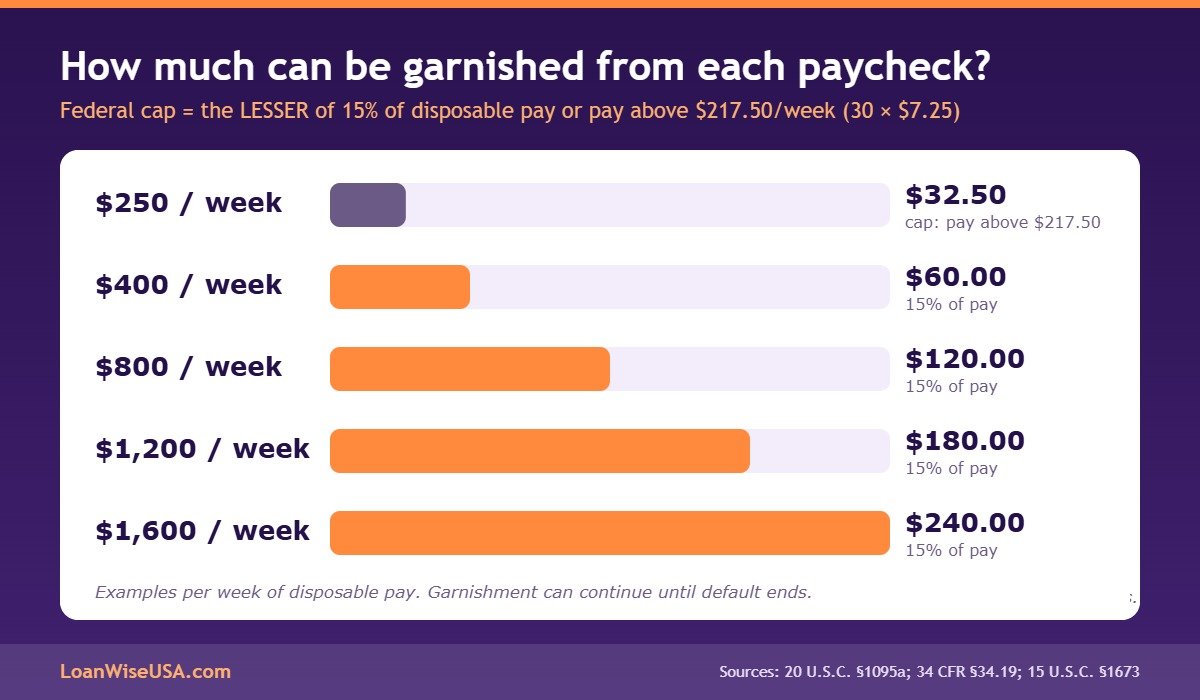
Federal law (20 U.S.C. §1095a) caps administrative wage garnishment (AWG) for student loans at 15% of disposable pay per pay period. Disposable pay is what’s left after legally required deductions such as federal, state and local taxes and Social Security and Medicare withholding.
A second protection applies: your employer can’t withhold more than the amount by which your weekly disposable pay exceeds 30 times the federal minimum wage, which is 30 × $7.25 = $217.50 a week. The employer withholds whichever amount is lower.
| Weekly disposable pay | 15% of pay | Pay above $217.50 | Maximum garnishment |
|---|---|---|---|
| $250 | $37.50 | $32.50 | $32.50 |
| $400 | $60.00 | $182.50 | $60.00 |
| $800 | $120.00 | $582.50 | $120.00 |
| $1,200 | $180.00 | $982.50 | $180.00 |
Worked example: Maria takes home $1,600 in disposable pay every two weeks ($800 a week). At 15%, up to $240 per paycheck could be withheld, which is about $6,240 a year. Part of what’s collected can go to collection costs rather than her principal.
Two more rules worth knowing: you can’t be garnished if you were involuntarily laid off and have been back at work for less than 12 continuous months, and a higher percentage can be taken only with your written consent.
What is the timeline from default to garnishment?
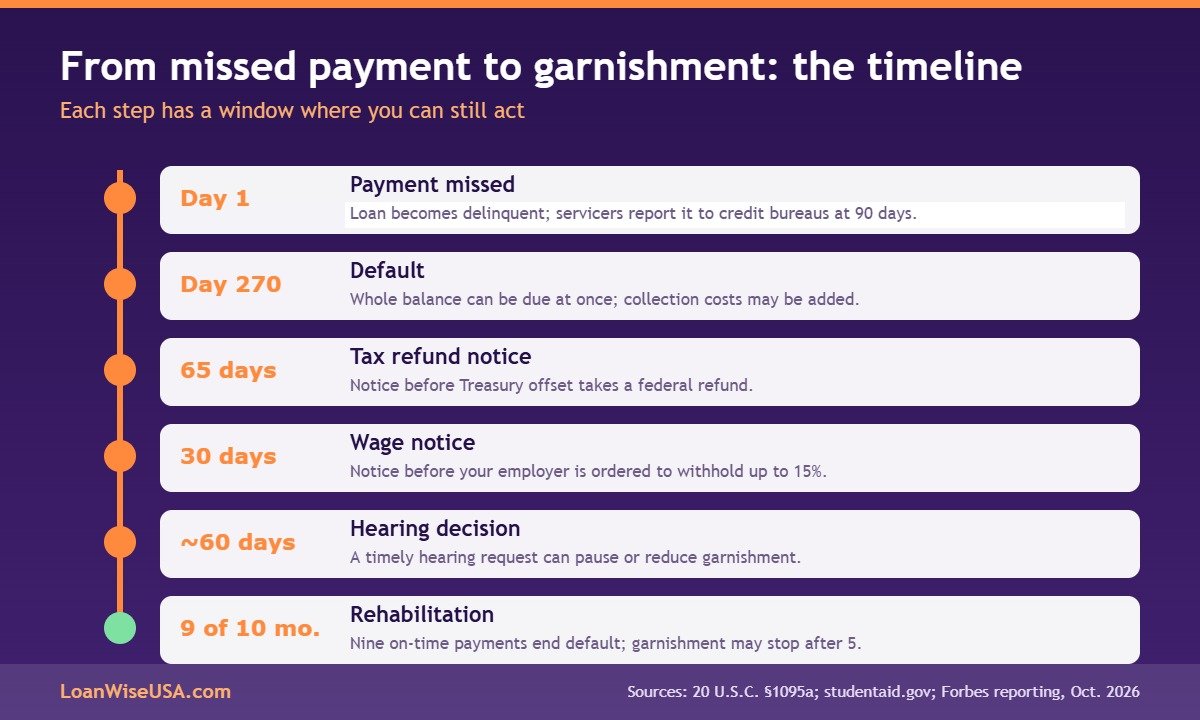
The government must send notice before it takes your money, and each notice opens a window to act:
- Tax refund (Treasury offset): you get an initial notice with 65 days to respond before a federal tax refund can be taken. You may not get another warning before a refund is seized.
- Wages: a “Notice Prior to Wage Withholding” must be mailed at least 30 days before your employer is ordered to garnish.
- Hearing: if you request one, a decision usually comes in about 60 days. A successful hardship hearing can mean no garnishment for 12 months or a reduced amount.
Notices only have to go to your last known address. If you’ve moved, update your address with your servicer and on StudentAid.gov now. A missed letter doesn’t extend your deadline.
Can they take my Social Security or tax refund?
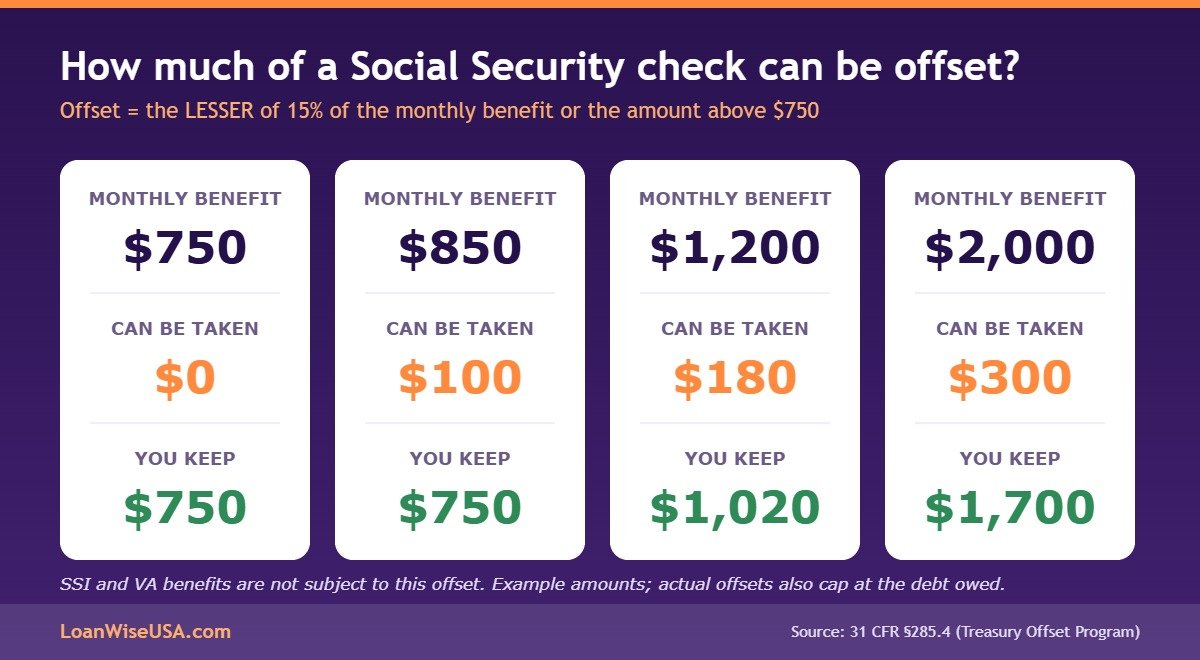
Yes. Through the Treasury Offset Program, the government can take some or all of a federal tax refund. It can also reduce Social Security retirement or disability benefits. Under 31 CFR §285.4, the monthly offset is the lesser of 15% of your benefit or the amount above $750, so a benefit of $750 or less can’t be reduced. Supplemental Security Income (SSI) and VA benefits are not subject to this offset.
| Monthly benefit | 15% of benefit | Amount above $750 | Maximum offset |
|---|---|---|---|
| $850 | $127.50 | $100 | $100 |
| $1,200 | $180 | $450 | $180 |
| $2,000 | $300 | $1,250 | $300 |
If you’re claiming benefits now, it helps to know how the new 2027 Social Security COLA changes your check, because a larger benefit can mean a larger offset.
How do I stop student loan wage garnishment?
1. Respond to the notice within 30 days
Your notice will explain how to request a review. Valid objections include that you don’t owe the debt, you aren’t actually in default, you’re in bankruptcy, or you qualify for a discharge (for example, total and permanent disability or a closed school). Send supporting documents with your request.
2. Request a hardship hearing
You can argue that a 15% withholding would cause extreme financial hardship. Bring a budget with proof of rent, utilities, child care, medical and transportation costs. Hearings can be held by phone, on paper, or in person (in-person hearings are offered only in a few cities, at your own travel cost). Hardship objections are often denied unless your finances are very tight, so pair a hearing with a plan to leave default.
3. Rehabilitate the loan
Rehabilitation means making nine voluntary, on-time payments within 10 consecutive months. The standard payment is 15% of your discretionary income divided by 12, and you can ask for a lower amount based on your income and expenses. Garnishment and offsets may continue until you’ve made at least five rehabilitation payments. When you finish, the default notation is removed from your credit report, though earlier late payments stay.
Worked example: A single borrower with $40,000 in income. 150% of the 2026 federal poverty guideline for one person ($15,960) is $23,940. Discretionary income is $40,000 − $23,940 = $16,060. 15% of that is $2,409 a year, or about $201 a month. That’s less than the roughly $6,240 a year garnishment in the example above, and it ends default.
Today you can rehabilitate a loan only once. Starting July 1, 2027, the One Big Beautiful Bill Act allows two rehabilitations and raises the minimum rehabilitation payment from $5 to $10.
4. Consolidate out of default
A Direct Consolidation Loan pays off the defaulted loans and is usually faster than rehabilitation. But borrowers whose wages are already being garnished may not be eligible until the garnishment order is lifted, consolidation keeps the default history on your credit report, and it can affect your repayment plan options and prior forgiveness credit. Check these trade-offs with your servicer before you sign.
5. Pay in full or settle
Paying the balance in full or negotiating a compromise ends collections. If you’re weighing a private loan to do this, compare the real cost first. Our guide to personal loans with bad credit explains the APRs you’re likely to see. Swapping a federal loan for private debt also gives up federal protections.
6. Bankruptcy
Filing triggers an automatic stay that pauses garnishment and offsets while the case is open. Discharging student loans still requires proving “undue hardship” in a separate proceeding, so talk to a bankruptcy attorney.
What is the 1% interest-rate cut, and can defaulted borrowers get it?
The Education Department has raised the autopay interest-rate reduction from 0.25% to 1% on Direct Loans first disbursed after July 1, 2012, for borrowers who enroll in autopay by December 31, 2026. The lower rate lasts through June 30, 2028, and it replaces the 0.25% discount rather than adding to it. Defaulted borrowers can qualify once their loans are back in good standing. That’s another reason to start rehabilitation or consolidation now instead of waiting.
Your student loan default checklist
- Log in to StudentAid.gov and confirm which loans are in default and who holds them.
- Update your mailing address, email and phone with your servicer and the Default Resolution Group.
- Open every letter, and write down the 65-day and 30-day deadlines.
- Gather pay stubs, your latest tax return and a monthly budget.
- Decide: object, request a hearing, rehabilitate, consolidate or pay.
- Ask for a rehabilitation payment based on your income and expenses if the standard amount is too high.
- Once you’re out of default, enroll in an income-driven plan and autopay so you don’t default again.
- Check your credit reports afterward and dispute any errors, such as a default that still shows after rehabilitation.
Frequently asked questions
Can student loans garnish wages without a court order?
Yes. Federal student loans use administrative wage garnishment, which doesn’t require a lawsuit. Private student loans are different: a private lender generally needs a court judgment first.
Will garnishment stop if I start rehabilitation?
Not right away. Garnishment and offsets may continue until you’ve made at least five qualifying rehabilitation payments, and they end once the loan leaves default.
How do I know if my loans are in default?
Log in to StudentAid.gov to see your loan status and servicer. Defaulted loans are usually handled by the Education Department’s Default Resolution Group.
Can my tax refund be taken even if I’m not garnished?
Yes. Treasury offset is separate from wage garnishment. A refund can be taken after the 65-day notice period even if your paycheck is never touched.
Does paying a defaulted loan help my credit?
Paying in full or consolidating stops collections, but the default history can stay on your report. Rehabilitation is the only route that removes the default notation itself.
This article is general information, not financial or legal advice. Rules and collection timelines can change. Confirm details with your loan servicer, StudentAid.gov, or a qualified attorney or nonprofit counselor.
Share this infographic
Writing about student loan collections? You’re welcome to republish our “How much can be garnished from each paycheck?” infographic on your site or in a newsletter. Just copy the code below so readers can find the full guide.
<a href="https://loanwiseusa.com/student-loan-wage-garnishment/"><img src="https://loanwiseusa.com/wp-content/uploads/2026/11/student-loan-wage-garnishment-per-paycheck-infographic.jpg" alt="How much student loan wage garnishment can take from each paycheck" width="1200" /></a><br />Source: <a href="https://loanwiseusa.com/student-loan-wage-garnishment/">LoanWiseUSA – Student Loan Wage Garnishment Is Coming Back: How to Stop It Before Up to 15% of Your Pay Is Taken</a>Related reading on LoanWiseUSA
- Student Loan Defaults Are Back: What Borrowers Need to Know Now
- SAVE Plan Is Ending: Your Deadline, RAP vs. IBR Payments and What Happens If You Do Nothing
- How to Dispute a Credit Report Error: Step-by-Step Guide
- How to Set Up an IRS Payment Plan: Fees, Interest and Step-by-Step Guide
Sources
- 20 U.S.C. §1095a – Wage garnishment requirement (Cornell LII)
- 34 CFR §34.19 – Amount of withholding (Cornell LII)
- 31 CFR §285.4 – Offset of federal benefit payments (eCFR)
- Federal Student Aid – Student Loan Rehabilitation for Borrowers in Default: FAQs
- HHS ASPE – 2026 Poverty Guidelines
- Forbes – Education Department Is About To Seize Student Loan Borrowers’ Wages And Benefits (Oct. 19, 2026)
- Forbes – Student Loan Borrowers Can Stop The Education Department From Taking Their Wages (Oct. 26, 2026)
- Newsweek – Report Warns That Millions Could See Wage Garnishment (Oct. 2026)
- Forbes – Education Department Extends Student Loan Interest Rate Reduction Deadline To End Of 2026
- Yahoo Finance – New rehabilitation rules under the One Big Beautiful Bill Act


[…] fallen behind long enough to be in default? Different rules apply there, so read our guide on how to stop student loan wage garnishment before collections reach your paycheck or tax […]