

How to Dispute a Credit Report Error: Step-by-Step Guide, Letter Checklist and Timelines

Quick answer: To dispute a credit report error, get your free reports from AnnualCreditReport.com, mark every mistake, gather proof, and file a dispute with each credit bureau that shows the error (Equifax, Experian and/or TransUnion) online, by phone or by certified mail. The bureau generally has 30 days (45 in some cases) to investigate and five business days after that to send you the results. You can also dispute directly with the lender or collector that reported the item. If the item is fixed, you get a free updated report; if not, you can add a statement of dispute and file a complaint with the CFPB.
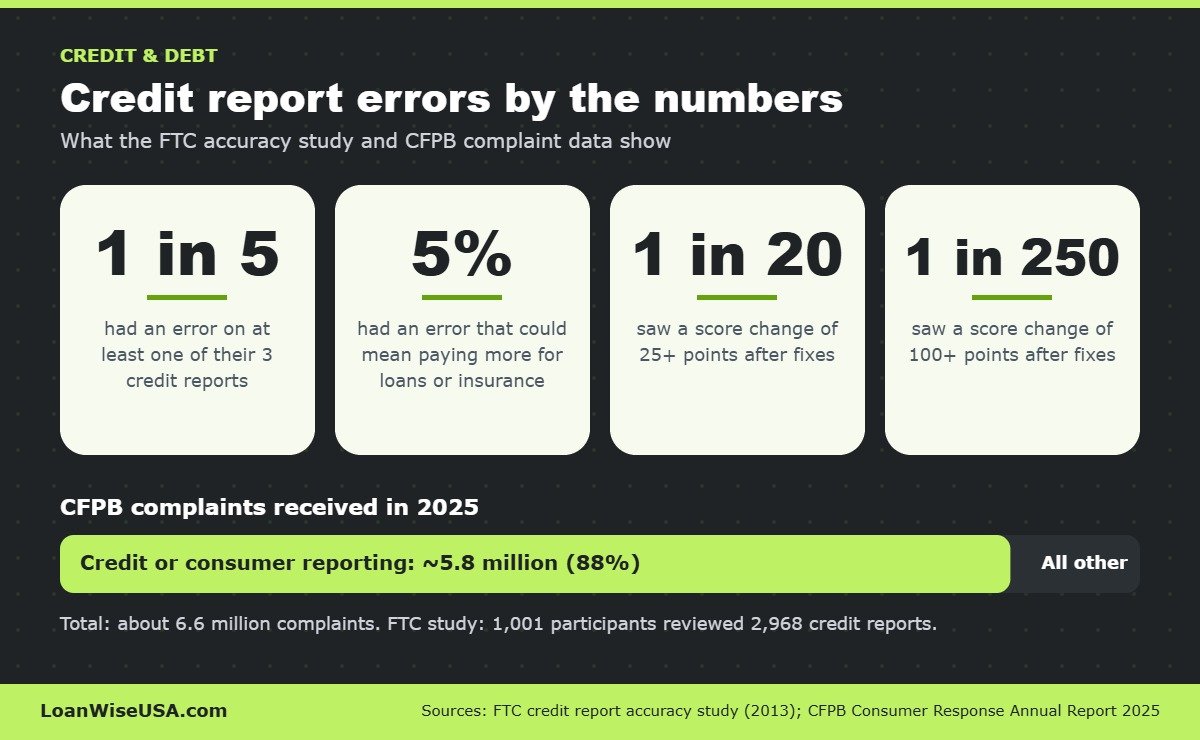
Credit report mistakes are more common than most people think. In the Federal Trade Commission’s landmark accuracy study, one in five consumers had an error on at least one of their three credit reports, and about 5% had an error serious enough that it could have cost them more on loans or insurance. Credit reporting is also, by far, the biggest source of complaints at the Consumer Financial Protection Bureau. The good news: the dispute process is free, you don’t need a lawyer or a paid “credit repair” company, and federal law spells out exactly what the bureaus must do. This guide walks you through it step by step.
What counts as a credit report error you can dispute?
Under the Fair Credit Reporting Act (FCRA), you can dispute any information on your report that is inaccurate or incomplete. You cannot get accurate negative information removed just because it hurts your score. Here are the errors the CFPB tells consumers to look for:
| Type of error | Examples | Why it matters |
|---|---|---|
| Identity mistakes | Wrong name, address, Social Security number; accounts that belong to someone with a similar name | Can signal a “mixed file” or identity theft |
| Account status errors | Paid-on-time accounts shown as late; closed accounts shown as open; an account listed more than once | Late payments are among the most damaging items |
| Balance and limit errors | Wrong balance, wrong credit limit, debt you paid off still showing a balance | Inflates your credit utilization |
| Outdated negatives | Late payments or collections older than about seven years | Most negative items must age off on schedule |
| Fraud | Accounts or hard inquiries you never opened or authorized | Needs identity theft steps as well as a dispute |
If you’re working to rebuild your score so you can borrow again, cleaning up errors is the cheapest first step. It pairs well with the strategies in our guide on how to get a personal loan with bad credit.
How common are credit report errors?
The best large-scale evidence still comes from the FTC’s study, which had 1,001 participants review 2,968 credit reports with a study associate. Its findings:
- About 1 in 5 consumers had an error on at least one of their three reports.
- About 5% had an error that could lead them to pay more for products such as auto loans and insurance.
- About 1 in 20 saw a maximum score change of more than 25 points after errors were corrected, and about 1 in 250 saw a change of more than 100 points.
Complaint data show the problem hasn’t gone away. The CFPB’s 2025 Consumer Response annual report says it received about 6.6 million complaints in 2025, and roughly 5.8 million of them, about 88%, were about credit or consumer reporting.
What does a credit report error cost you? Two worked examples
A wrongly reported late payment or collection can push you into a higher pricing tier. The exact rate jump depends on the lender and your full profile, so the examples below are illustrations, not quotes. They show how much even a modest rate difference costs.
| Loan | Rate with clean report | Rate with error | Monthly payment difference | Total extra cost |
|---|---|---|---|---|
| $300,000, 30-year mortgage | 7.0% ($1,995.91/mo) | 7.5% ($2,097.64/mo) | $101.74 | About $36,625 over 30 years |
| $10,000, 3-year personal loan | 12% ($332.14/mo) | 18% ($361.52/mo) | $29.38 | About $1,058 over 3 years |
That’s why it’s smart to check your reports a few months before any big application, especially a mortgage. If you’re house hunting, also read how mortgage points work to see the other main lever you have over your rate.
How to dispute a credit report error, step by step
Step 1: Get all three of your credit reports for free
Go to AnnualCreditReport.com, the only website authorized by federal law for free reports. Equifax, Experian and TransUnion made free weekly online reports permanent in 2023, so you can check as often as you need. Pull all three: each bureau’s file is separate, and an error may appear on just one.
Step 2: Mark every mistake
Go line by line: personal information, each account’s status, payment history, balance and dates, collections, public records and hard inquiries. Circle or highlight each error and write down the account number and the bureau where it appears.
Step 3: Gather your proof
Collect copies (never originals) of documents that show the item is wrong: bank statements, cleared checks, payoff or “paid in full” letters, settlement agreements, correspondence with the lender, or a court document. For identity-related errors, include copies of ID and proof of address.
Step 4: File the dispute with each bureau that shows the error
You can dispute online, by phone or by mail. Online is fastest. Mail creates the strongest paper trail: the CFPB suggests certified mail with a return receipt. Address each error separately, state the facts, explain why each one is wrong, and ask for it to be corrected or deleted. Your letter should include:
- Your full name, address and phone number
- Your report confirmation number, if you have one
- Each disputed item, with the account number
- A clear explanation of why it’s wrong and what you want done
- A copy of the report page with the error highlighted
- Copies of your supporting documents
Step 5: Dispute with the furnisher too
The “furnisher” is the company that sent the information, such as a card issuer, lender, landlord or collection agency. Send it a written dispute at the address on your report or the address it lists for credit reporting disputes. Furnishers generally must investigate and respond within 30 days. If the information is wrong or can’t be verified, the furnisher must correct it with every bureau it reported to.
Step 6: Track the deadlines
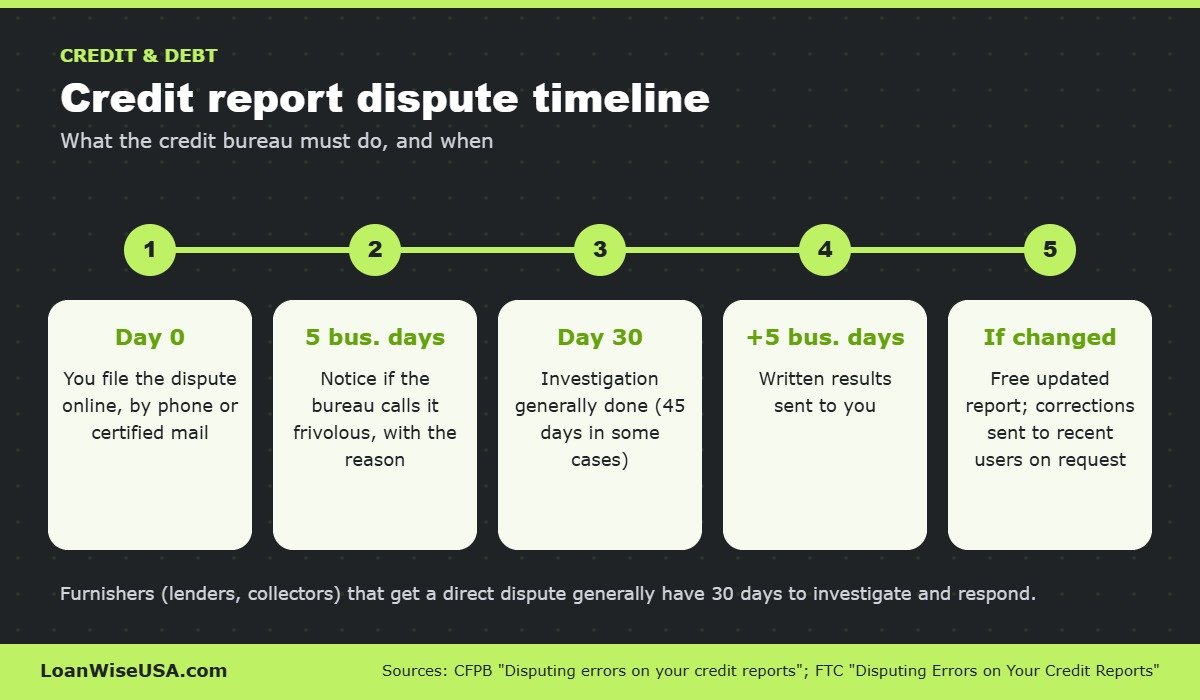
Mark your calendar. The bureau must investigate (usually within 30 days), forward your evidence to the furnisher, and send you the results in writing within five business days of finishing. If it decides your dispute is “frivolous” (for example, it doesn’t say what’s wrong), it must tell you why within five business days of that decision.
Step 7: Check the results and follow up
If your dispute changes your report, the bureau must send you a free updated copy. That copy doesn’t count against your free reports. You can also ask the bureau to send the correction to anyone who pulled your report in the past six months, or in the past two years for employment purposes. A deleted item can’t be put back unless the furnisher certifies that it’s accurate and the bureau notifies you.
How long does a credit report dispute take?
| Stage | Deadline | Source |
|---|---|---|
| Bureau says the dispute is frivolous | Notice within 5 business days of that decision | CFPB |
| Bureau investigation | Generally 30 calendar days (45 in some cases) | CFPB, FTC |
| Furnisher investigation (direct dispute) | Generally 30 days | CFPB |
| Results sent to you | Within 5 business days after the investigation ends | CFPB |
| Corrections to past report users (on request) | Anyone who pulled your report in the past 6 months (2 years for jobs) | FTC |
Online disputes often resolve faster than the legal maximum, but plan for at least a month. If you’re applying for a mortgage soon, tell your loan officer. Lenders can sometimes run a “rapid rescore” after a correction is confirmed.
How long do negative items stay on a credit report?
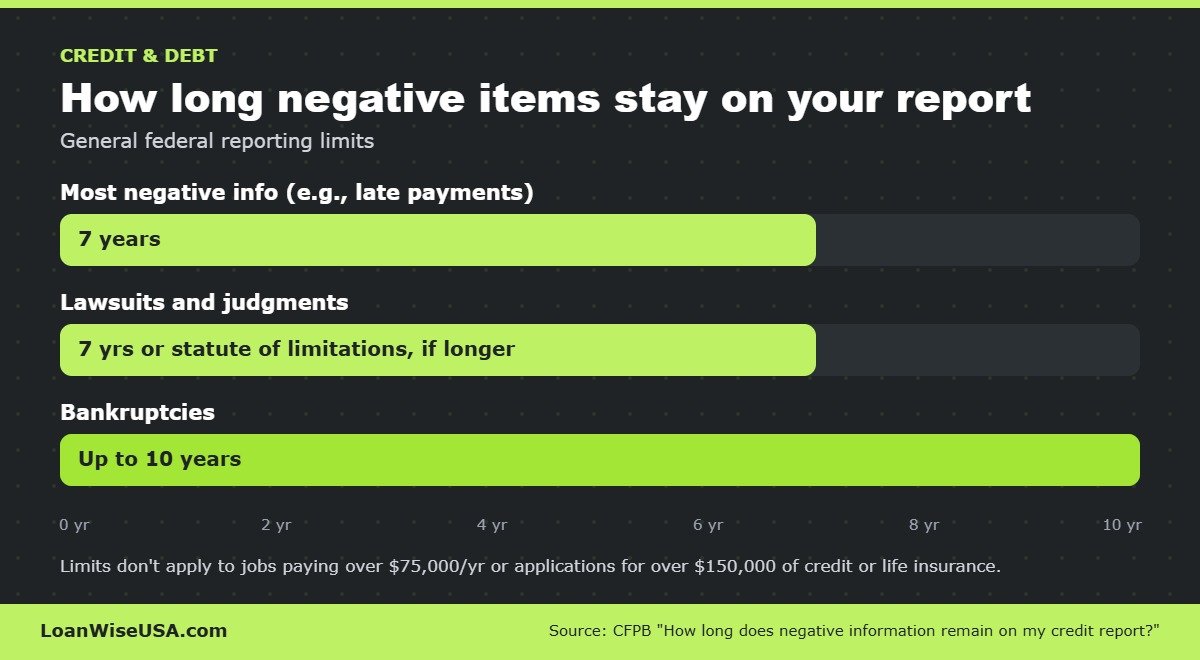
Before you dispute an old item, check whether it should already be gone. According to the CFPB, most negative information, such as late payments, generally stays on your report for seven years. Bankruptcies can stay for up to ten years. Lawsuits and judgments stay for seven years or until the statute of limitations runs out, whichever is longer. These limits don’t apply when the report is used for a job paying more than $75,000 a year, or for an application for more than $150,000 of credit or life insurance.
If an item has outlived its reporting period, dispute it as “obsolete.” That’s one of the cleanest wins you can get.
What if the dispute doesn’t fix the error?
- Send new evidence. A second dispute with stronger documents often succeeds where a bare claim didn’t.
- Add a statement of dispute. You can ask the bureau to add a brief explanation to your file. It will be included in future reports.
- File a complaint with the CFPB at consumerfinance.gov/complaint or (855) 411-2372. The CFPB forwards complaints to the company for a response. You can also report to the FTC at ReportFraud.ftc.gov.
- Consider a consumer attorney. The FCRA lets consumers sue for certain violations, and many consumer lawyers take these cases with no up-front fee.
What about identity theft errors?
If you see accounts or inquiries you didn’t open, go to IdentityTheft.gov to create an FTC identity theft report and a personalized recovery plan. Then place a free fraud alert (contact one bureau and it must tell the other two) or a free credit freeze at each bureau. An identity theft report also lets you ask the bureaus to block fraudulent information, which is often faster than a standard dispute.
Common mistakes to avoid
- Disputing accurate information. It wastes time, and a bureau may label repeated baseless disputes frivolous.
- Checking only one bureau. Errors often appear on one or two reports, not all three.
- Sending originals. Always send copies and keep a file of everything you send and receive.
- Using a vague form letter. Name each item, give the account number, and explain why it’s wrong.
- Paying a “credit repair” company up front. Under the Credit Repair Organizations Act, these companies can’t charge you before they perform their services. Anything they can legally do, you can do yourself for free.
- Paying a collection you don’t owe in order to “fix” it. Dispute the debt first. In some states, a payment on an old debt can also restart the statute of limitations for a lawsuit.
- Ignoring the deadlines. If 30 days pass with no answer, follow up in writing and escalate to the CFPB.
Errors aren’t the only thing that can sink your score. Missed payments on short-term financing can show up too, as we explain in our look at the buy now, pay later debt trap. Federal student loans in default are also being reported again, which is covered in student loan defaults are back.
Frequently asked questions
Does disputing a credit report error hurt my credit score?
No. Filing a dispute doesn’t lower your score. If the bureau corrects or deletes a negative item, your score may go up.
Is it better to dispute online or by mail?
Online is usually fastest and easiest to track. Certified mail with a return receipt gives you the strongest proof of what you sent and when, which helps if you later need to escalate.
Can I dispute a hard inquiry?
Yes, if you didn’t authorize it. That can be a sign of identity theft. Hard inquiries you did authorize are accurate and stay on your report for two years.
Can I get a late payment removed if it was accurate?
Not through a dispute. Accurate information can stay for its full reporting period. Some lenders will consider a “goodwill” request to remove an isolated late payment, but they aren’t required to.
Do I need to pay a credit repair company?
No. Disputing errors is free, and you have the same rights a credit repair company does. If you hire one anyway, federal law bars it from charging you before it performs its services.
What if a debt collector keeps reporting a debt I don’t owe?
Dispute it with the bureaus and in writing with the collector. If it can’t verify the debt, it must stop reporting it as accurate. If it doesn’t, file a CFPB complaint.
This article is general information, not financial or legal advice. Rules and deadlines can change, and your situation may differ. For legal questions about a credit reporting dispute, consider speaking with a consumer attorney or a nonprofit credit counselor.
Share this infographic
Found the “Credit report errors by the numbers” infographic useful? You’re welcome to share it on your website or blog. Just copy the code below, which includes a credit link back to this guide.
<a href="https://loanwiseusa.com/how-to-dispute-credit-report-error/"><img src="https://loanwiseusa.com/wp-content/uploads/2026/11/credit-report-errors-by-the-numbers.jpg" alt="Credit report errors by the numbers infographic" width="1200" /></a><br />Source: <a href="https://loanwiseusa.com/how-to-dispute-credit-report-error/">LoanWiseUSA – How to Dispute a Credit Report Error: Step-by-Step Guide, Letter Checklist and Timelines</a>Related reading on LoanWiseUSA
- How to Get a Personal Loan With Bad Credit: Options, Real Costs and a Step-by-Step Plan
- BNPL Debt Trap: Why Buy Now, Pay Later Is Getting Riskier
- How Mortgage Points Work: Cost, Break-Even Math and When They Pay Off
- How to Set Up an IRS Payment Plan: Fees, Interest and Step-by-Step Guide
Sources
- CFPB – How do I dispute an error on my credit report?
- CFPB – Disputing errors on your credit reports (handout)
- CFPB – How long does negative information remain on my credit report?
- CFPB – Consumer Response Annual Report 2025 (March 2026)
- FTC – Disputing Errors on Your Credit Reports
- FTC – Study: Five percent of consumers had errors on their credit reports that could result in less favorable terms
- CDIA – Equifax, Experian and TransUnion make free weekly credit reports permanent
- AnnualCreditReport.com and IdentityTheft.gov



[…] score and a high debt load. If a mistake on your report is dragging your score down, our guide on how to dispute a credit report error shows how to fix it for free before you […]
[…] up as late on your credit report when you actually paid on time, you can challenge it. Here’s how to dispute a credit report error step by […]