

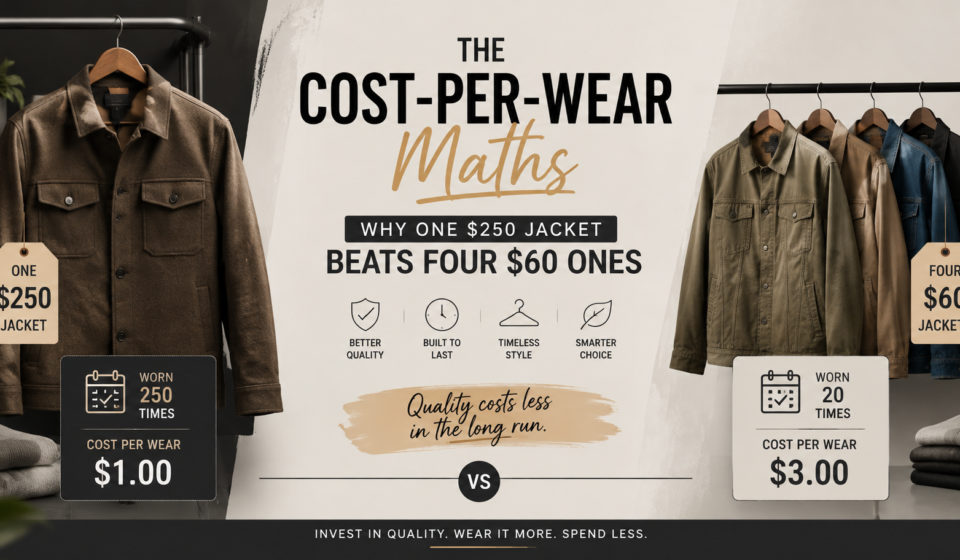

Cost per wear is the only clothing maths that actually predicts what something costs you. The formula is one line: price divided by the number of times you wear it. It is the same logic as the unit price on a supermarket shelf, pointed at your wardrobe instead. A $250 jacket worn 200 times costs $1.25 a wear. A $60 jacket worn 12 times before the lining tears costs $5.00 a wear. The cheap one was four times more expensive.
Most people run this calculation backwards, if at all. We compare price tags at the till, feel good about the smaller number, and never revisit it when the item ends up in a donation bag eight months later.
How cost per wear actually works
Take the purchase price, add anything you spend keeping the item usable — dry cleaning, repairs, a $15 tin of conditioner — and divide by realistic wears over the life of the item. Realistic is the operative word. Not the wears you imagine on the day you buy it.
Here is the comparison that started this piece, run over five years.
| Items | Fast-fashion jacket | Real leather jacket |
|---|---|---|
| Purchase price | $60 | $250 |
| Replacements in 5 years | 4 | 0 |
| Upkeep over 5 years | $0 | $30 |
| Total 5-year spend | $240 | $280 |
| Total wears | ~160 | ~500 |
| Cost per wear | $1.50 | $0.56 |
The two options land within $40 of each other on total spend. They are nowhere near each other on value received. And the cheap route front-loads a decision you have to make four separate times, each one an opportunity to spend more than you planned.
Why the cheap option feels cheaper than it is
Three things distort the comparison at the moment of purchase.
The price tag is visible and the wear count is not. You know exactly what you are paying. You are guessing at everything on the other side of the equation, and guesses skew optimistic.
Replacement spending is spread out. Four separate $60 purchases across five years never register as one $240 decision. They register as four small ones, each individually defensible. This is the same mechanism that makes subscriptions and buy-now-pay-later instalments so easy to accumulate.
We forget the failures. The jacket that pilled after one winter does not get mentally charged against the next cheap jacket. Each purchase starts with a clean slate it has not earned.
Where the cost per wear argument falls apart
This is not a licence to buy expensive things. The maths only works when the wear count is genuinely high, and there are several cases where it is not.
Occasion pieces. A wedding outfit worn twice has a terrible cost per wear at any price. Spend accordingly, or rent.
Trend-driven items. Durability is irrelevant if you stop wanting to wear it. A silhouette that dates in eighteen months will not reach the wear count no matter how well it is made.
Bodies and lives that change. If your size, climate or commute is likely to shift within a year or two, projecting 500 wears is fantasy.
Cash flow. Cost per wear is a value calculation, not a liquidity one. Being right about the five-year maths does not help if the $250 is money you need this month. Paying interest to buy the cheaper-per-wear option usually wipes out the entire advantage — the same trap that turns a manageable balance into a default problem on any other kind of debt. If you cannot buy it outright, the honest answer is to keep wearing what you have and buy it later.
How to judge whether something will actually last
The premium option only wins if it delivers the wears. Before you accept a high price as an investment, check the things that actually determine lifespan.
Materials, stated specifically. “Genuine leather” is a grade of split hide, not a quality claim. Full-grain, top-grain, lambskin and cowhide are specific and checkable. A seller who cannot tell you the material and its thickness is not selling you longevity.
The parts that fail first. On outerwear it is the zip, the lining seams and the stitch density at the armhole. On footwear it is the sole attachment. On luggage it is the wheels and the zip. Every category has two or three failure points, and they are cheap to inspect before you buy.
Repairability. Can a zip be replaced? Can a sole be resoled? An item that can be repaired twice for $40 has double the denominator of one that gets binned when it fails.
Whether the price reflects the product or the route to market. Two jackets made from the same hide can differ by $200 depending on how many parties take a margin between the tannery and you. Direct sellers such as Decrum, which has sold real lambskin and cowhide direct to customers since 2015, sit lower on price for the same material because there is no wholesale layer in between. The point is not brand loyalty, it is that a high price is not itself evidence of quality — ask what you are paying for.
Running the numbers on your own wardrobe
The useful version of this exercise is backwards-looking. Pick the five things you wore most in the last year and work out what each one actually cost per wear. Then do the same for the five most expensive things you bought.
The overlap between those two lists is usually small, and it is the single most instructive thing you can learn about your own spending. Most people find the winners are unglamorous and old, and that the money went somewhere else entirely.
Cost per wear works the same way on everything with a lifespan — boots, a winter coat, a mattress, a laptop bag, a cast-iron pan. Anywhere the difference between the cheap version and the good one is measured in years of service rather than features, the same calculation applies, and it usually points in the same direction.
It also has a limit worth respecting. The maths gives you a cost per wear number, not permission. Buying something you cannot comfortably afford is still buying something you cannot comfortably afford, however good the five-year projection looks.