


Quick answer: If you owe federal taxes you can’t pay in full, you can usually set up an IRS payment plan online in minutes. Individuals who owe less than $100,000 in combined tax, penalties and interest can get a short-term plan (up to 180 days) with no setup fee. Those who owe $50,000 or less and have filed all required returns can get a long-term monthly installment agreement online, with a $29 setup fee if they pay by automatic direct debit ($69 with other payment methods). Interest (7% a year for the fourth quarter of 2026) and penalties keep running until the balance is paid. But if you filed on time, the late-payment penalty is cut in half, to 0.25% a month, while an approved plan is in place.
A tax bill you can’t cover is stressful, but the IRS is one of the more flexible creditors you’ll deal with, provided you act before collection notices pile up. This guide explains the types of IRS payment plans, what they really cost, how to apply step by step, and the mistakes that can cause a plan to default.
This article is general information, not tax, legal or financial advice. IRS fees and rates change, so confirm the details on IRS.gov or with a tax professional before you act.
What is an IRS payment plan?
An IRS payment plan is an agreement to pay a federal tax balance over time instead of all at once. The IRS offers two main versions to individuals:
- Short-term payment plan: you agree to pay the full balance within 180 days or less. There’s no setup fee, and you don’t make fixed monthly payments; you just need to clear the balance by the deadline.
- Long-term payment plan (installment agreement): you make monthly payments, either by automatic withdrawal from your bank account (a Direct Debit Installment Agreement, or DDIA) or by another method such as online, check or card payments.
Either way, the balance keeps growing with interest and penalties until it’s paid off. A plan doesn’t erase what you owe. It makes the bill manageable and stops it escalating into liens, levies and the higher penalty rates that come with ignoring the IRS.
Who qualifies for an IRS payment plan online?
According to the IRS, individuals can apply online through the Online Payment Agreement tool if they meet these thresholds:
| Plan | Who can apply online | How long you get |
|---|---|---|
| Short-term plan | Individuals who owe less than $100,000 in combined tax, penalties and interest | Up to 180 days |
| Long-term plan (installment agreement) | Individuals who owe $50,000 or less in combined tax, penalties and interest and have filed all required returns | Monthly payments |
| Businesses | Apply by calling the number on the notice (800-829-4933) or visiting a Taxpayer Assistance Center | Varies |
Sole proprietors and independent contractors apply as individuals. If you owe more than the online limits, you can still ask for a plan by phone, by mail with Form 9465 (Installment Agreement Request), or in person, but expect the IRS to ask for more detail about your income, expenses and assets.
How much does an IRS payment plan cost?
There are three separate costs: a one-time setup fee, interest, and the failure-to-pay penalty.
Setup fees
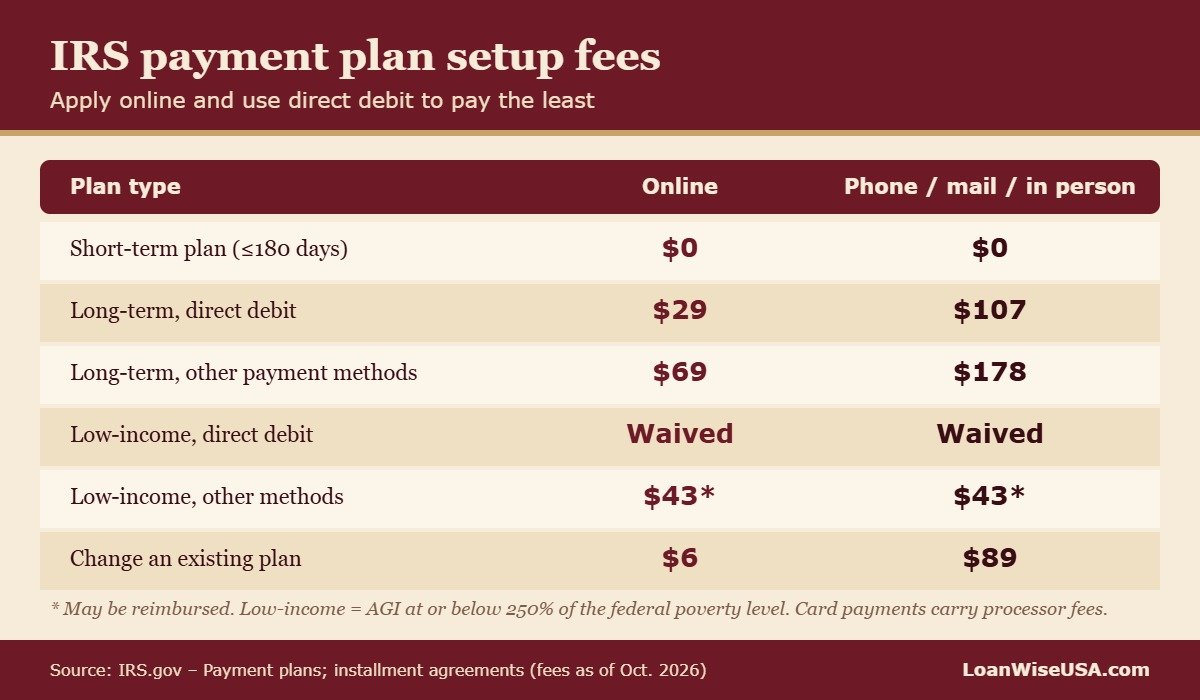
Applying online is cheaper than applying by phone, mail or in person, and paying by automatic direct debit is cheaper than any other payment method. Here are the IRS’s current fees:
| Plan type | Apply online | Phone, mail or in person |
|---|---|---|
| Short-term plan (180 days or less) | $0 | $0 |
| Long-term plan, automatic direct debit | $29 | $107 |
| Long-term plan, other payment methods | $69 | $178 |
| Low-income, direct debit | Fee waived | Fee waived |
| Low-income, other payment methods | $43 (may be reimbursed) | $43 (may be reimbursed) |
| Changing an existing plan | $6 | $89 |
The IRS treats you as low-income if your adjusted gross income is at or below 250% of the federal poverty level. If the IRS doesn’t flag you as low-income but you think you qualify, you can file Form 13844 within 30 days of the date on your installment agreement acceptance letter.
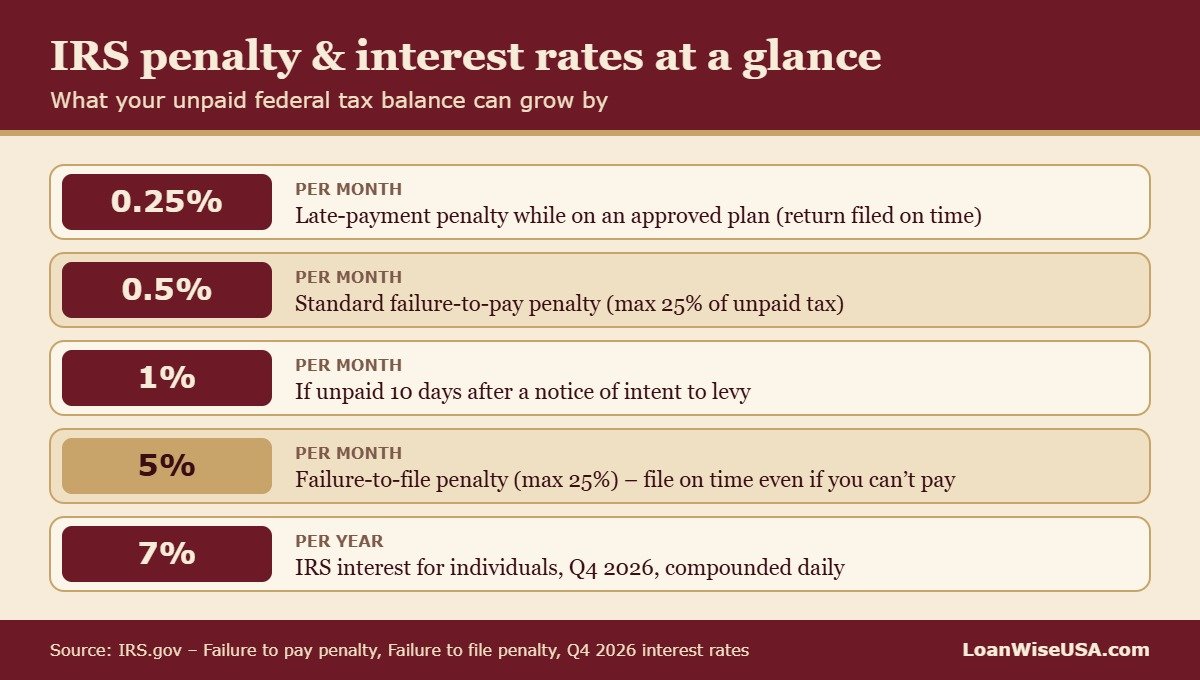
Interest
The IRS charges interest on unpaid tax at the federal short-term rate plus 3 percentage points, compounded daily. For the quarter that began October 1, 2026, the rate for individual underpayments is 7% a year. The rate is reset every quarter, so it can rise or fall during a long plan. This is the same short-term rate environment we covered in our explainer on the Fed’s October 2026 rate decision.
Failure-to-pay penalty
The standard failure-to-pay penalty is 0.5% of the unpaid tax for each month or part of a month it stays unpaid, up to a maximum of 25%. Being on a plan changes that rate:
- 0.25% a month while an approved payment plan is in place, if you filed your return on time.
- 0.5% a month as the normal rate.
- 1% a month if you still haven’t paid 10 days after the IRS sends a notice of intent to levy.
Filing late is much more expensive than paying late. The failure-to-file penalty is generally 5% of the unpaid tax per month, also capped at 25%. That’s why the most important rule is to file on time even if you can’t pay.
What does a payment plan really cost? Worked examples
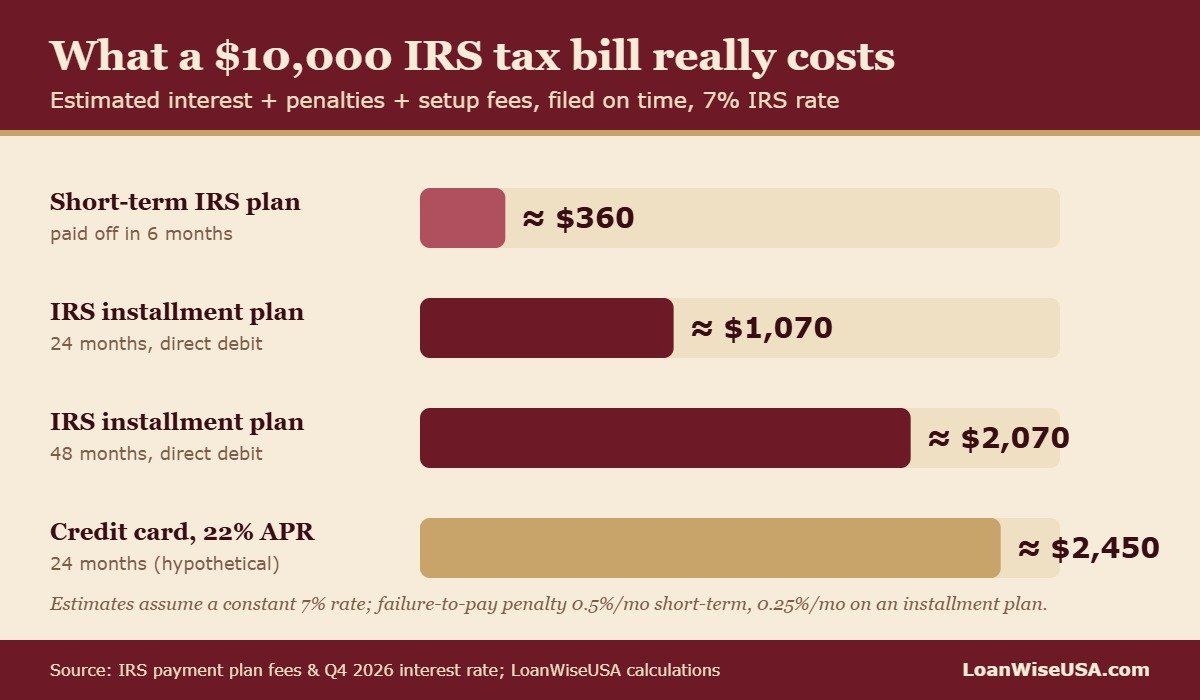
Suppose you filed on time and owe $10,000. The estimates below assume the interest rate stays at 7% for the whole period, apply the penalty rates described above, and are rounded. Your actual IRS figures will differ a little because of daily compounding, quarterly rate changes and when exactly your payments post.
| Option | Monthly payment (approx.) | Interest + penalty + fees (approx.) |
|---|---|---|
| Short-term IRS plan, paid off in 6 months | About $1,700 (no fixed schedule required) | About $360 |
| Long-term IRS plan, 24 months, direct debit, applied online | About $460 | About $1,070 (includes $29 fee) |
| Long-term IRS plan, 48 months, direct debit, applied online | About $250 | About $2,070 (includes $29 fee) |
| Credit card at a hypothetical 22% APR, 24 months | About $519 | About $2,450 |
Two lessons stand out. First, paying it off faster saves real money: stretching the same $10,000 from 24 to 48 months roughly doubles the cost. Second, an IRS plan is usually cheaper than putting taxes on a high-interest credit card, and card payment processors charge their own fee as well. A personal loan at a low rate can sometimes beat the IRS plan, but only if your credit qualifies you for a rate well below the IRS’s roughly 7% interest plus penalty.
How to set up an IRS payment plan, step by step
- File your return, even if you can’t pay. Filing on time avoids the 5%-a-month failure-to-file penalty and makes you eligible for the lower 0.25% failure-to-pay rate while on a plan. If you need more time, file an extension, but remember that an extension gives you more time to file, not more time to pay.
- Find your exact balance. Sign in to your IRS Online Account to see what you owe, including penalties and interest, or check the amount on your most recent notice.
- Pay what you can right away. Every dollar paid now stops accruing interest and penalties, and getting under $50,000 lets you use the online long-term plan.
- Pick a plan. If you can clear the balance within 180 days, the short-term plan has no setup fee. If not, choose a long-term installment agreement and pick the shortest term your budget can handle.
- Choose automatic direct debit if you can. It has the lowest setup fee ($29 online), it’s free for low-income taxpayers, and it makes a missed payment much less likely.
- Apply through the IRS Online Payment Agreement tool. You’ll verify your identity, enter your payment amount and due date, and usually get an answer immediately. If you can’t apply online, call the number on your notice or mail Form 9465.
- Save the confirmation and set a reminder. Keep your acceptance letter and track each payment in your online account.
- Adjust your withholding or estimated payments. To keep the plan in good standing you must file and pay future taxes on time, so fix whatever caused the shortfall, whether that’s too little withholding from your paycheck or self-employment income with no estimated payments.
What if you can’t afford any payment plan?
A payment plan isn’t the only option. The IRS also offers:
- Offer in Compromise: settling for less than the full amount if paying in full would cause financial hardship or the full amount can’t realistically be collected. The IRS has a pre-qualifier tool on its website, and acceptance depends on your income, expenses and assets.
- Temporarily delaying collection (currently not collectible status): if the IRS agrees you can’t pay any of the balance and still cover basic living expenses, it may pause collection. Interest and penalties continue, and the IRS may review your finances later.
- Penalty relief: first-time penalty abatement or reasonable-cause relief can remove some penalties if you have a clean history or a good reason, such as a serious illness or disaster.
- Taxpayer Advocate Service: an independent office within the IRS that can help if a tax problem is causing financial hardship or you haven’t been able to resolve it through normal channels.
Be wary of “tax relief” companies that promise to settle your debt for “pennies on the dollar” in exchange for a large upfront fee. The FTC has warned consumers about these pitches. Most people can set up a plan themselves for free or for a small IRS fee.
Common mistakes to avoid
- Not filing because you can’t pay. The failure-to-file penalty is ten times the normal failure-to-pay rate. File on time, then arrange the payments.
- Ignoring IRS notices. Once the IRS sends a notice of intent to levy and you don’t respond within 10 days, the failure-to-pay penalty doubles to 1% a month and wage or bank levies become possible.
- Picking the longest term by default. Lower monthly payments are tempting, but the stretched term can double your total interest and penalties.
- Skipping direct debit. It costs $40 less to set up online than other payment methods and protects you from forgetting a payment.
- Missing a payment or a future filing. Falling behind on the plan, or not filing and paying next year’s taxes, can cause the agreement to default. Reinstating it can mean a reinstatement fee, and penalties and interest keep accruing.
- Swapping an IRS plan for worse debt. High-APR cards and buy now, pay later stacking can cost more than the IRS plan they replace.
- Forgetting payroll and high-earner rules. If your income changed, review your withholding. Our piece on new payroll tax rules for high earners covers recent changes that can affect how much is withheld.
Frequently asked questions
Can I set up an IRS payment plan online?
Yes. Individuals who owe less than $100,000 can request a short-term plan online, and those who owe $50,000 or less and have filed all required returns can set up a long-term installment agreement online. Larger balances and businesses generally need to apply by phone, mail or in person.
How much is the IRS payment plan setup fee?
Short-term plans have no setup fee. Long-term plans cost $29 online with direct debit, $69 online with other payment methods, $107 by phone, mail or in person with direct debit, and $178 by phone, mail or in person with other methods. Low-income taxpayers pay nothing with direct debit or $43 otherwise, and that $43 may be reimbursed.
Does the IRS charge interest on payment plans?
Yes. Interest is charged at the federal short-term rate plus 3 percentage points, compounded daily: 7% a year for individuals in the fourth quarter of 2026. The failure-to-pay penalty also continues, at 0.25% a month on an approved plan if you filed on time.
Is there a minimum monthly payment?
For a long-term plan, your payment generally needs to be large enough to pay off the balance within the time the IRS allows for your plan type. The Online Payment Agreement tool shows you the acceptable range when you apply. Paying more than the minimum reduces your total cost.
Does an IRS payment plan hurt my credit score?
The IRS doesn’t report payment plans to the credit bureaus, and federal tax liens no longer appear on credit reports from the three nationwide bureaus. Your plan itself won’t show up as a credit account. Lenders may still ask about tax debt on mortgage or loan applications, though, so be ready to disclose it.
Will the IRS keep my tax refund while I’m on a plan?
Generally, yes. Future federal tax refunds are applied to your outstanding balance until it’s paid off, so don’t count on a refund while you’re on a plan.
Can I pay off my IRS payment plan early?
Yes. There’s no prepayment penalty, and paying early cuts the interest and penalties you’d otherwise owe.
Share this infographic
Found the cost comparison useful? You are welcome to share it on your own site or blog. Copy the code below to embed the infographic with a link back to this guide.
<a href="https://loanwiseusa.com/irs-payment-plan/"><img src="https://loanwiseusa.com/wp-content/uploads/2026/10/irs-payment-plan-cost-10000-infographic.jpg" alt="What a $10,000 IRS tax bill really costs – LoanWiseUSA infographic" width="1200" /></a><br />Source: <a href="https://loanwiseusa.com/irs-payment-plan/">LoanWiseUSA – How to Set Up an IRS Payment Plan: Fees, Interest and Step-by-Step Guide</a>Related reading on LoanWiseUSA
- How to Get a Personal Loan With Bad Credit: Options, Real Costs and a Step-by-Step Plan
- Trump Accounts & New Payroll Tax Rules: What High Earners Should Know
- Fed Holds Rates at 3.75%–4% on Oct. 28, 2026: What It Means for Your Money
- BNPL (Buy Now, Pay Later) Debt Trap: Why More Americans Are at Risk
Sources
- IRS – Payment plans; installment agreements (eligibility and setup fees)
- IRS – Failure to pay penalty
- IRS – Failure to file penalty
- IRS – Interest rates remain the same for the fourth quarter of 2026
- IRS – Online Payment Agreement application
- IRS – Offer in Compromise
- Taxpayer Advocate Service
- FTC – Tax relief companies



[…] borrowing, consider whether a cheaper option exists. If the money is meant to cover a tax bill, an IRS payment plan usually costs far less than a high-APR loan. Other options […]
[…] Report raises, new jobs and household changes to the marketplace within 30 days so your credit can be adjusted during the year. If you end up with a tax bill you can’t pay in full, see our step-by-step guide to setting up an IRS payment plan. […]