
Fed Holds Rates at 3.75%–4% on Oct. 28, 2026: What It Means for Your Mortgage, Credit Cards and Savings

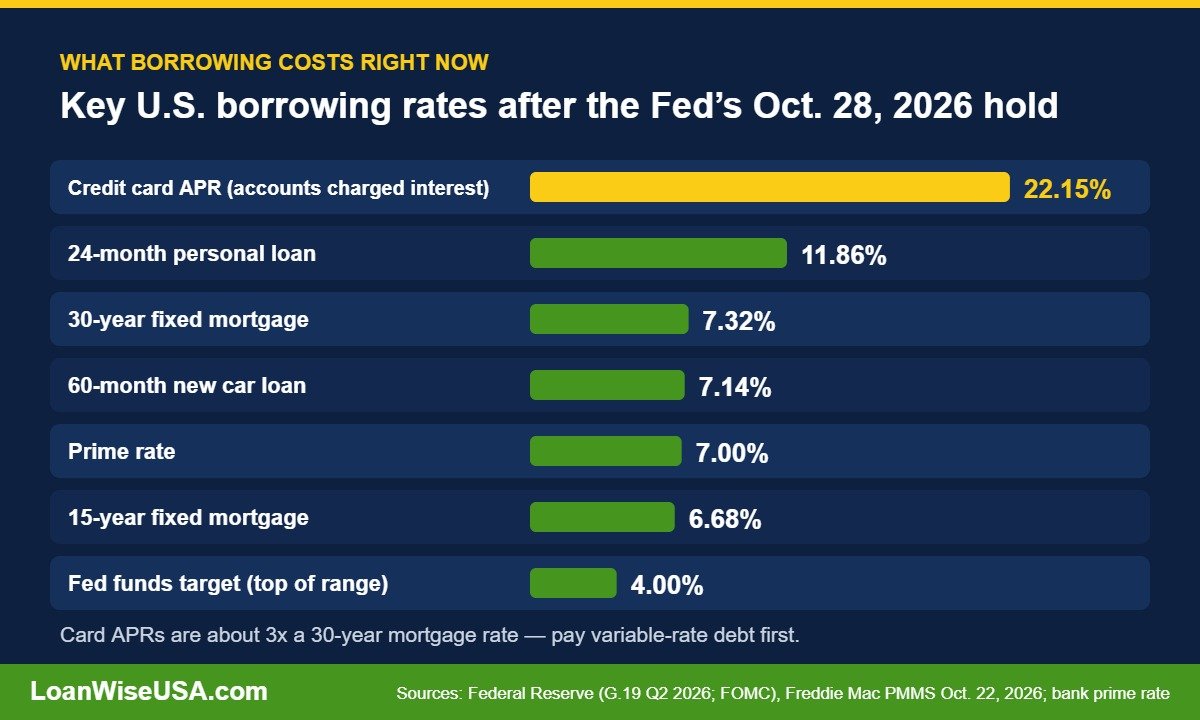
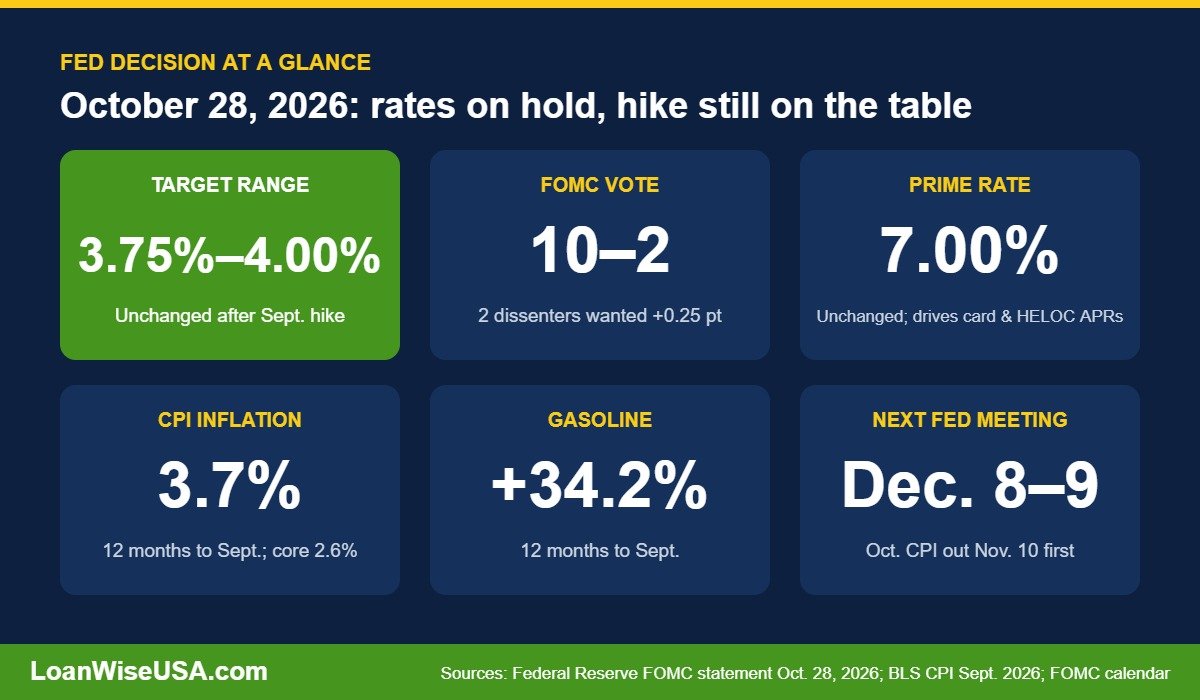
Quick answer: The Federal Reserve held its benchmark rate steady at 3.75%–4.00% on October 28, 2026, in a 10–2 vote in which the two dissenters wanted another hike. After September’s quarter-point hike, the prime rate is 7.00%, the average 30-year fixed mortgage is 7.32% (Freddie Mac, Oct. 22), and the average credit card APR on balances that carry interest is 22.15% (Federal Reserve, Q2 2026). The decision itself won’t change most bills overnight, but it does tell you the high-rate environment isn’t ending soon, so paying down variable-rate debt and shopping around for loans matter more than usual.
What did the Fed decide on October 28, 2026?
The Federal Open Market Committee voted 10–2 to keep the federal funds target range at 3.75% to 4.00%, the level it set with a quarter-point hike in September. Two officials, Lisa D. Cook and Beth M. Hammack, voted against the decision because they preferred to raise rates by another 0.25 percentage point.
In its statement, the Fed said the economy is expanding at a strong pace, job gains have kept pace with the workforce, and inflation “remains elevated.” It said more information will help it decide what policy is needed to bring inflation back to its 2% goal. In plain English: no change today, but the door to another increase is open.
Because the rate didn’t move, the prime rate stays at 7.00%. That’s the number most credit cards, home equity lines and many small-business loans are priced from.
Why are rates this high right now?
The short answer is inflation. The Consumer Price Index rose 3.7% in the 12 months through September 2026, and prices rose 0.6% in September alone, according to the Bureau of Labor Statistics. Energy is doing most of the damage: energy prices were up 20.4% over the year and gasoline was up 34.2%. Core inflation, which leaves out food and energy, was a calmer 2.6%, and shelter costs rose 3.2%.
The Fed’s job is to bring inflation back to 2%. When it can’t tell whether a price spike will fade or spread, it keeps borrowing costs high. That’s why the Committee raised its target range by 0.25 percentage point on September 16, its first hike since 2023, to 3.75%–4.00%.
| Key number | Latest reading | Source |
|---|---|---|
| Federal funds target range | 3.75%–4.00% (unchanged) | Federal Reserve, Oct. 28, 2026 |
| Prime rate (major banks) | 7.00% (unchanged) | Bank announcements |
| CPI inflation, 12 months to Sept. | 3.7% | BLS |
| Core CPI, 12 months to Sept. | 2.6% | BLS |
| 30-year fixed mortgage (avg.) | 7.32% (6.19% a year ago) | Freddie Mac PMMS, Oct. 22 |
| 15-year fixed mortgage (avg.) | 6.68% (5.44% a year ago) | Freddie Mac PMMS, Oct. 22 |
| Credit card APR, accounts assessed interest | 22.15% | Federal Reserve G.19, Q2 2026 |
| 24-month personal loan (avg.) | 11.86% | Federal Reserve G.19, Q2 2026 |
| 60-month new car loan (avg.) | 7.14% | Federal Reserve G.19, Q2 2026 |
What does the Fed decision mean for my credit card?
Credit cards feel Fed moves most directly. Almost every card APR is variable and is set as the prime rate plus a margin, and the prime rate moves with the top of the Fed’s target range. When banks raised prime from 6.75% to 7.00% on September 17, card APRs on most accounts rose by the same quarter point within a billing cycle or two.
Because the Fed held, your card APR shouldn’t change because of this meeting. But two officials wanted a hike, so a December increase is possible, and the 7.00% prime rate is already a quarter point higher than it was this summer.
Worked example: a $6,000 balance
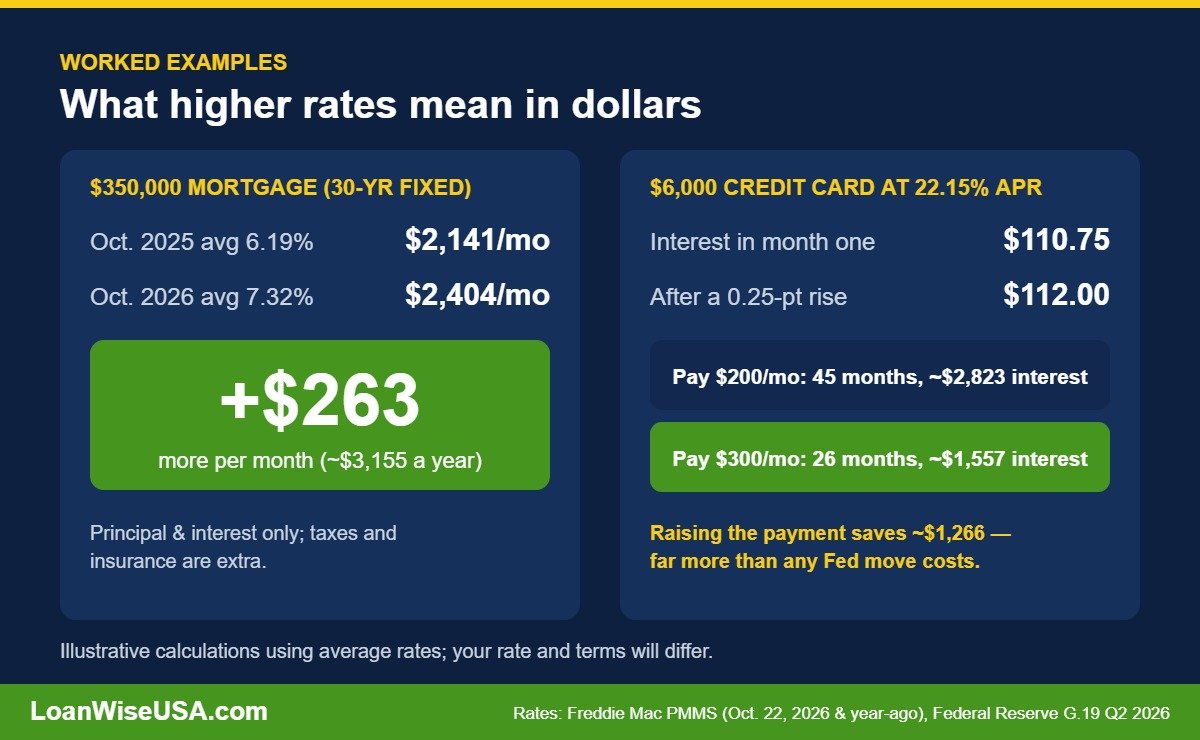
- At 22.15% APR, a $6,000 balance builds about $110.75 of interest in a month.
- A quarter-point increase to 22.40% raises that to about $112.00, roughly $1.25 more a month.
- The bigger lever is your payment. Paying $200 a month at 22.15% takes about 45 months and roughly $2,823 in interest. Paying $300 a month cuts that to about 26 months and roughly $1,557 in interest.
The lesson: a Fed move changes your card bill by a dollar or two, but the rate you’re already paying costs you hundreds. If you’re juggling cards plus buy now, pay later plans, list every balance and APR first so you know where extra dollars do the most good.
Will mortgage rates go up or down after the Fed meeting?
Fixed mortgage rates don’t follow the fed funds rate one-for-one. They track longer-term Treasury yields, which move on what investors expect inflation and the Fed to do over many years (our look at what’s moving bonds and markets in 2026 explains why). That’s why the 30-year average jumped to 7.40% in mid-October, a three-year high, and then slipped to 7.32% the week of October 22 even before this meeting.
Freddie Mac’s next weekly survey comes out Thursday, October 29, and will be the first to reflect market reaction to this decision. Expect daily lender quotes to move first.
Worked example: a $350,000 loan
| Loan | Rate | Monthly principal & interest |
|---|---|---|
| 30-year fixed, today’s average | 7.32% | $2,404 |
| 30-year fixed, a year ago | 6.19% | $2,141 |
| 15-year fixed, today’s average | 6.68% | $3,084 |
The same $350,000 loan costs about $263 more a month, or roughly $3,155 a year, than it would have at last October’s average. Taxes, insurance and any mortgage insurance come on top of these figures.
What about ARMs and HELOCs?
Adjustable-rate mortgages reset based on a market index, often SOFR, which moves closely with the fed funds rate. If yours is due to adjust in the next few months, check your loan documents for the index, margin and rate caps. Home equity lines of credit are usually priced at prime plus a margin, so they move almost immediately.
HELOC example: on a $50,000 balance at 8.00% (prime of 7.00% plus a 1-point margin, used here only as an illustration), interest-only payments are about $333 a month. A quarter-point rise to 8.25% adds about $10 a month.
What does it mean for car loans, personal loans and student loans?
- Car loans: Most are fixed, so your current loan doesn’t change. New loans average 7.14% for 60 months at banks. On a $35,000 loan, that’s about $695 a month; a quarter point higher adds about $4.
- Personal loans: Also usually fixed. The bank average is 11.86% for 24 months, which is about $470 a month on $10,000. Your credit score affects your rate far more than the Fed does.
- Federal student loans: Existing federal loans have fixed rates, so this decision doesn’t change them. Rates for new federal loans are set once a year based on the May 10-year Treasury auction.
- Private student loans: Variable-rate private loans can rise with benchmark rates. If you’re weighing a switch, read our guide on refinancing student loans before year-end, and remember that refinancing federal loans into a private loan gives up federal protections.
Is there any good news for savers?
Yes. When the Fed keeps rates high, high-yield savings accounts, money market funds and CDs tend to keep paying more than they did a few years ago. Rates vary widely by bank, so compare what you’re actually earning.
Example: $10,000 earning a hypothetical 4.00% APY makes about $400 in a year. The same money in an account paying 0.40% earns about $40. Moving it is one of the easiest ways to offset higher borrowing costs. If you’re retired, this matters alongside the 2027 Social Security COLA when you plan next year’s budget.
What could happen at the December 8–9 meeting?
The Fed’s next meeting is December 8–9, 2026, and it will include new economic projections. Officials will see the October CPI report, due November 10, before then. Markets and economists are watching whether energy-driven inflation spreads into core prices. Any forecast of what the Fed will do in December is a market estimate, not an official plan, and it can change quickly with new data.
Your checklist: what to do this week
- Pull up every card and line of credit and write down the current APR. Look for a rate-change notice in recent statements.
- Put extra payments toward the highest-APR balance first.
- Ask your card issuer for a lower rate, or look at a 0% balance transfer and do the math on the transfer fee.
- If you have a HELOC or ARM, find your index, margin and next reset date.
- Shopping for a home? Get quotes from at least three lenders on the same day and compare the APR, not only the rate.
- Move idle cash into an account that pays a competitive yield.
- Check your credit report for errors before you apply for any new loan.
Frequently asked questions
Does the Fed set mortgage rates?
No. The Fed sets a target for overnight lending between banks. Fixed mortgage rates follow longer-term bond yields, which react to the Fed’s outlook but also to inflation, the economy and investor demand.
How fast does my credit card APR change after a Fed move?
Usually within one or two billing cycles, because most card APRs are tied to the prime rate. Your card agreement explains exactly when changes take effect.
Should I lock my mortgage rate now?
That depends on your closing date and how much rate risk you can handle. Ask your lender how long a lock lasts, what it costs to extend, and whether there’s a float-down option.
Will my federal student loan rate change?
No. Federal student loans issued since 2006 have fixed rates for the life of the loan.
Is it a good time to refinance?
For most mortgages, today’s averages are well above where many homeowners locked in. Refinancing usually makes sense only if you can lower your rate enough to recover closing costs within the time you’ll keep the loan.
Share this infographic
Writing about the Fed, mortgage rates or credit card APRs? You’re welcome to share our “Key U.S. borrowing rates” infographic on your site. Copy the code below to embed it, and please keep the credit link to LoanWiseUSA.
<a href="https://loanwiseusa.com/fed-rate-decision-october-2026/"><img src="https://loanwiseusa.com/wp-content/uploads/2026/10/borrowing-rates-after-fed-october-2026-infographic.jpg" alt="Key U.S. borrowing rates after the Fed’s Oct. 28, 2026 hold – LoanWiseUSA infographic" width="1200" /></a><br />Source: <a href="https://loanwiseusa.com/fed-rate-decision-october-2026/">LoanWiseUSA – Fed Holds Rates at 3.75%–4% on Oct. 28, 2026: What It Means for Your Mortgage, Credit Cards and Savings</a>This article is general information, not financial advice. Rates and terms vary by lender and borrower. Consider talking with a qualified professional about your situation.
Related reading on LoanWiseUSA
- BNPL (Buy Now, Pay Later) Debt Trap: Why More Americans Are Getting Stuck
- Best Time to Refinance Student Loans Before Year-End 2026
- World Financial Markets in 2026: What’s Really Moving Stocks, Bonds and Currencies
- Medicare Open Enrollment 2027: Part D Cap Rises to $2,400 and What Else Changes Before Dec. 7
Sources
- Federal Reserve: FOMC statement, October 28, 2026
- Federal Reserve: FOMC statement, September 16, 2026
- Federal Reserve: FOMC meeting calendar
- Federal Reserve G.19 Consumer Credit (released Oct. 7, 2026): terms of credit, Q2 2026
- U.S. Bureau of Labor Statistics: Consumer Price Index, September 2026
- Freddie Mac Primary Mortgage Market Survey (Oct. 22, 2026: 30-year 7.32%, 15-year 6.68%)
- Kitco News: U.S. banks raise prime rate after Fed decision (Sept. 16, 2026)
- Federal Student Aid: interest rates for federal student loans



-
-
-
-
-
-
Show Comments[…] With the average card APR at 22.15% and the Fed holding rates at 3.75%–4.00%, moving a BNPL balance onto a credit card can get expensive fast. See what the Fed’s October 28 decision means for your credit card and loans. […]
[…] loans go into default, because default can lead to seized tax refunds and wages. And with the Fed holding rates at 3.75% to 4%, a credit card won’t be a cheap stopgap for a higher loan […]
[…] 2026 meeting, average personal loan rates are unlikely to fall quickly. Read our breakdown of what the Fed’s October 2026 decision means for your borrowing costs. Your own credit profile still matters more than the Fed for the rate you are […]
[…] Mac’s Oct. 22 survey, and the Fed held its benchmark steady on Oct. 28. Our breakdown of what the Fed decision means for mortgage rates explains why fixed rates don’t move in lockstep with the […]
[…] For how this year’s rate path is reaching household borrowing costs, see what the Fed’s October 28, 2026 decision means for your mortgage, credit cards and savings. […]
[…] The IRS charges interest on unpaid tax at the federal short-term rate plus 3 percentage points, compounded daily. For the quarter that began October 1, 2026, the rate for individual underpayments is 7% a year. The rate is reset every quarter, so it can rise or fall during a long plan. This is the same short-term rate environment we covered in our explainer on the Fed’s October 2026 rate decision. […]