

ACA Open Enrollment 2027: Premiums Up 13%, the 400% Subsidy Cliff and Your Dec. 15 Deadline

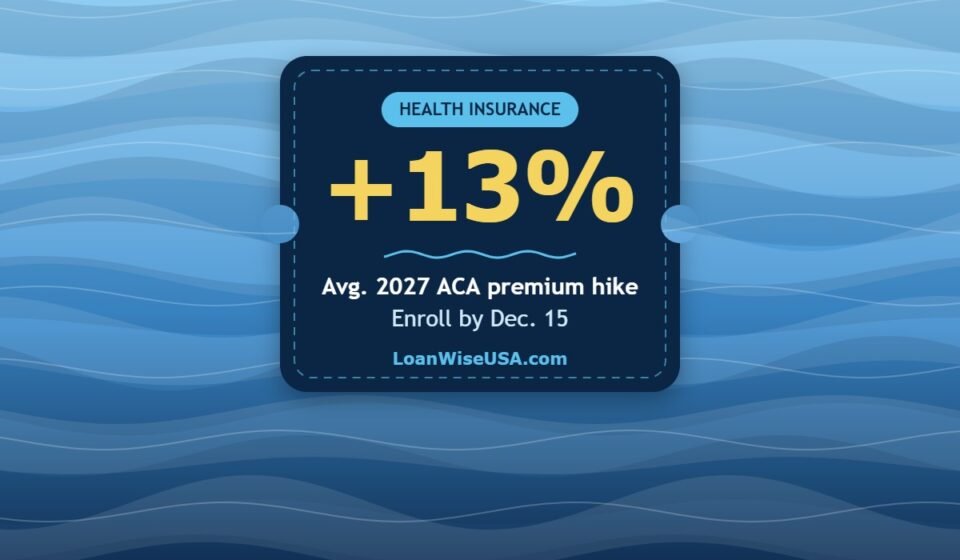
Quick answer: ACA open enrollment for 2027 coverage runs from November 1, 2026 to January 15, 2027 on HealthCare.gov. To have coverage start January 1, you need to pick a plan by December 15. Benchmark silver premiums are up about 13% on average, and premium tax credits now stop completely once household income goes above 400% of the federal poverty level ($63,840 for one person, $132,000 for a family of four). Check your numbers before you let your plan auto-renew.
Open enrollment for Affordable Care Act (ACA) Marketplace coverage began on November 1. This is the second year in a row of double-digit price increases, and the extra subsidies that kept bills low from 2021 through 2025 are no longer in place. Below we cover the deadlines, the income limits that decide whether you get help, worked dollar examples, and the steps that can lower your 2027 premium.
When is ACA open enrollment for 2027?
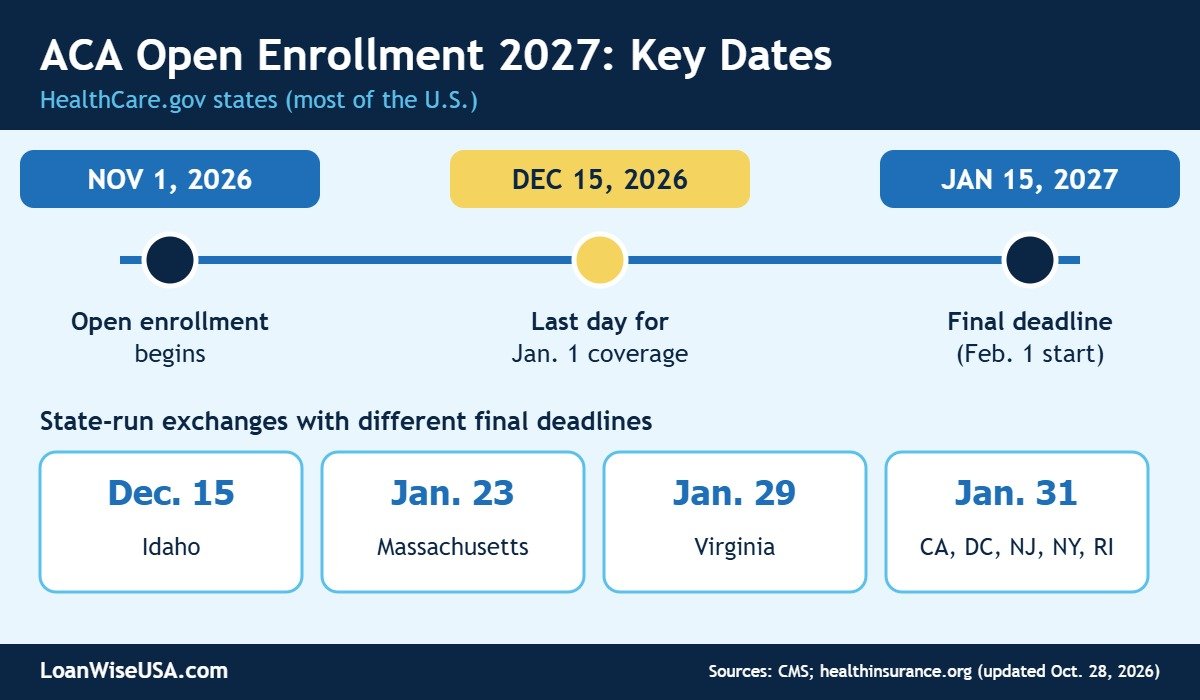
On HealthCare.gov, which serves most states, the key dates are:
- November 1, 2026: open enrollment begins.
- December 15, 2026: last day to pick a plan for coverage that starts January 1, 2027.
- January 15, 2027: final deadline. If you enroll between December 16 and January 15, coverage generally starts February 1.
A 2025 federal rule would have ended open enrollment on December 15. A federal court vacated that rule in June 2026 (Columbus v. Kennedy), and HHS confirmed that the traditional schedule applies for 2027 coverage. The case is under appeal, so dates for future years could change.
Do state-run marketplaces have different deadlines?
Yes. States that run their own exchanges set their own dates, according to healthinsurance.org’s state-by-state tracker:
| Deadline | States |
|---|---|
| Dec. 15 (no January window) | Idaho |
| Jan. 15 | HealthCare.gov states plus CO, CT, GA, IL, KY, ME, MD, MN, NV, NM, OR, PA, VT, WA |
| Jan. 23 | Massachusetts |
| Jan. 29 | Virginia |
| Jan. 31 | California, DC, New Jersey, New York, Rhode Island |
Several states also let you sign up later than December 15 and still start on January 1. That cutoff is December 31 in California, Maryland, Nevada, New Jersey, New Mexico, Oregon, Virginia and Washington, and December 23 in Massachusetts and Rhode Island.
How much are ACA premiums going up in 2027?
KFF’s analysis of final rate data shows that the average benchmark silver premium, the plan used to calculate subsidies, is 13% higher for 2027. The increase averages 11% in HealthCare.gov states and 16% in states with their own platforms. This comes after a 26% average increase for 2026, which puts benchmark premiums about 42% above 2025 levels.
Most of the increase lands on people who don’t get a subsidy. If you qualify for a premium tax credit, your share of the benchmark plan is capped at a percentage of your income, so the credit absorbs most of the price increase. CMS says more than 75% of HealthCare.gov shoppers will be able to find a plan at or below $50 a month after tax credits.
Insurer choices are changing too. KFF counted 11 carriers leaving at least one state for 2027. Cigna is leaving the individual market in all 11 states where it sold plans. If your insurer is leaving, you must choose a new plan, or the marketplace may move you into a different one.
Who qualifies for a premium tax credit in 2027?
The enhanced subsidies expired on December 31, 2025. A House-passed extension has not received a Senate vote. That means the original ACA rules apply for 2027:
- Help is generally available when household income is between 100% and 400% of the federal poverty level (FPL). In states that expanded Medicaid, adults below 138% FPL are usually sent to Medicaid instead.
- Above 400% FPL there is no credit at all. This is the “subsidy cliff.”
- Your expected contribution for the benchmark plan ranges from 2.15% to 10.22% of income, based on the IRS’s 2027 table.
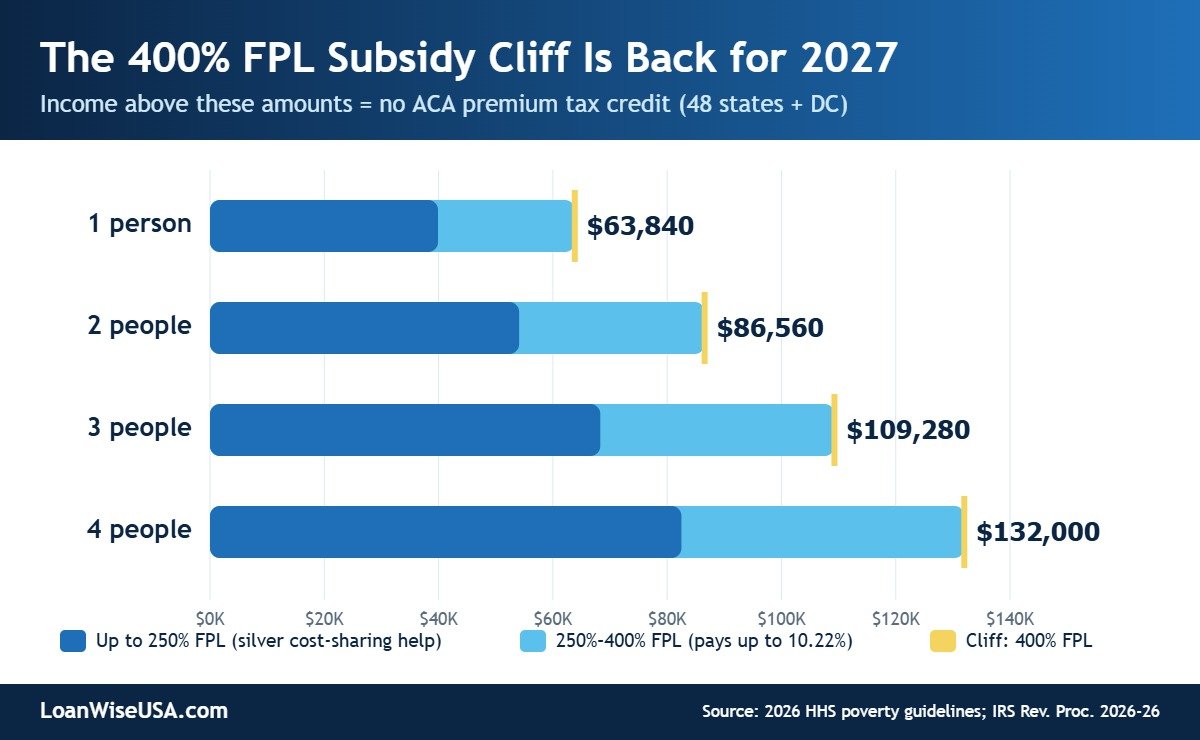
For 2027 coverage, the marketplace uses the 2026 HHS poverty guidelines. Here is where the main income lines fall in the 48 contiguous states and DC (Alaska and Hawaii are higher):
| Household size | 100% FPL | 150% FPL | 250% FPL | 400% FPL (cliff) |
|---|---|---|---|---|
| 1 | $15,960 | $23,940 | $39,900 | $63,840 |
| 2 | $21,640 | $32,460 | $54,100 | $86,560 |
| 3 | $27,320 | $40,980 | $68,300 | $109,280 |
| 4 | $33,000 | $49,500 | $82,500 | $132,000 |
Income here means modified adjusted gross income (MAGI), which you estimate for all of 2027 when you apply. Lower-income enrollees between 100% and 250% FPL who pick a silver plan also get cost-sharing reductions, which lower deductibles and copays.
What share of income will I pay?
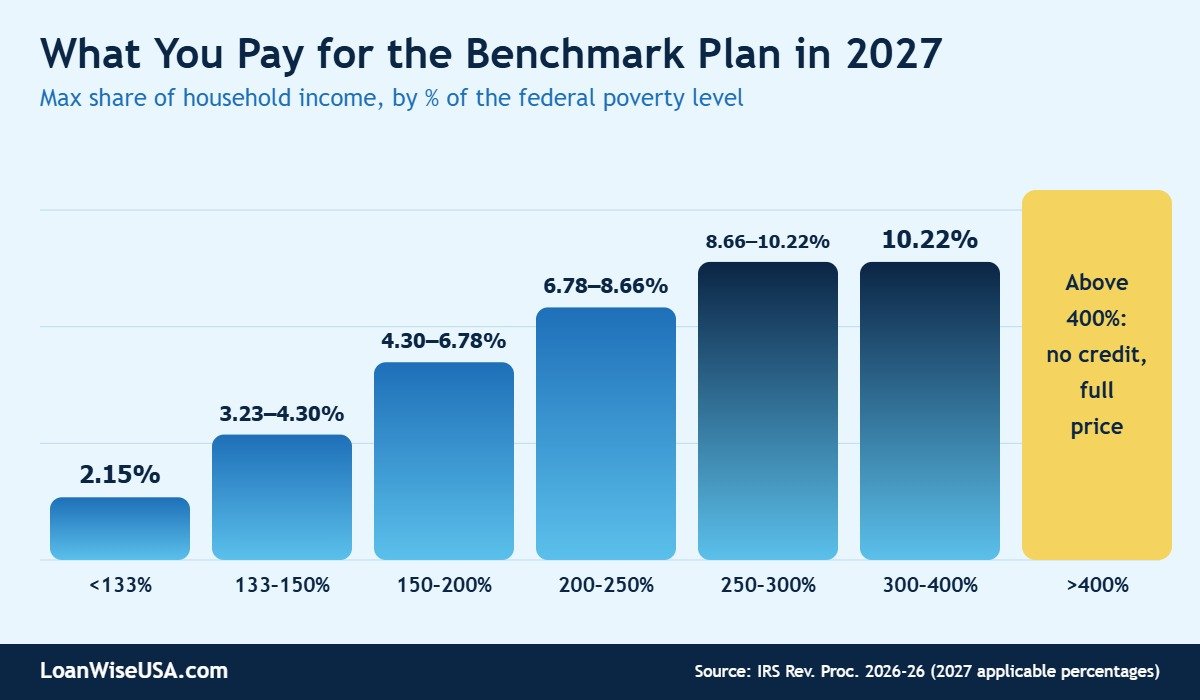
Your expected contribution is set by the IRS in Rev. Proc. 2026-26. Within each band, the percentage rises gradually as income goes up:
| Income (% of FPL) | You pay for the benchmark plan |
|---|---|
| Below 133% | 2.15% of income |
| 133% to 150% | 3.23% to 4.30% |
| 150% to 200% | 4.30% to 6.78% |
| 200% to 250% | 6.78% to 8.66% |
| 250% to 300% | 8.66% to 10.22% |
| 300% to 400% | 10.22% |
| Above 400% | No credit; full price |
What does that look like in dollars?
The examples below use the official FPL and percentage figures. Premium amounts vary by age, ZIP code and household, so the benchmark premiums here are round illustrations, not quotes. Your real numbers will appear on HealthCare.gov or your state’s site.
Example 1: Single adult earning $40,000
- Income is about 250.6% of FPL ($40,000 ÷ $15,960).
- Expected contribution: about 8.68% of income, or $3,472 a year ($289 a month).
- If the local benchmark silver plan costs $550 a month, the credit is about $261 a month.
- Apply that credit to a $400 bronze plan and the net premium is about $139 a month. The trade-off is a higher deductible.
Example 2: Married couple, both 60, near the cliff
- At $86,000 of MAGI (about 397% FPL), they pay 10.22%: $8,789 a year, or $732 a month. If their benchmark plan costs $2,000 a month, the credit is about $1,268 a month ($15,216 a year).
- At $87,000 (about 402% FPL), they get no credit and pay the full $24,000 a year.
- That $1,000 of extra income costs them about $15,000 in lost subsidy.
Older enrollees in high-cost areas feel the cliff most, because their full-price premiums are highest. People who retire before Medicare age and live on savings or part-time income should run the numbers carefully. Our guide to the 2027 Social Security COLA explains how benefit income changes in 2027.
How can I stay under the 400% FPL cliff?
Because MAGI decides eligibility, lowering it legally can be worth far more than the dollars you set aside. Common options include:
- Health savings account (HSA) contributions. Under the 2025 tax law, bronze and catastrophic Marketplace plans are treated as HSA-compatible. CMS says HealthCare.gov shoppers will see about 35 HSA-eligible plans on average. The 2027 HSA limits are $4,500 for self-only and $9,000 for family coverage, plus $1,000 catch-up at 55+ (IRS Rev. Proc. 2026-24).
- Traditional (pre-tax) 401(k), 403(b) or deductible IRA contributions. These reduce adjusted gross income. Roth contributions do not.
- Timing income. For example, choosing which year to take a bonus, sell investments or convert to a Roth.
In Example 2, putting $1,500 into deductible retirement or HSA accounts would bring the couple’s MAGI back under $86,560 and restore roughly $15,000 in credits. Confirm your own situation with a tax professional before you count on it.
What happens if my income estimate is wrong?
The credit is paid in advance using your estimate, then reconciled on your 2027 tax return (Form 8962). Starting with tax year 2026, the law removed the caps on repaying excess advance credits. If your income ends up higher than estimated, especially if it crosses 400% FPL, you may owe back the entire advance credit.
Report raises, new jobs and household changes to the marketplace within 30 days so your credit can be adjusted during the year. If you end up with a tax bill you can’t pay in full, see our step-by-step guide to setting up an IRS payment plan.
What else is different for 2027?
- Immigrant eligibility: Premium tax credits are now limited to lawful permanent residents, Cuban and Haitian entrants and certain Compact of Free Association residents. Refugees and asylees can still buy plans but at full price.
- Medicaid work requirements: States must start them by January 1, 2027. Adults who lose Medicaid only for not meeting work requirements can’t get marketplace subsidies.
- Enrollment checks: In September, HHS canceled about 760,000 enrollments it called “phantom.” Log in and confirm your coverage is active.
- Broker delays: New agent and broker registrations are paused until February 2027, so finding a new broker may take longer.
- Out-of-pocket limit: The 2027 cap on in-network cost-sharing is $12,000 for self-only and $24,000 for family coverage.
If you’re 65 or helping a parent who is, Marketplace plans don’t apply. See our Medicare open enrollment 2027 guide instead; that window closes December 7.
Should I let my plan auto-renew?
Usually not without checking. Auto re-enrollment keeps you covered, but it uses old information and may place you in a plan whose price, network or credit has changed. Also, the benchmark plan in your area may be different this year, which can lower your credit even if your income stays the same. Comparing plans takes about 20 minutes and can save hundreds of dollars a month.
Your 2027 open enrollment checklist
- Write down the deadline that applies in your state: December 15 for January 1 coverage on HealthCare.gov.
- Estimate 2027 MAGI and compare it with the 400% FPL line for your household size.
- Update your application: income, household size, address and any job-based coverage offers.
- Compare total yearly cost: premium × 12 plus your likely deductible and copays.
- Check that your doctors, hospitals and prescriptions are in-network.
- If you’re near the cliff, plan HSA or pre-tax retirement contributions for 2027.
- Confirm your enrollment and pay the first premium so coverage starts.
Building an emergency fund for a higher deductible? Rates on savings move with Fed policy. Our breakdown of the Fed’s October rate decision covers what savers can earn right now.
FAQ
What is the last day to enroll in ACA coverage for January 1, 2027?
December 15, 2026, on HealthCare.gov. Some state exchanges allow sign-ups until December 23 or December 31 for a January 1 start.
Is the ACA subsidy cliff back for 2027?
Yes. The enhanced credits expired at the end of 2025, so households with income above 400% FPL ($63,840 single, $86,560 for two, $132,000 for four) don’t get a premium tax credit in 2027 unless Congress changes the law.
Can I enroll after January 15?
Only if you qualify for a special enrollment period after a life event such as losing other coverage, moving, marriage or having a baby. Medicaid and CHIP accept applications year-round.
Are bronze plans worth it in 2027?
They have the lowest premiums and now work with an HSA, but deductibles are high. They can work well if you’re healthy and have savings. If you’re under 250% FPL, a silver plan with cost-sharing reductions often costs less overall.
Do I have to repay my premium tax credit?
If your actual income is higher than estimated, you repay the excess when you file. Starting with 2026 returns there is no repayment cap, so keep your estimate current.
This article is general information, not financial, tax or insurance advice. Premiums and eligibility depend on your location, age, household and income. Confirm details on HealthCare.gov or your state marketplace, or with a licensed professional.
Share this infographic
Bloggers, newsrooms, benefits teams and financial educators are welcome to share our 2027 ACA subsidy cliff infographic. Copy the code below to embed it on your site with a credit link to LoanWiseUSA.
<a href="https://loanwiseusa.com/aca-open-enrollment-2027/"><img src="https://loanwiseusa.com/wp-content/uploads/2026/11/aca-open-enrollment-2027-subsidy-cliff.jpg" alt="2027 ACA subsidy cliff: 400% FPL income limits by household size" width="1200" /></a><br />Source: <a href="https://loanwiseusa.com/aca-open-enrollment-2027/">LoanWiseUSA – ACA Open Enrollment 2027: Premiums Up 13%, the 400% Subsidy Cliff and Your Dec. 15 Deadline</a>Related reading on LoanWiseUSA
- Medicare Open Enrollment 2027: Part D Cap Rises to $2,400 and What Else Changes Before Dec. 7
- 2027 Social Security COLA Is 3.6%: What Changes in Your Check
- How to Set Up an IRS Payment Plan: Fees, Interest and Step-by-Step Guide
- How to Get a Personal Loan With Bad Credit: Options and Real Costs
Sources
- CMS: Plan Year 2027 Marketplace Plans and Prices Fact Sheet (Oct. 30, 2026)
- KFF: 9 Things to Watch for the 2027 ACA Open Enrollment Period (Oct. 30, 2026)
- IRS Rev. Proc. 2026-26: 2027 applicable percentage table
- IRS Rev. Proc. 2026-24: 2027 HSA limits
- Federal Register: 2026 HHS Poverty Guidelines
- CMS: 2027 Payment Notice parameters (out-of-pocket maximum)
- healthinsurance.org: 2027 open enrollment deadlines by state
- HealthCare.gov



[…] 65 and buying your own coverage? That is a separate window: see our guide to ACA open enrollment 2027, which runs through January […]