
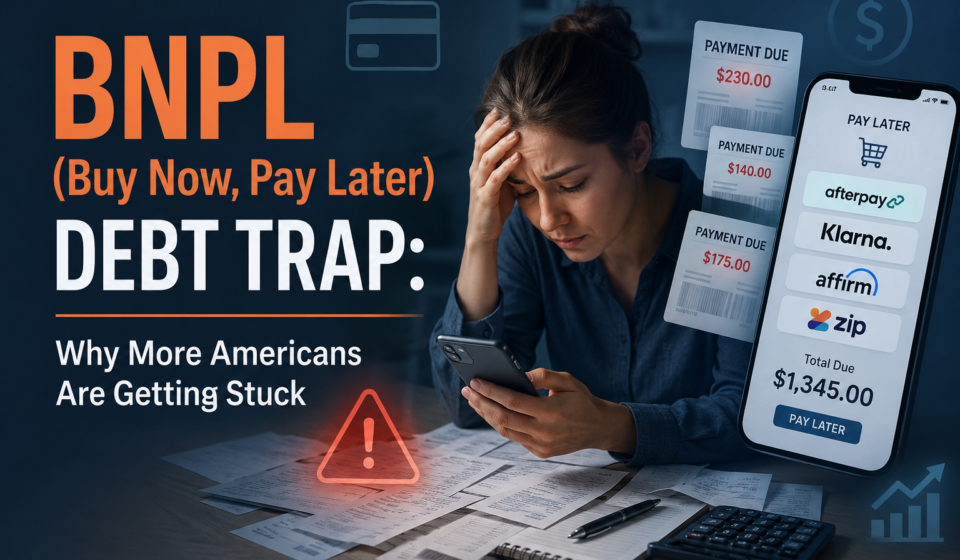

Buy Now, Pay Later has quietly become one of the most-used financial tools in America — and one of the least tracked. Nearly half of the country has used it, more people are missing payments than ever before, and yet the debt barely shows up anywhere official. Here’s a clear, data-backed look at why BNPL is becoming a real problem for millions of Americans, and how to avoid getting stuck.
How Big Is BNPL Really?
BNPL has moved from niche checkout option to mainstream financial habit almost overnight. Nearly half of Americans, 47%, say they’ve used a BNPL service, including 10% who have used one six or more times. Adoption skews heavily toward parents and younger consumers — nearly 7 in 10 parents with young kids have used these loans, and 61% of Gen Zers between 18 and 29 say they’ve used one.
On the dollar side, U.S. BNPL transaction value has grown roughly 20% per year in real terms since 2021, reaching an estimated $70 billion in 2025 — still just about 1.1% of total credit card spending. That’s real money, but small relative to the overall consumer credit picture. The bigger concern isn’t the size of the industry — it’s what’s happening to the people using it.
Late Payments Are Climbing Fast
Here’s the number that should worry every BNPL user: 47% of BNPL users say they’ve paid late on a loan in the past year, up six percentage points from 2025 and 13 percentage points from just two years ago. That’s a rapid, sustained climb — and it’s happening even as the industry insists its loans are safe.
This is where BNPL data gets genuinely confusing, and it’s worth understanding why. The CFPB’s dollar-weighted charge-off rate came in at 1.83%, the industry’s own trade group reports delinquency under 2%, and yet 47% of users self-report having paid late at some point — three very different numbers, all technically accurate, because they measure completely different things. A “default” or “charge-off” means the lender has essentially given up on getting paid. A “late payment” just means you missed a due date, even by a few days — and that’s the number that’s rising fastest. To be fair, most of that late-payment group isn’t in serious trouble: 72% of late payers were roughly a week late at most. But a growing share of a week-late today can become a pattern of true delinquency tomorrow.
Why BNPL Debt Is Called “Phantom Debt”
The scariest part of BNPL isn’t the interest — most pay-in-four plans are interest-free. It’s that this debt is largely invisible to the rest of the financial system. Because most BNPL loans aren’t reported to credit bureaus, they can accumulate into what’s known as “phantom debt” — debt that exists financially but doesn’t show up when a bank or lender checks your credit profile, introducing risk that the system simply can’t see coming.
That invisibility creates a specific danger: loan stacking. 63% of BNPL users have multiple loans active at the same time, and a third use multiple providers simultaneously — making it genuinely difficult for anyone, including the borrowers themselves, to track their true debt exposure across every app and provider. If you have four BNPL plans running across four different apps, no single lender, and often not even you, has a full picture of what you owe.
Who’s Actually Getting Stuck
BNPL isn’t just a tool for people who can’t afford things outright — but the data shows financial fragility is common among heavy users. 72.6% of BNPL users earn less than $75,000 a year, renters are 51.9% more likely to use BNPL than homeowners, and 32.7% of users have a credit score below 620, a rejected credit application, or a delinquent loan — a rate 97% higher than the national average.
The CFPB’s own research backs this up with a striking comparison: borrowers who take out at least one BNPL loan per month carry, on average, $453 more in personal loan debt and $871 more in credit card debt than similar consumers with the same age and credit score who don’t use BNPL at all. In other words, BNPL usage tends to travel alongside higher debt elsewhere, not instead of it.
There’s also a newer, more troubling trend: people are starting to use BNPL for essentials, not just discretionary purchases. LendingTree’s 2026 report found more users are now buying groceries with BNPL loans and carrying three or more BNPL loans at once — and more than half of BNPL users say they wouldn’t be able to make ends meet without them. That’s a meaningful shift from “convenient way to split a big purchase” to “necessary tool for covering basic costs.”
Credit Scores Are About to Catch Up
For years, BNPL has operated in a blind spot — but that’s starting to change. Some BNPL lenders have begun voluntarily reporting loan performance to credit bureaus, meaning missed or late payments could start affecting credit scores directly, not just future BNPL eligibility. If you’ve been treating BNPL as “off the books” debt, that assumption is becoming less true by the month.
The Regulatory Picture Is Shifting Too
Oversight of BNPL has been inconsistent, and that inconsistency is itself part of the risk. The CFPB previously moved to apply stronger consumer protections to BNPL products, but that interpretive rule was later rescinded, leaving much of the industry to self-regulate through its own trade association’s reporting standards rather than mandatory federal rules. That gap matters for borrowers: the protections you’d expect with a credit card, like standardized dispute rights or mandatory reporting, don’t automatically apply to BNPL.
Is BNPL a Systemic Risk — or Just a Personal One?
It’s worth noting that most economists studying BNPL at a macro level, including the Richmond Fed, currently see limited risk to the financial system as a whole. Given its current scale, outstanding debt, and observed default rates, BNPL’s impact on broader financial stability appears limited for now, though the possibility of spillover into other consumer credit markets can’t be ruled out.
That’s genuinely reassuring at the macro level — but it says nothing about what BNPL is doing to individual households already stretched thin. The system-wide risk being low doesn’t mean your personal risk is low if you’re juggling four BNPL plans against a shrinking paycheck.
How to Avoid the BNPL Debt Trap
- Track every plan in one place. Since BNPL loans don’t automatically show up on your credit report, you’re the only one keeping the full picture — write down every provider, due date, and balance.
- Treat BNPL like real debt, not free money. Interest-free doesn’t mean consequence-free. A missed payment can still trigger late fees, collections, or now, a credit score hit.
- Avoid stacking multiple providers. If you’re using more than one BNPL app at a time, that’s usually a sign your budget is already stretched further than it can handle.
- Never use BNPL for essentials as a habit. Splitting a one-time big purchase is very different from routinely using BNPL to buy groceries — the second pattern usually signals a cash flow problem that BNPL is masking, not solving.
- Ask about late fee waivers before you miss a payment. Data shows lenders are often willing to waive a first late fee if you simply ask — but you have to be proactive, not wait for them to offer.
The Bottom Line
BNPL isn’t inherently dangerous, and for a one-time, well-planned purchase, it can genuinely be a useful, interest-free tool. The problem is how it’s actually being used by a growing share of Americans: stacked across multiple providers, increasingly applied to groceries and essentials, and largely invisible to the rest of the financial system until it isn’t. With late payments climbing for the third year running and credit bureau reporting on the horizon, the “it’s not real debt” mindset around BNPL is quickly becoming outdated — and potentially expensive.



[…] small ones, each individually defensible. This is the same mechanism that makes subscriptions and buy-now-pay-later instalments so easy to […]