

How Social Security Spousal Benefits Work: Who Qualifies, How Much You Get and When to Claim

Quick answer: A Social Security spousal benefit lets a husband or wife collect up to 50% of their spouse’s full retirement benefit (called the primary insurance amount, or PIA), even if they never worked. You need to have been married at least one year, be 62 or older (or caring for a qualifying child), and your spouse must already be collecting their own retirement or disability benefit. Claim before your full retirement age (FRA) and the 50% shrinks permanently, to as little as 32.5% at age 62. Waiting past FRA does not raise a spousal benefit, so there is no reason to delay it beyond that point.
Spousal benefits are one of the most misunderstood parts of Social Security. Many couples leave money on the table because they assume a spouse who stayed home gets nothing, or because they claim too early without realizing the cut is permanent. This guide explains how the benefit is calculated, who qualifies (including divorced spouses), how early claiming and work change the check, and the mistakes to avoid. The examples use 2027 figures from the Social Security Administration (SSA).
What is a Social Security spousal benefit?
A spousal benefit is a monthly payment based on your husband’s or wife’s work record rather than your own. It exists so that a lower-earning spouse, often someone who took years off to raise children or care for family, still has retirement income.
The key number is your spouse’s PIA: the benefit they would receive if they claimed at exactly their full retirement age. Your maximum spousal benefit is half of that figure. Importantly, it is based on their PIA, not on the amount they actually get. If your spouse claims early and takes a smaller check, your spousal maximum is still 50% of their full PIA. If they delay to 70 and earn delayed retirement credits, those credits do not increase your spousal benefit (although they do increase a future survivor benefit).
Your spouse’s own benefit is not reduced when you collect a spousal benefit. The two payments are separate.
Who qualifies for spousal benefits?
According to the SSA, you can receive benefits as a current spouse if you have been married at least one year and either:
- you are 62 or older, or
- you are caring for your spouse’s child who is under 16 or who has a disability and receives benefits on that record.
Your spouse must also have filed for their own retirement or disability benefits. You cannot collect on a living spouse’s record until they have filed.
Can a divorced spouse collect on an ex’s record?
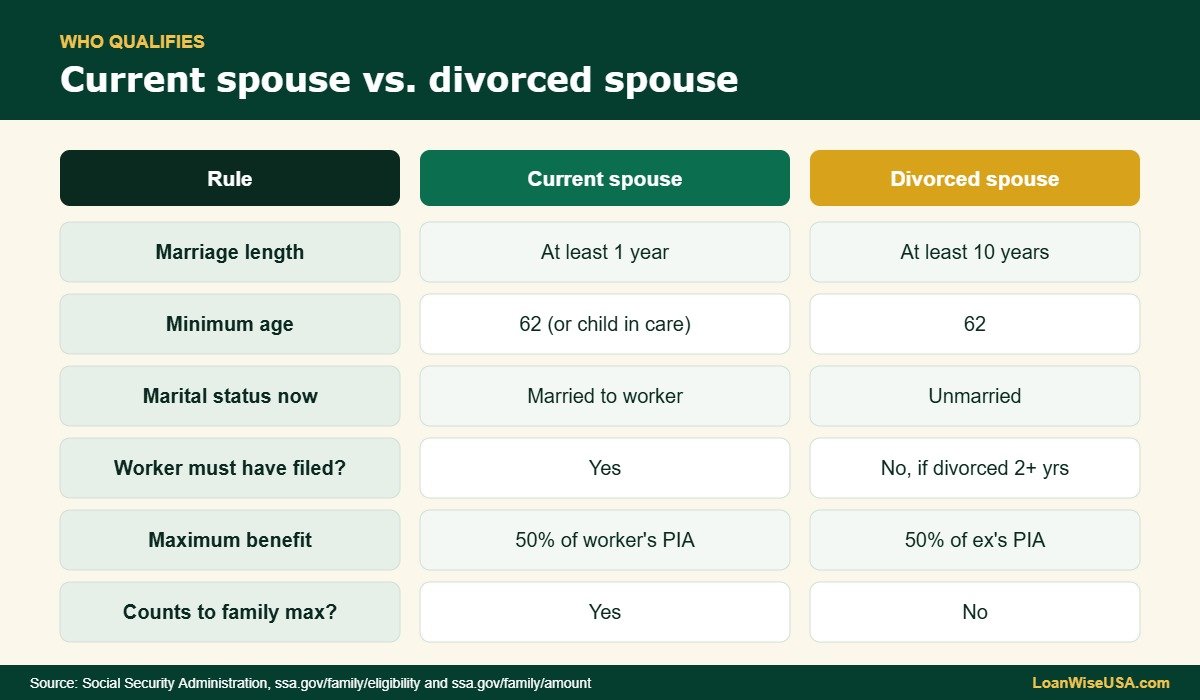
Yes. A divorced spouse can collect on an ex-spouse’s record if the marriage lasted at least 10 years, the person claiming is currently unmarried, both are at least 62, and the claimant’s own benefit is smaller. There is one helpful twist: if you have been divorced for at least two years, you can collect even if your ex has not filed yet, as long as they are eligible. Your ex is not notified, their benefit is not reduced, and payments to divorced spouses do not count toward the family maximum.
| Rule | Current spouse | Divorced spouse |
|---|---|---|
| Length of marriage | At least 1 year | At least 10 years |
| Minimum age | 62 (or any age with a qualifying child in care) | 62 |
| Marital status now | Married to the worker | Unmarried |
| Worker must have filed? | Yes | No, if divorced 2+ years and ex is 62+ |
| Maximum benefit | 50% of worker’s PIA | 50% of ex’s PIA |
| Counts toward family maximum? | Yes | No |
How much is the spousal benefit?
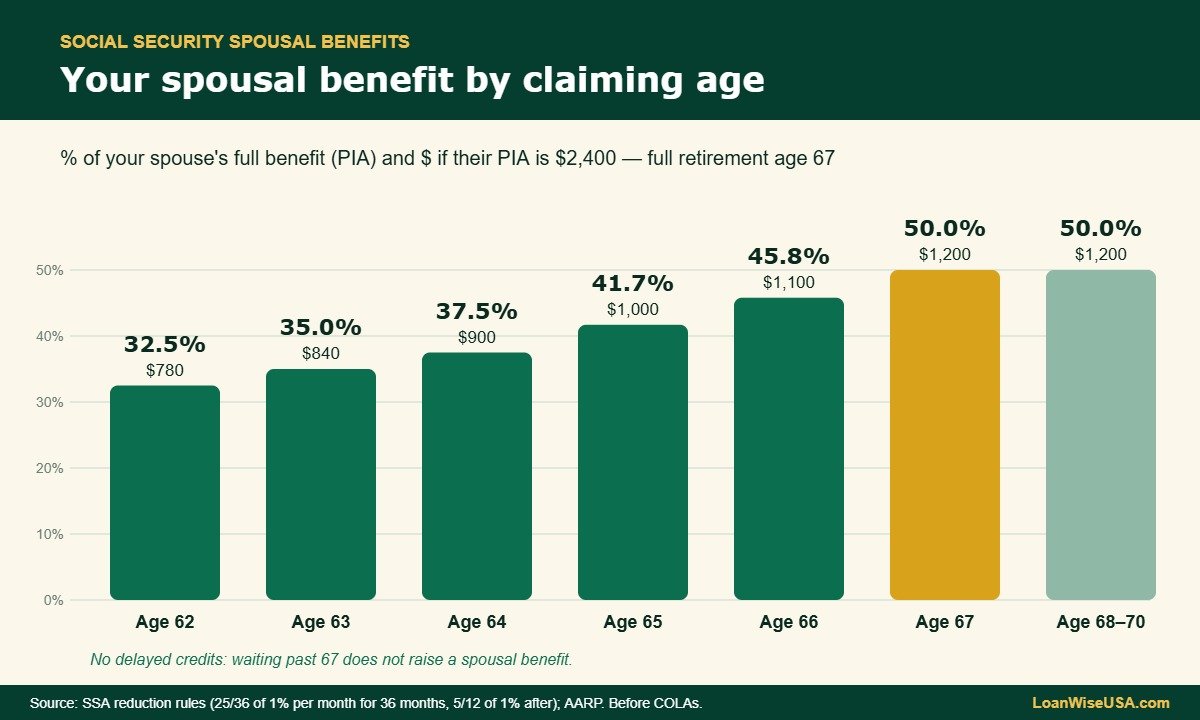
If you claim at your full retirement age, you get up to 50% of your spouse’s PIA. For anyone born in 1960 or later, FRA is 67. The SSA reduces a spousal benefit by 25/36 of 1% for each of the first 36 months you claim before FRA, plus 5/12 of 1% for each additional month. Here is what that means for someone whose FRA is 67:
| Age you claim | Months early | Spousal benefit as % of spouse’s PIA | Monthly benefit if spouse’s PIA is $2,400 |
|---|---|---|---|
| 62 | 60 | 32.5% | $780 |
| 63 | 48 | 35.0% | $840 |
| 64 | 36 | 37.5% | $900 |
| 65 | 24 | 41.7% | $1,000 |
| 66 | 12 | 45.8% | $1,100 |
| 67 (FRA) | 0 | 50.0% | $1,200 |
| 68–70 | — | 50.0% (no delayed credits) | $1,200 |
Before cost-of-living adjustments. Each year’s COLA (3.6% for 2027) is applied on top of these amounts once you are receiving benefits.
What if I also worked and have my own benefit?
You never get both benefits added together. When you file, the SSA pays your own retirement benefit first. If half of your spouse’s PIA is larger than your own PIA, you also get a “spousal excess” to make up the difference. In practice, you receive whichever is higher, but it arrives as two pieces.
Worked examples: what couples actually receive
Example 1: A spouse with no work record
Maria never worked outside the home. Her husband, David, has a PIA of $2,400 and has already filed. If Maria waits until her FRA of 67, she receives $1,200 a month (50%). If she claims at 62, she receives $780 a month (32.5%), and that lower amount is permanent, apart from future COLAs. Claiming early costs her $420 a month, or $5,040 a year.
Example 2: A spouse with a small benefit of their own
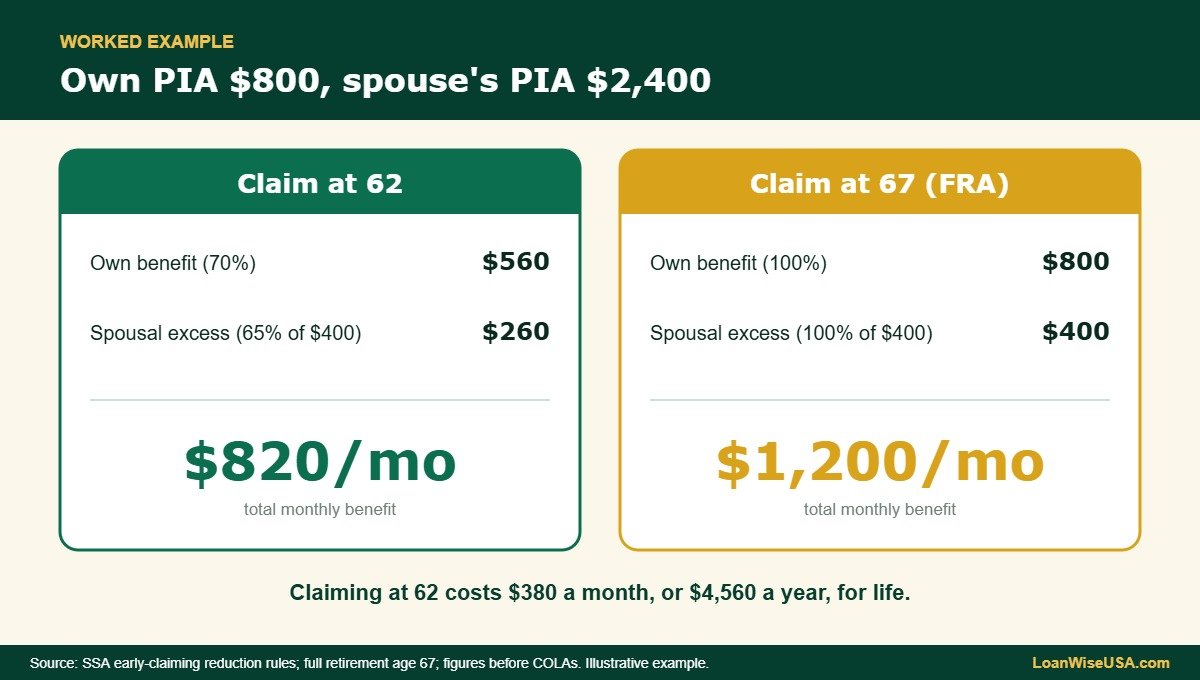
Linda’s own PIA is $800. Her husband’s PIA is $2,400, so her maximum spousal benefit is $1,200. At FRA, she gets her own $800 plus a $400 spousal excess, for a total of $1,200.
If Linda claims everything at 62, both pieces are reduced. Her own retirement benefit is cut to 70% ($560), and her $400 excess is cut by 35% to $260. Her total is about $820 a month instead of $1,200, a difference of $380 a month.
Example 3: When the spousal benefit doesn’t help
Kevin’s own PIA is $1,500, and his wife’s PIA is $2,600. Half of her PIA is $1,300, which is less than Kevin’s own $1,500. Kevin gets no spousal excess at all and simply collects his own benefit. For couples with similar earnings, the spousal benefit often adds nothing.
Does working affect my spousal benefit?
Yes, if you are under full retirement age. The Social Security earnings test applies to spousal benefits just as it does to retirement benefits. For 2027, the SSA withholds $1 for every $2 you earn above $25,560 if you are under FRA all year. In the year you reach FRA, it withholds $1 for every $3 above $67,920, counting only earnings before the month you reach FRA. Once you reach FRA, there is no limit.
Your spouse’s earnings matter too. If the worker is under FRA, is collecting, and earns over the limit, withholding against their record can also reduce benefits paid to family members on that record. Withheld money isn’t lost forever: at FRA, the SSA recalculates your benefit to credit the months it was withheld.
Spousal benefits vs. survivor benefits: what’s the difference?
These two benefits are often confused, and the difference matters for claiming decisions.
| Feature | Spousal benefit | Survivor benefit |
|---|---|---|
| When paid | While the worker is alive | After the worker dies |
| Maximum | 50% of worker’s PIA | Up to 100% of what the worker was receiving or entitled to |
| Earliest age | 62 | 60 (50 if disabled) |
| Boosted by worker’s delayed credits? | No | Yes |
| Can claim separately from own benefit? | No (deemed filing applies) | Yes, you can switch between them |
This is why many couples have the higher earner wait until 70. It doesn’t raise the spousal benefit, but it locks in the largest possible survivor benefit for whichever spouse lives longer.
What is “deemed filing,” and why can’t I switch later?
Under the Bipartisan Budget Act of 2015, anyone born on or after January 2, 1954, is subject to deemed filing. When you apply for your own retirement benefit or a spousal benefit, you are automatically considered to have applied for both. You can’t take a spousal benefit at 66 and let your own benefit grow until 70. That old “restricted application” strategy is no longer available to anyone reaching retirement age today.
The practical result: you pick one claiming age, and the SSA pays you the higher combination available at that age.
What about government pensions?
Until recently, the Government Pension Offset (GPO) cut or eliminated spousal and survivor benefits for many teachers, police officers and other public workers with pensions from jobs that didn’t pay Social Security tax. The Social Security Fairness Act, signed on January 5, 2025, repealed both the GPO and the Windfall Elimination Provision for benefits payable after December 2023. If you were previously told you couldn’t get a spousal benefit because of a public pension, check your eligibility again.
How to apply for spousal benefits: step by step
- Get both earnings records. Each spouse should create or sign in to a my Social Security account at ssa.gov to see their PIA and earnings history. Fix any missing years now.
- Do the 50% math. Divide your spouse’s PIA by two and compare it with your own PIA. If yours is higher, the spousal benefit won’t add anything.
- Confirm eligibility. Check the marriage length (1 year, or 10 years if divorced), your age and, for current spouses, whether the worker has filed.
- Choose your claiming age. Use the reduction table above. Remember that waiting beyond FRA doesn’t raise a spousal benefit.
- Check the earnings test. If either of you will still be working before FRA, estimate whether earnings will exceed $25,560 (2027).
- Apply. You can apply online at ssa.gov, by phone at 1-800-772-1213, or at a local office. Have your marriage certificate (and divorce decree, if applicable) and your spouse’s Social Security number ready.
- Plan your health coverage. Medicare eligibility starts at 65 regardless of when you claim Social Security (see our Medicare open enrollment guide), so a spouse retiring earlier may need ACA marketplace coverage until then.
Common spousal benefit mistakes to avoid
- Assuming a stay-at-home spouse gets nothing. A spouse with no earnings can still receive up to 50% of the worker’s PIA.
- Claiming early without realizing the cut is permanent. At 62, you lock in 32.5% instead of 50%.
- Waiting past FRA for a bigger spousal check. Spousal benefits stop growing at full retirement age. Each month you wait beyond that is a month of lost payments.
- Forgetting about an ex-spouse. If you were married 10 or more years and are now unmarried, you may qualify on your ex’s record without them ever knowing.
- Ignoring the survivor angle. The higher earner’s claiming age decides the survivor benefit, which can last for decades.
- Trusting old public-pension advice. The GPO no longer applies.
- Falling for scams. The SSA will not threaten you, demand payment by gift card or crypto, or ask you to move money to “protect” your benefits. We covered the latest COLA-related scam in our 2027 COLA explainer.
Frequently asked questions
Does my spousal benefit reduce my husband’s or wife’s benefit?
No. The worker receives their full benefit regardless of whether a spouse collects. The only exception is the family maximum, which can trim payments to a spouse and children (but never the worker’s own benefit).
Can I get spousal benefits if my spouse hasn’t retired yet?
Not if you’re currently married. Your spouse must have filed for retirement or disability benefits. A divorced spouse who has been divorced for at least two years can collect without the ex filing.
Do spousal benefits increase if I wait until 70?
No. Spousal benefits reach their maximum of 50% of the worker’s PIA at your full retirement age and do not earn delayed retirement credits.
How long do I have to be married to get spousal benefits?
At least one year for a current spouse. For a divorced spouse, the marriage must have lasted at least 10 years.
If I remarry, do I lose benefits from my ex-spouse?
Generally, yes. Divorced-spouse benefits usually end if you remarry. Survivor benefit rules are different: remarrying at 60 or older (50 if disabled) doesn’t end survivor benefits.
Are spousal benefits taxable?
They can be. Spousal benefits follow the same federal tax rules as other Social Security benefits, so up to 85% may be taxable depending on your combined income. Some states also tax benefits. If a surprise tax bill is more than you can pay at once, an IRS payment plan can spread it out.
Do same-sex spouses qualify?
Yes. The SSA recognizes same-sex marriages for all spousal, divorced-spouse and survivor benefits.
This article is general information, not financial, legal or tax advice. Social Security rules depend on your birth date, work history and marital history. Confirm your own figures with the Social Security Administration or a qualified professional before you claim.
Share this infographic
Writing about Social Security or retirement planning? You are welcome to share our spousal-benefit-by-age chart. Copy the code below to embed it with a credit link to this guide.
<a href="https://loanwiseusa.com/social-security-spousal-benefits/"><img src="https://loanwiseusa.com/wp-content/uploads/2026/11/social-security-spousal-benefits-by-claiming-age.jpg" alt="Social Security spousal benefit by claiming age infographic" width="1200" /></a><br />Source: <a href="https://loanwiseusa.com/social-security-spousal-benefits/">LoanWiseUSA – How Social Security Spousal Benefits Work: Who Qualifies, How Much You Get and When to Claim</a>Related reading on LoanWiseUSA
- 2027 Social Security COLA Is 3.6%: What Changes in Your Check
- Medicare Open Enrollment 2027: Part D Cap and What Changes Before Dec. 7
- ACA Open Enrollment 2027: Premiums, the Subsidy Cliff and Your Deadline
- How to Set Up an IRS Payment Plan: Fees, Interest and Steps
Sources
- Social Security Administration – Family benefits eligibility
- Social Security Administration – Family benefit amounts
- Social Security Administration – 2027 COLA fact sheet
- Social Security Administration – Benefits for your family
- AARP – How spousal benefits are calculated at 62
- Congressional Research Service – The Social Security Fairness Act



[…] on a husband’s or wife’s record, the COLA applies to that check too; our guide to how Social Security spousal benefits work explains how that amount is […]