

2027 Social Security COLA Is 3.6%: What Changes in Your Check (and the Scam to Avoid)

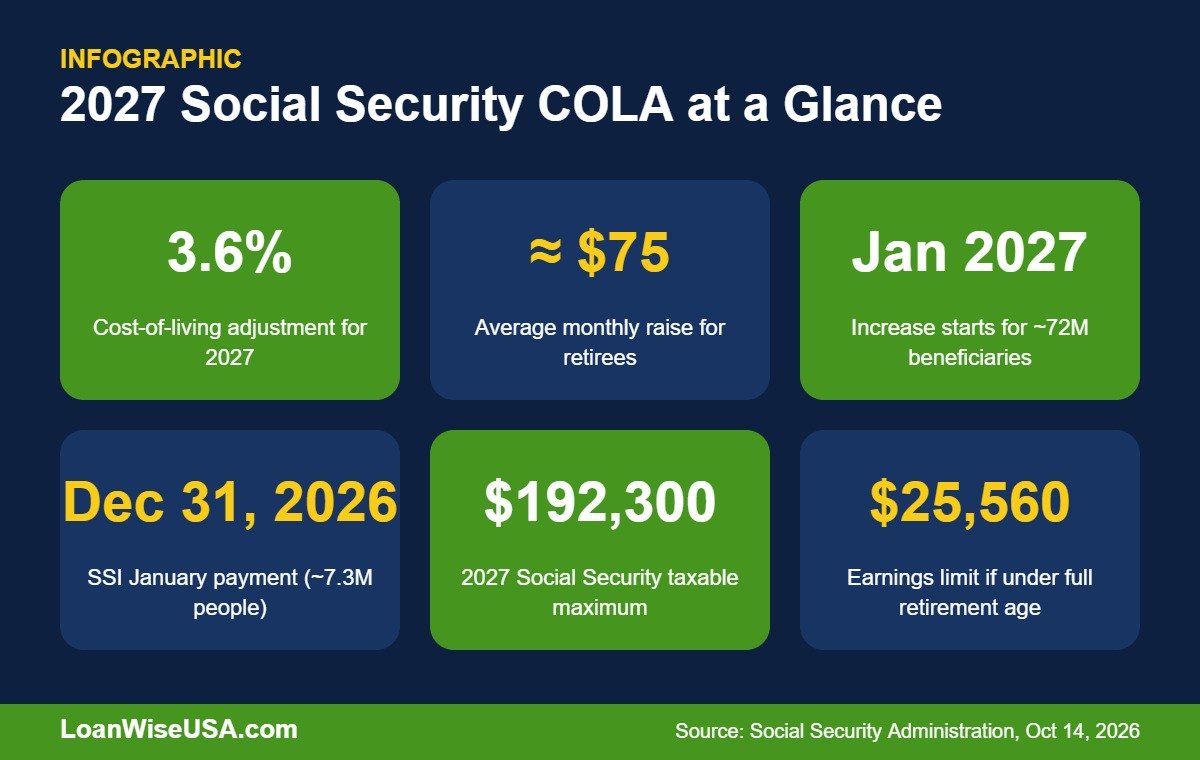
Quick answer: Social Security benefits will rise 3.6% in 2027. The Social Security Administration (SSA) announced the cost-of-living adjustment (COLA) on October 14, 2026. About 72 million Social Security beneficiaries will see the increase starting with their January 2027 payment. About 7.3 million Supplemental Security Income (SSI) recipients get it a little earlier, on December 31, 2026. SSA says the average retirement benefit will go up by about $75 a month. You don’t need to apply or sign up for it, because the raise is automatic.
Below we explain what the 3.6% increase means for your monthly check, when the new amounts arrive, which other numbers change in 2027, and the scam that is already circulating around this year’s raise.
How big is the 2027 Social Security COLA?
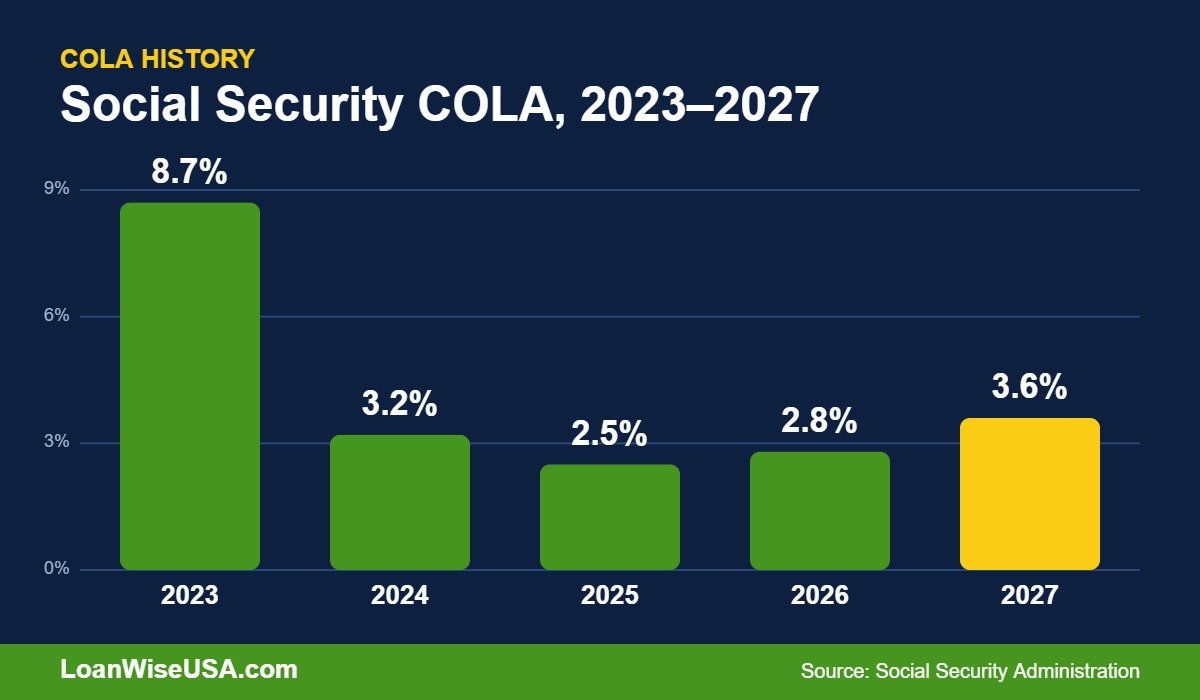
The 2027 COLA is 3.6%. It is the largest annual increase since the 3.2% raise for 2024, and it’s well above the last two years:
- 2027: 3.6%
- 2026: 2.8%
- 2025: 2.5%
- 2024: 3.2%
- 2023: 8.7% (the post-pandemic inflation spike)
According to SSA, the COLA applies to about 76 million Americans in total, including both Social Security and SSI. The Committee for a Responsible Federal Budget estimates that the 3.6% raise adds roughly $900 a year to the average retiree’s benefits.
How is the COLA calculated?
The Social Security Act sets the formula. SSA compares the average Consumer Price Index for Urban Wage Earners and Clerical Workers (CPI-W) for the third quarter (July, August and September) with the same quarter a year earlier. The percentage increase becomes the next year’s COLA. The Bureau of Labor Statistics publishes the CPI-W.
Retiree advocates have long pointed out that the CPI-W tracks spending by working households, not retirees. Older Americans tend to spend more of their budget on healthcare and housing, which can rise faster than overall inflation. So a 3.6% COLA may not fully match what your own costs have done. For the wider picture on inflation and interest rates, see what’s really moving markets in 2026.
How much will your check go up? Quick examples
To estimate your raise, multiply your current monthly benefit (before Medicare deductions) by 0.036. Here are some rough examples:
| Current monthly benefit | Approximate increase (3.6%) | Approximate new benefit |
|---|---|---|
| $1,200 | +$43 | $1,243 |
| $1,500 | +$54 | $1,554 |
| $2,000 | +$72 | $2,072 |
| $2,500 | +$90 | $2,590 |
| $3,000 | +$108 | $3,108 |
These are estimates. SSA calculates your exact new amount and lists it in your COLA notice. The amount that actually reaches your bank account also depends on what’s deducted, such as Medicare premiums or tax withholding. If you collect on a husband’s or wife’s record, the COLA applies to that check too; our guide to how Social Security spousal benefits work explains how that amount is set.
When will the higher payments arrive?
Social Security beneficiaries
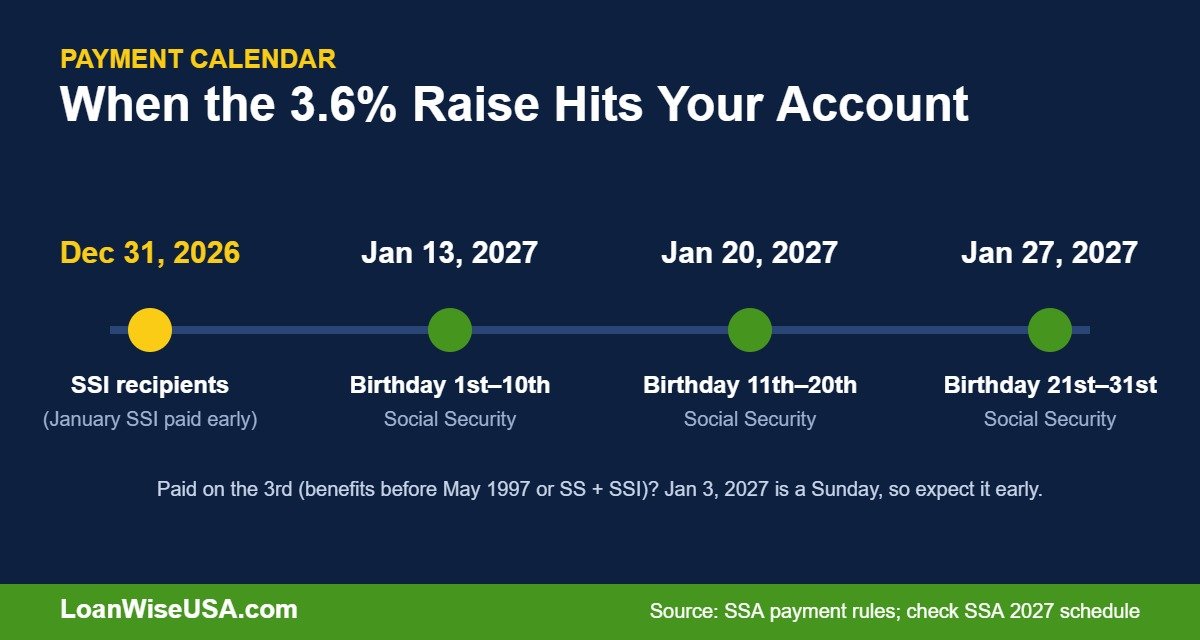
The 3.6% increase starts with benefits paid in January 2027. Most people are paid on a Wednesday that depends on their birth date:
- Birthday on the 1st–10th: second Wednesday, January 13, 2027
- Birthday on the 11th–20th: third Wednesday, January 20, 2027
- Birthday on the 21st–31st: fourth Wednesday, January 27, 2027
People who started benefits before May 1997, or who get both Social Security and SSI, are normally paid on the 3rd of the month. In January 2027 the 3rd falls on a Sunday and January 1 is a federal holiday, so those payments are expected to arrive early. Check SSA’s official 2027 payment calendar to confirm your date.
SSI recipients
SSI payments are normally made on the 1st of the month. Because January 1, 2027 is New Year’s Day, the January payment, which includes the 3.6% increase, goes out on December 31, 2026. That isn’t an extra payment. It’s your January check arriving early, so budget for it accordingly. If money gets tight before February, think twice before covering the gap with buy now, pay later. Here’s why BNPL debt is getting riskier.
Other Social Security numbers changing in 2027
Every year SSA also adjusts several wage-based limits. These matter if you’re still working:
| Item | 2026 | 2027 |
|---|---|---|
| Maximum earnings subject to Social Security tax | $184,500 | $192,300 |
| Earnings limit if you are under full retirement age all year | $24,480 | $25,560 |
| Earnings limit in the year you reach full retirement age | $65,160 | $67,920 |
What the earnings limits mean
If you claim Social Security before full retirement age and keep working, SSA temporarily withholds $1 for every $2 you earn above $25,560 in 2027. In the calendar year you reach full retirement age, the limit is much higher, at $67,920. SSA withholds $1 for every $3 above it, and only counts earnings before the month you reach full retirement age. From that month on, there’s no earnings limit at all.
Withheld benefits aren’t lost for good. Once you reach full retirement age, SSA recalculates your monthly benefit to credit the months it withheld.
Higher earners will pay a bit more payroll tax
The maximum earnings subject to the 6.2% Social Security tax rises to $192,300. If you earn more than $184,500, the extra $7,800 of wages now subject to the tax means up to about $484 more Social Security tax for an employee in 2027. Self-employed workers, who pay both halves at 12.4%, could owe up to about $967 more. High earners should also read our breakdown of Trump Accounts and the new payroll tax rules.
Will Medicare premiums eat into the raise?
For many retirees, the biggest unknown is Medicare Part B. If your Part B premium is deducted from your Social Security check, a premium increase reduces how much of the 3.6% COLA you actually see.
The standard Part B premium for 2026 is $202.90 a month. The Centers for Medicare & Medicaid Services (CMS) usually announces the next year’s premium in the fall. At the time of writing, SSA says to look for 2027 Medicare information on Medicare.gov. Your COLA notice will show your new gross benefit, any Medicare deductions and your net payment.
The “hold harmless” rule: for most people who have Part B taken out of their Social Security check, federal law says the premium increase can’t push their net benefit below the previous year’s amount. People with higher incomes who pay IRMAA surcharges, and people newly enrolled in Medicare, aren’t protected by this rule.
How to see your exact 2027 benefit amount
- Online (fastest): SSA says COLA notices will appear in the Message Center of your my Social Security account starting in late November 2026. You can turn on text or email alerts so you know when it arrives.
- Deadline to see it online: if you don’t have an account yet, SSA says you needed to create one by November 18, 2026 to view the COLA notice online this year.
- By mail: if you haven’t opted out of paper notices, your COLA letter will be mailed in December 2026.
Scam alert: nobody can “activate” your COLA
Within a week of the announcement, the SSA Office of the Inspector General (OIG) warned that criminals are using the 2027 COLA to target beneficiaries. According to the OIG, scammers:
- Contact people by phone, text, email, social media or mail while pretending to be from Social Security or another agency
- Claim they can increase your payment or “activate” your 2027 COLA
- Ask for a fee, ask you to change your direct deposit details, or ask for personal and bank information
- Send links to fake government-looking websites or ask you to download software
- Use real employees’ names, fake documents or your personal details to sound believable
The key fact: the COLA is automatic. You don’t need to register, apply, pay anything or “activate” it. Anyone who says otherwise is running a scam.
How to protect yourself: hang up and contact SSA directly using contact details you find yourself on an official .gov site. Never pay with gift cards, wire transfers or crypto. Set up your own my Social Security account so nobody else can open one in your name. Report suspected scams at oig.ssa.gov or call the SSA OIG fraud hotline at 1-800-269-0271.
Have defaulted federal student loans? Watch your benefit
Federal law lets the government collect defaulted federal student loans by withholding part of your Social Security benefit through the Treasury Offset Program: up to 15%, while the first $750 a month is protected. Collections on defaulted loans restarted in 2025, and the Education Department has changed its approach to benefit offsets since then, so check the current rules on StudentAid.gov. If you’re in default, getting back on track now can protect your higher 2027 check. Read our guide: Student loan defaults are back: what borrowers need to know now.
What to do now: a 5-step checklist
- Estimate your raise by multiplying your current benefit by 0.036.
- Watch for your COLA notice in my Social Security from late November, or in the mail in December.
- Check for a Medicare change once CMS announces the 2027 Part B premium.
- Review your tax withholding. A higher benefit can push more of it into taxable income. If you have federal tax withheld from your benefits, Form W-4V lets you change it.
- If you’re working and claiming early, compare your expected 2027 earnings with the new $25,560 or $67,920 limits.
Frequently asked questions
What is the Social Security COLA for 2027?
3.6%, announced by the Social Security Administration on October 14, 2026.
When does the 2027 COLA start?
For Social Security beneficiaries, with payments in January 2027. For SSI recipients, with the payment dated December 31, 2026.
How much will the average retiree get?
SSA estimates the average retirement benefit will rise by about $75 a month.
Do I need to apply for the COLA?
No. The increase is applied automatically. Anyone asking you to pay or register to receive it is running a scam.
Is the 2027 COLA bigger than 2026’s?
Yes. It’s 3.6%, compared with 2.8% for 2026 and 2.5% for 2025.
Where can I find my new benefit amount?
Your COLA notice shows it. You’ll find the notice in your my Social Security Message Center from late November, or it will be mailed to you in December 2026.
Share this infographic
You’re welcome to share the “2027 Social Security COLA at a glance” infographic on your website, newsletter or community page. Just copy the code below so readers can find the full explanation:
<a href="https://loanwiseusa.com/social-security-cola-2027/"><img src="https://loanwiseusa.com/wp-content/uploads/2026/10/social-security-cola-2027-at-a-glance.jpg" alt="2027 Social Security COLA at a glance infographic" width="1200" /></a><br />Source: <a href="https://loanwiseusa.com/social-security-cola-2027/">LoanWiseUSA – 2027 Social Security COLA explained</a>Married, divorced or widowed? Your COLA can also raise a benefit you claim on a spouse’s record. See how Social Security spousal benefits work to check who qualifies.
Related reading on LoanWiseUSA
- Trump Accounts and new payroll tax rules: what high earners should know
- Student loan defaults are back: what borrowers need to know now
- The BNPL debt trap: why more Americans are getting stuck
- World financial markets in 2026: what’s really moving stocks, bonds and currencies
Sources
- Social Security Administration – Cost-of-Living Adjustment (COLA) Information
- SSA Blog – Social Security Announces 3.6 Percent Benefit Increase for 2027
- SSA Office of the Inspector General – 2027 COLA scam alert
- Fox Business – Social Security announces 3.6% COLA for 2027
Disclaimer: This article is general information, not financial, tax or legal advice. Benefit amounts and rules can change. For details about your own situation, check with the Social Security Administration or a qualified professional.



[…] Social Security checks, so they decide how much of your raise you actually keep. Our guide to the 2027 Social Security COLA of 3.6% and what changes in your check walks through that […]
[…] before Medicare age and live on savings or part-time income should run the numbers carefully. Our guide to the 2027 Social Security COLA explains how benefit income changes in […]
[…] cost-of-living adjustments. Each year’s COLA (3.6% for 2027) is applied on top of these amounts once you are receiving […]