

SAVE Plan Is Ending: Your Deadline, RAP vs. IBR Payments and What Happens If You Do Nothing

Quick answer: The SAVE plan is over, and borrowers who were parked in SAVE forbearance must pick a new repayment plan. The first wave of borrowers, notified around July 1, 2026, reached the end of their 90-day window plus a 30-day “final notice” extension on Oct. 29, 2026; later waves have later dates printed on their own notices. If you don’t choose, your servicer moves you to a Standard or Tiered Standard plan, which can mean a much bigger fixed bill. For most low- and middle-income borrowers, the realistic choice is between the new Repayment Assistance Plan (RAP) and Income-Based Repayment (IBR), and the cheaper one depends on your income, family size and when you first borrowed.
This guide walks through the dates, the payment formulas and three worked dollar examples so you can make the call in one sitting. It is general information, not financial advice.
Why is the SAVE plan ending?
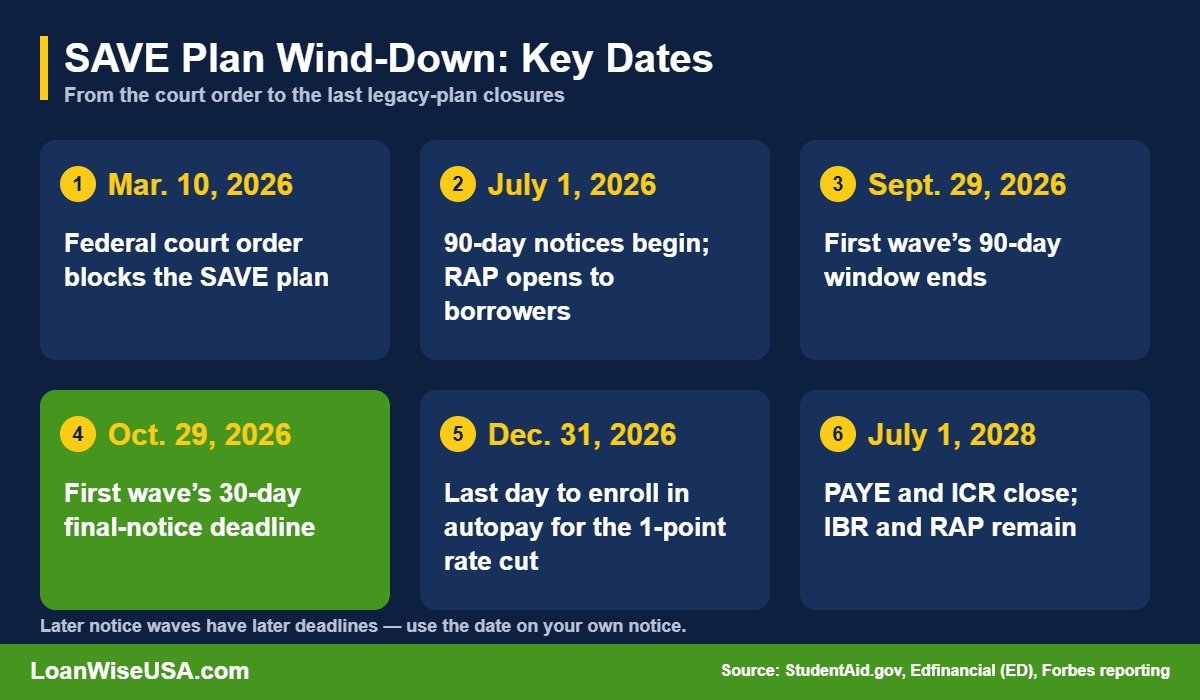
On March 10, 2026, a federal court issued an order preventing the U.S. Department of Education (ED) from implementing the SAVE plan, according to StudentAid.gov. The ruling also struck down SAVE’s payment formula, its interest subsidy and its discharges. ED says borrowers whose loans are in forbearance because they enrolled in or applied for SAVE “must select a new repayment plan and begin repaying their loans.”
That forbearance was not free. Interest has been accruing on SAVE loans since August 2025, and forbearance months generally don’t count toward IDR forgiveness, so every month you stay parked is a month of growing balance and no progress.
When is my deadline?
Starting July 1, 2026, servicers began sending SAVE borrowers notices giving them 90 days to choose another plan. Notices are going out in waves, so your date is the one on your own notice, not a neighbor’s or a headline’s.
- First wave (notified about July 1): the 90-day window ended Sept. 29, 2026. ED then sent a “final notice” adding 30 days, which put the effective deadline at Oct. 29, 2026, as Forbes reported.
- Later waves: 90 days from your notice date, plus any final-notice extension ED sends. ED has not announced a blanket extension for everyone.
- Not notified yet? You don’t have to wait. You can apply for a different plan now.
What happens if I miss the deadline?
Your servicer will move you into a fixed-payment plan:
- If none of your loans were disbursed on or after July 1, 2026: the traditional 10-year Standard plan (or a longer standard schedule for consolidation loans).
- If you have any loan disbursed on or after July 1, 2026, including a new consolidation: the new Tiered Standard plan, which is not a qualifying plan for Public Service Loan Forgiveness (PSLF).
Missing the date is not the end of the road. You can still apply for an income-driven plan afterward, and servicers must notify you at least 21 days before the first payment under a new plan is due. If your IDR application is still being processed when a bill arrives, you can ask your servicer for a processing forbearance. If you’re on autopay, check your next withdrawal amount so a higher Standard payment doesn’t surprise your checking account.
How long is the Tiered Standard plan?
| Total Direct Loan principal when you enter the plan | Maximum repayment term |
|---|---|
| Under $25,000 | 10 years |
| $25,000 to under $50,000 | 15 years |
| $50,000 to under $100,000 | 20 years |
| $100,000 or more | 25 years |
Source: Edfinancial Services (an ED loan servicer) on StudentAid.gov and Mass.gov.
How does the new Repayment Assistance Plan (RAP) work?
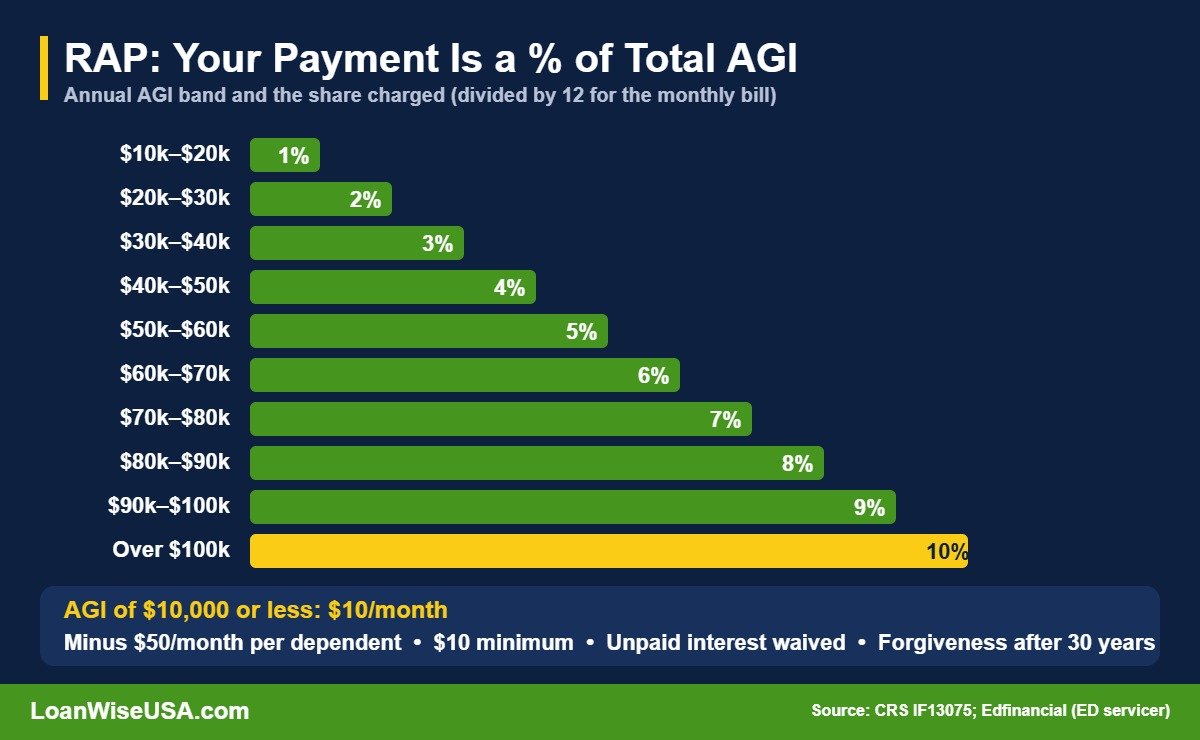
RAP was created by the July 2025 reconciliation law and became available to Direct Loan borrowers on July 1, 2026. Instead of using “discretionary income,” it charges a percentage of your total adjusted gross income (AGI):
| Annual AGI | RAP payment (% of AGI, divided by 12) |
|---|---|
| $10,000 or less | $10 per month |
| $10,001 to $20,000 | 1% |
| $20,001 to $30,000 | 2% |
| $30,001 to $40,000 | 3% |
| $40,001 to $50,000 | 4% |
| $50,001 to $60,000 | 5% |
| $60,001 to $70,000 | 6% |
| $70,001 to $80,000 | 7% |
| $80,001 to $90,000 | 8% |
| $90,001 to $100,000 | 9% |
| Over $100,000 | 10% |
Other RAP rules that matter:
- $50 off per dependent claimed on your tax return, but the payment never drops below $10 a month.
- Unpaid interest is waived each month you make your full, on-time payment, so your balance can’t balloon.
- Principal help: if your payment covers less than $50 of principal, ED reduces principal so it falls by up to $50 that month.
- Forgiveness after 30 years (360 qualifying payments), versus 20 or 25 years under IBR. RAP payments do count toward PSLF.
- Spousal income counts only if you file a joint tax return.
- Parent PLUS loans and consolidation loans that include Parent PLUS loans are not eligible.
How does IBR compare?
Income-Based Repayment is the legacy plan that survives long term. Your payment is a share of discretionary income, which is AGI minus 150% of the federal poverty guideline for your family size:
- 10% of discretionary income with forgiveness after 20 years if you were a new borrower on or after July 1, 2014.
- 15% with forgiveness after 25 years if you borrowed before then.
- Payments are never more than the 10-year Standard amount.
- The 2025 law removed the old “partial financial hardship” test, so higher earners can now enroll, per ED’s guidance to schools and servicers.
For 2026, the poverty guideline in the 48 contiguous states and D.C. is $15,960 for one person, $21,640 for two, $27,320 for three and $33,000 for four. That makes the IBR income exemption $23,940 for a single borrower and $40,980 for a family of three.
PAYE and ICR are still open to borrowers who have no loans disbursed after June 30, 2026, but both close permanently on July 1, 2028.
RAP vs. IBR vs. Standard: worked dollar examples
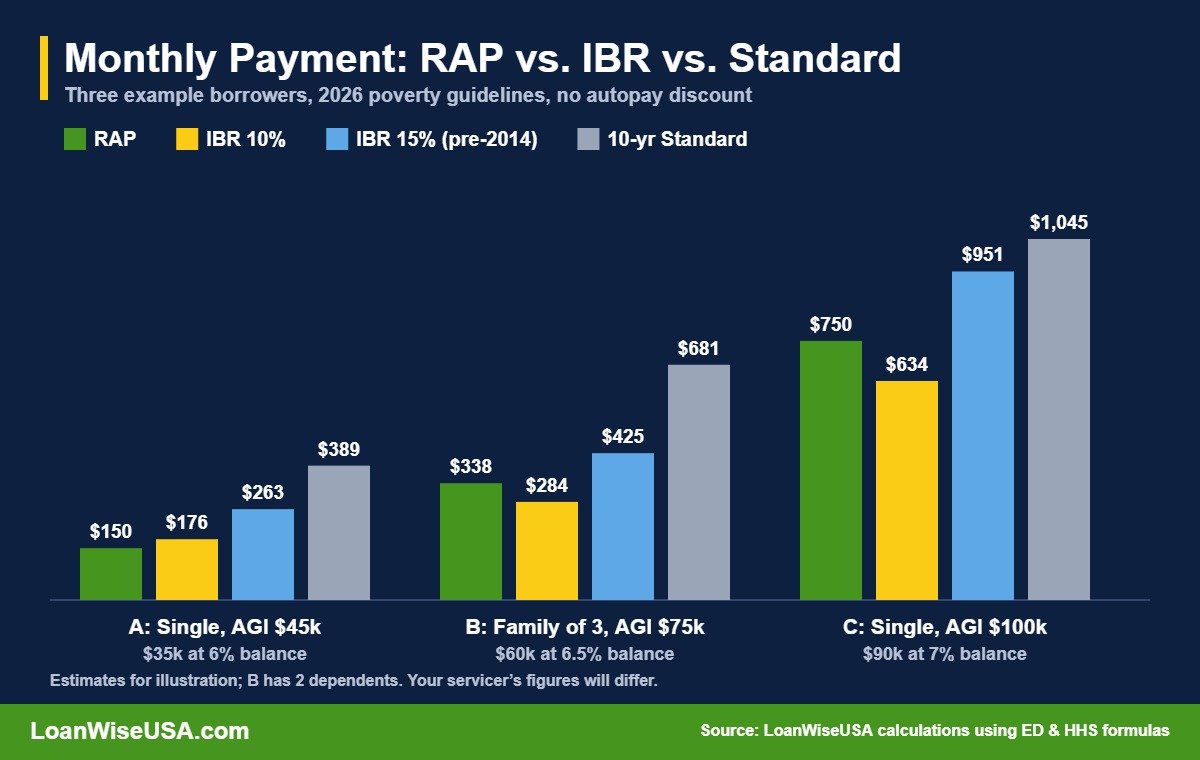
These examples use 2026 poverty guidelines, assume no autopay discount, and assume the borrower has no loans disbursed after June 30, 2026. They are estimates for illustration; your servicer’s figures will differ.
| Borrower | RAP | IBR (10%) | IBR (15%, pre-2014) | 10-year Standard |
|---|---|---|---|---|
| A: single, AGI $45,000, $35,000 at 6% | $150 | $176 | $263 | $389 |
| B: family of 3 (2 kids), AGI $75,000, $60,000 at 6.5% | $338 | $284 | $425 | $681 |
| C: single, AGI $100,000, $90,000 at 7% | $750 | $634 | $951 | $1,045 |
Example A: lower income, single
RAP: 4% of $45,000 is $1,800 a year, or $150 a month. IBR at 10%: $45,000 minus $23,940 leaves $21,060 of discretionary income; 10% of that is $175.50 a month. Monthly interest on $35,000 at 6% is about $175, so under RAP the $25 of interest the payment doesn’t cover is waived and ED’s principal help still knocks the balance down by about $50. Here RAP wins on both the monthly bill and balance growth.
Example B: middle income with kids
RAP: 7% of $75,000 is $437.50 a month, minus $100 for two dependents, or $337.50. IBR at 10%: $75,000 minus $40,980 leaves $34,020; 10% is $283.50. A newer borrower saves about $54 a month on IBR and reaches forgiveness after 20 years instead of 30. A pre-2014 borrower on 15% IBR would pay $425.25, so RAP is cheaper for them.
Example C: higher income
RAP: an AGI of exactly $100,000 falls in the 9% band, so the payment is $750. One more dollar of income moves it to 10%, or $833, which is the “cliff” critics point to. IBR at 10% is $633.83. For a pre-2014 borrower, IBR at 15% is $950.75, still below the $1,045 Standard payment.
Which plan should I choose?
- Working toward PSLF? Get into any qualifying IDR plan fast. Both RAP and IBR count; Tiered Standard doesn’t. Pick whichever has the lower payment, since the remaining balance is forgiven after 120 qualifying payments either way.
- Low income or large family? RAP’s $50-per-dependent credit, $10 minimum and interest waiver often make it the cheapest month to month.
- New borrower since 2014 with moderate-to-high income? IBR at 10% is often cheaper and forgives after 20 years, not 30.
- Pre-2014 borrower? Compare IBR at 15% with RAP carefully; RAP frequently comes out lower.
- Can pay it off within about 10 years? A Standard plan, or refinancing with a private lender, may cost less in total interest. Refinancing federal loans permanently gives up IDR and PSLF, so weigh that first.
One trap to avoid: as Forbes has reported, years spent on RAP may not carry over if you later switch to IBR, which could restart your forgiveness clock. Make the long-term choice now if you can.
Checklist: what to do this week
- Find your notice (email, servicer inbox or paper mail) and write down your deadline.
- Log in to StudentAid.gov and confirm your loan types and first-disbursement dates.
- Run your numbers in the Loan Simulator or with the formulas above.
- Apply for your chosen plan on StudentAid.gov and give consent to import tax data so future recertifications are automatic.
- Ask your servicer for a processing forbearance if a bill arrives before your application is processed.
- Check autopay. ED’s autopay discount is 1 percentage point on eligible Direct Loans disbursed on or after July 1, 2012, through June 30, 2028, and the enrollment deadline is Dec. 31, 2026.
- Keep screenshots of every submission and confirmation number.
If you’re already behind, read our guide on what happens when student loans go into default, because default can lead to seized tax refunds and wages. And with the Fed holding rates at 3.75% to 4%, a credit card won’t be a cheap stopgap for a higher loan bill.
FAQ
Is the SAVE deadline Oct. 29 for everyone?
No. Oct. 29, 2026, was the effective deadline for the first wave notified around July 1, including the 30-day final notice. Later waves have later dates. Use the date on your own notice.
Will I lose credit toward forgiveness if I’m moved to a Standard plan?
Payments under the 10-year Standard plan can count toward PSLF, but Tiered Standard payments don’t, and Standard payments generally don’t count toward IDR forgiveness. Switching back to an IDR plan quickly limits the damage.
Can Parent PLUS borrowers use RAP?
No. Parent PLUS loans, and consolidation loans that include them, are not eligible for RAP.
Is forgiven debt taxable?
Forgiveness under IDR plans may be taxable as income for federal tax purposes; PSLF forgiveness is not. Check with a tax professional before your forgiveness date.
Does my spouse’s income count?
Under RAP, your spouse’s income counts only if you file a joint tax return. Filing separately can lower your payment but may raise your tax bill, so run both numbers.
Disclaimer: This article is general information, not financial, tax or legal advice. Student loan rules are changing quickly; confirm your options with your loan servicer or StudentAid.gov before you act.
Share this infographic
Writing about the end of the SAVE plan? You are welcome to republish our RAP vs. IBR vs. Standard payment comparison on your site. Copy the code below to embed it with a credit link back to this article.
<a href="https://loanwiseusa.com/save-plan-ending-rap-vs-ibr/"><img src="https://loanwiseusa.com/wp-content/uploads/2026/10/rap-vs-ibr-vs-standard-payments.jpg" alt="RAP vs. IBR vs. Standard monthly student loan payments for three example borrowers" width="1200" /></a><br />Source: <a href="https://loanwiseusa.com/save-plan-ending-rap-vs-ibr/">LoanWiseUSA – SAVE Plan Is Ending: Your Deadline, RAP vs. IBR Payments and What Happens If You Do Nothing</a>Already fallen behind long enough to be in default? Different rules apply there, so read our guide on how to stop student loan wage garnishment before collections reach your paycheck or tax refund.
Related reading on LoanWiseUSA
- Student Loan Defaults Are Back: What Borrowers Need to Know Now
- Best Time to Refinance Student Loans Before Year-End 2026
- Fed Holds Rates at 3.75%–4%: What It Means for Your Mortgage, Credit Cards and Savings
- BNPL Debt Trap: Why Buy Now, Pay Later Is Getting Riskier
Sources
- Federal Student Aid: IDR Plan Court Actions: Impact on Borrowers (updated Sept. 29, 2026)
- Edfinancial Services (ED servicer): RAP, IBR and Tiered Standard plan terms
- U.S. Department of Education, Dear Colleague Letter GEN-25-04
- Congressional Research Service: The Repayment Assistance Plan (RAP) in P.L. 119-21
- HHS: Annual Update of the Poverty Guidelines, Federal Register, Jan. 15, 2026
- Mass.gov: The New Tiered Standard Plan
- Forbes: “Final” Deadline for Student Loans Hits Some Borrowers This Week (Oct. 28, 2026)



[…] This is different from the SAVE plan wind-down, which affects borrowers who are not in default. If you’re still current on your loans but were on SAVE, see our guide on the SAVE plan ending and RAP vs. IBR payments. […]