

Debt Avalanche vs. Snowball: Which Payoff Method Saves More (With Real Numbers)
Quick answer: The debt avalanche (pay the highest interest rate first) always costs the same or less in interest than the debt snowball (pay the smallest balance first). In our $24,500 example below, the avalanche saves $539 and both methods finish in 31 months. The snowball can still be the better choice if quick wins are what keep you paying. Either way, the biggest lever is the extra amount you pay each month, not the order.
Credit card debt is expensive right now. Banks charged an average 22.36% APR on card accounts that paid interest in August 2026, according to the Federal Reserve’s G.19 consumer credit release, and Americans carried $1.26 trillion in card balances at the end of June 2026, per the New York Fed. With rates like that, picking a payoff order and sticking to it matters. This guide walks through both methods with real math, shows when each one wins and gives you a step-by-step plan.
What is the debt avalanche method?
With the debt avalanche, you list your debts from the highest interest rate to the lowest. You pay the minimum on everything, then put every extra dollar toward the debt with the highest APR. When that debt is gone, you roll its full payment (minimum plus extra) into the next-highest rate.
Because you are always attacking the most expensive balance, less of your money goes to interest. That is why the avalanche is the mathematically cheapest order when your monthly budget is fixed.
What is the debt snowball method?
With the debt snowball, you list your debts from the smallest balance to the largest, ignoring interest rates. You pay minimums on everything and throw your extra money at the smallest balance. Each time a debt is paid off, its payment “snowballs” into the next one.
The appeal is psychological: you close accounts sooner, which can make the plan feel like it is working. Research backs this up. A study by Kellogg School of Management professors David Gal and Blakeley McShane, published in the Journal of Marketing Research in 2012, looked at nearly 6,000 clients of a debt settlement firm and found that the number of accounts people closed predicted whether they finished the program better than the dollar amount they had paid off.
Debt avalanche vs. snowball: how do they compare?
| Feature | Debt avalanche | Debt snowball |
|---|---|---|
| Order | Highest APR first | Smallest balance first |
| Total interest | Lowest possible for a fixed budget | Same or higher |
| First payoff | Can take months if the high-rate debt is large | Usually fast |
| Best for | Disciplined payers, big rate gaps between debts | People who need early wins to stay motivated |
| Biggest risk | Losing steam before the first payoff | Paying more interest than necessary |
A worked example: $24,500 of debt, two payoff orders
Here is a sample household with four debts. The rates are illustrative, but they sit close to today’s averages: the Fed’s G.19 shows 22.36% for card accounts assessed interest and 11.90% for 24-month personal loans at commercial banks (August 2026).
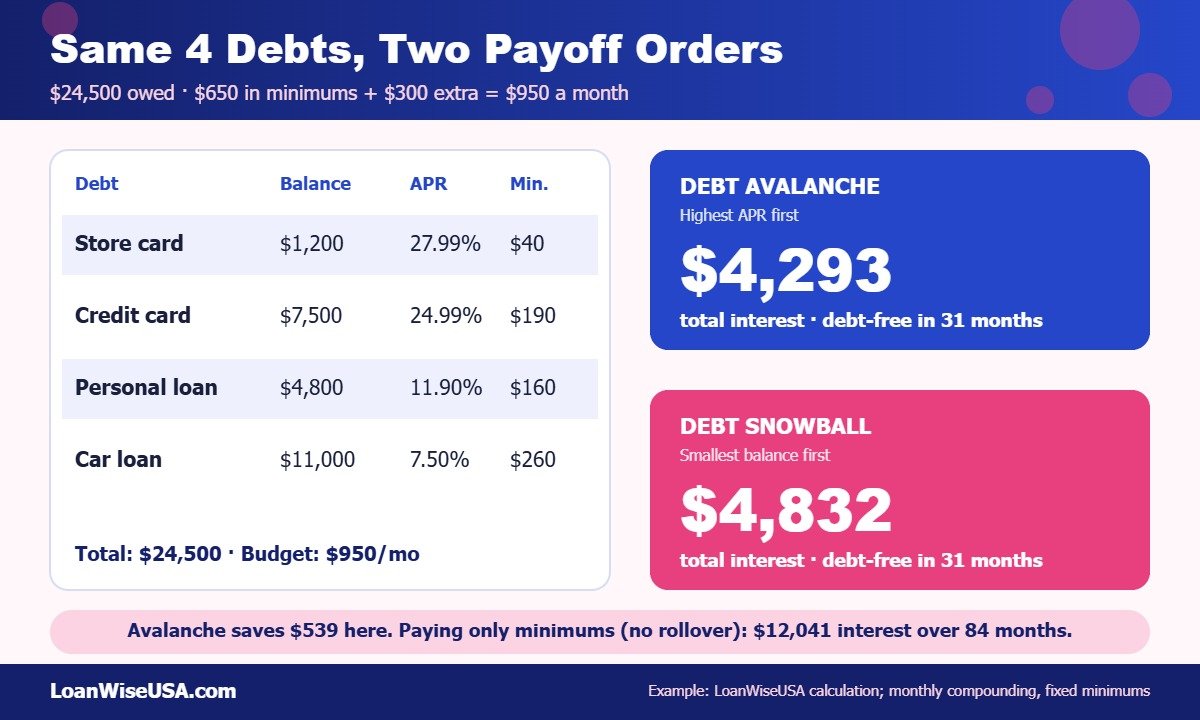
| Debt | Balance | APR | Minimum payment |
|---|---|---|---|
| Store card | $1,200 | 27.99% | $40 |
| Credit card | $7,500 | 24.99% | $190 |
| Personal loan | $4,800 | 11.90% | $160 |
| Car loan | $11,000 | 7.50% | $260 |
| Total | $24,500 | $650 |
The household pays a fixed $950 a month: $650 in minimums plus $300 extra. Interest compounds monthly, and each paid-off debt’s payment rolls into the next target. Here is what happens:
| Result | Avalanche | Snowball | Minimums only (no rollover) |
|---|---|---|---|
| Total interest paid | $4,293 | $4,832 | $12,041 |
| Months to debt-free | 31 | 31 | 84 |
| Payoff order | Store card, credit card, personal loan, car loan | Store card, personal loan, credit card, car loan | Each debt on its own schedule |
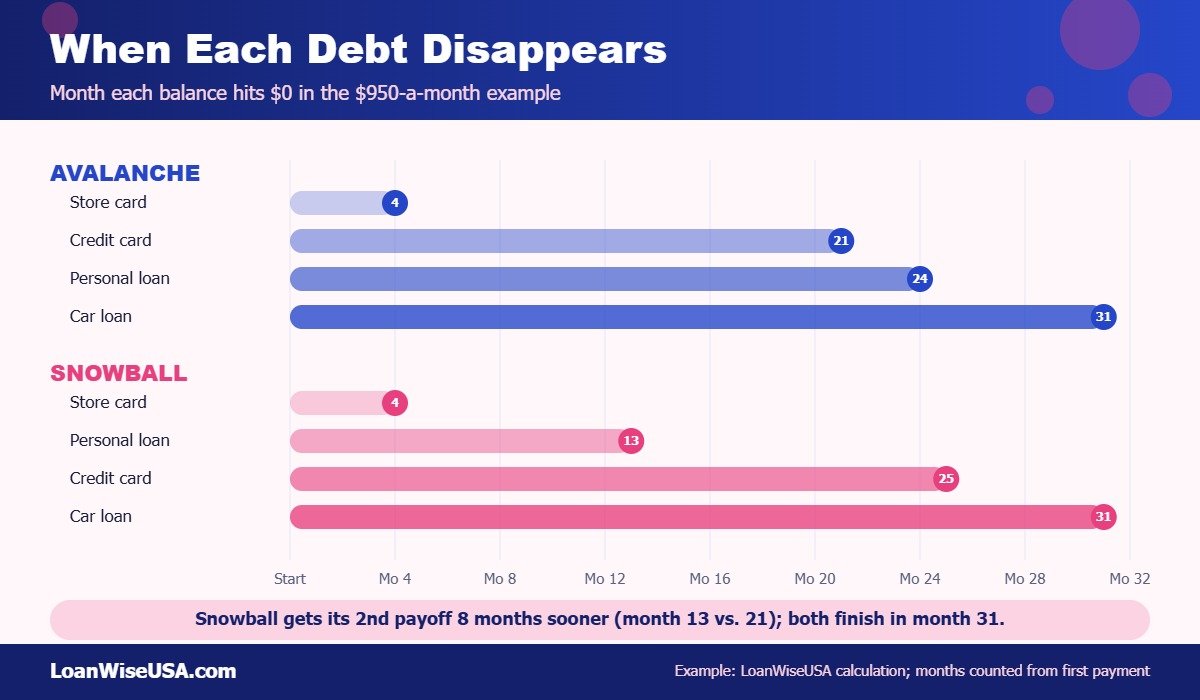
The avalanche saves $539 in this example. Both methods clear the store card in month 4, because it is both the smallest balance and the highest rate. After that they split: the snowball knocks out the personal loan in month 13, while the avalanche keeps grinding on the 24.99% credit card until month 21. The snowball gets its second win eight months sooner, but the card keeps charging interest the whole time.
When does the snowball cost almost nothing extra?
The gap between the two methods depends on how your balances and rates line up:
- Small balances with high rates: If your smallest debts also carry your highest APRs, both methods pick the same order and cost exactly the same.
- Similar rates: If all your debts are credit cards between 22% and 27%, the order barely changes the interest bill.
- Big rate gaps: If a large balance carries a much higher rate than a small one (for example, a $9,000 card at 29% and a $1,500 loan at 6%), the avalanche can save hundreds or thousands of dollars.
Does your extra payment matter more than the method?
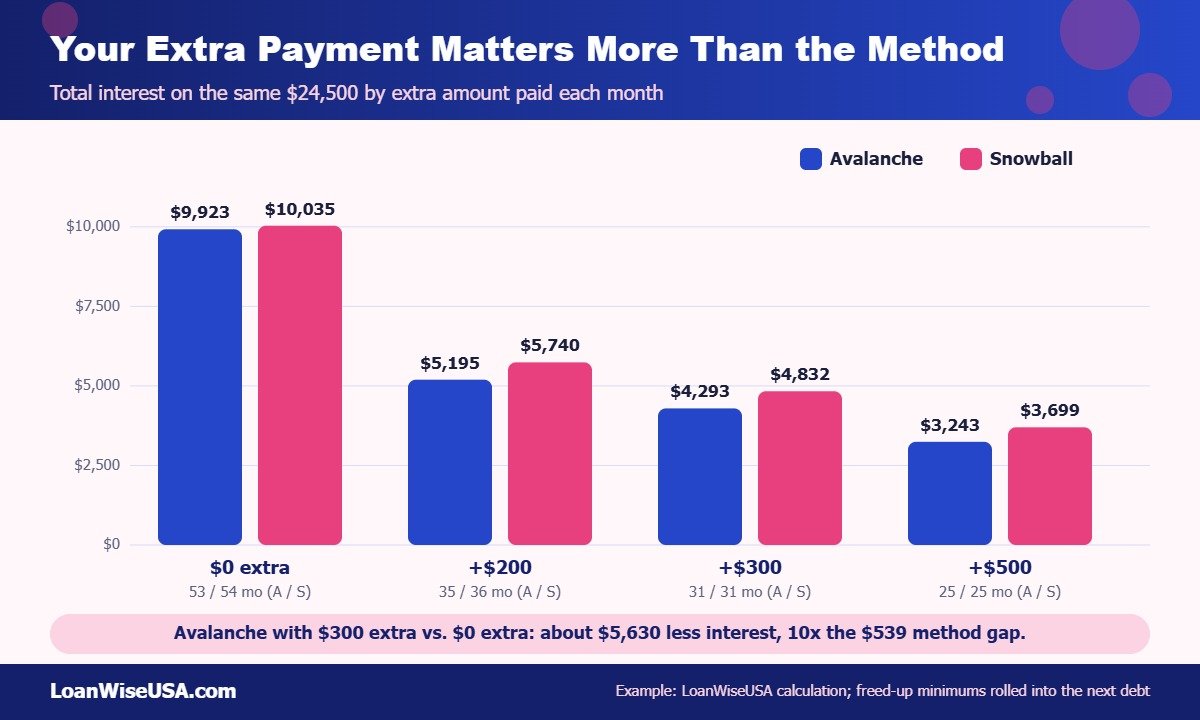
Usually, yes. We ran the same four debts with different extra payments. Going from $0 extra to $300 extra cuts avalanche interest by about $5,630, roughly ten times the $539 gap between the two methods.
| Extra per month | Avalanche interest | Snowball interest | Months (avalanche / snowball) |
|---|---|---|---|
| $0 (rollover only) | $9,923 | $10,035 | 53 / 54 |
| $200 | $5,195 | $5,740 | 35 / 36 |
| $300 | $4,293 | $4,832 | 31 / 31 |
| $500 | $3,243 | $3,699 | 25 / 25 |
Even with no extra money, simply rolling freed-up minimums into the next debt cuts the bill from $12,041 to about $10,000 and shaves more than two and a half years off the timeline compared with paying minimums only.
How to start a debt payoff plan, step by step
- List every debt. Write down each balance, APR and minimum payment. Your statements and your credit reports show them. If something on your report looks wrong, dispute the credit report error before you build the plan around it.
- Set a fixed monthly payoff budget. Add up your minimums, then decide how much extra you can pay every month without missing rent, utilities or groceries.
- Keep a small cushion. A few hundred dollars in savings can stop a car repair from landing on a credit card and undoing months of progress.
- Pick your order. Sort by APR for the avalanche or by balance for the snowball. Write the order down.
- Automate the minimums. Set autopay for at least the minimum on every account so you never pay late fees.
- Send the extra to one target. Make one extra payment each month to the debt at the top of your list.
- Roll the payment forward. When a debt hits $0, add its whole payment to the next debt. Do not let that money drift back into your spending.
- Check in monthly. Update balances, and re-sort if a promotional rate ends or a new rate kicks in.
Can a hybrid approach work?
Yes. Many people start with a snowball move by paying off one or two tiny balances for a quick win, then switch to the avalanche for everything else. Others pick the avalanche but break a large high-rate balance into milestones (for example, every $1,000 paid) so progress feels visible. A plan you finish beats a “perfect” plan you abandon.
Should you consolidate or transfer balances instead?
A lower rate can help either method. A personal loan that replaces card debt can cut your rate in half if you qualify: compare the Fed’s 11.90% average for 24-month personal loans with 22.36% on cards that charge interest. A 0% balance transfer card can also pause interest for a set period, but read the terms for the transfer fee and the rate after the promotion ends.
Consolidation only works if you stop adding new debt. Moving balances and then running the cards back up leaves you worse off. Be especially careful with a HELOC or home equity loan, because it turns card debt into debt backed by your house; see our HELOC vs. home equity loan guide for the trade-offs. The same goes for pay-later plans; see our look at the buy now, pay later debt trap.
If you are behind on payments or can’t cover your minimums, a nonprofit credit counselor may help. The CFPB says credit counselors can help you build a budget and may set up a debt management plan, which typically lowers monthly payments and interest charges. Be cautious with for-profit debt settlement: the FTC warns that some debt relief companies charge high fees and that missed payments can hurt your credit.
Common mistakes to avoid
- Skipping minimums on lower-priority debts. Late payments bring fees, penalty rates and credit damage. Every debt gets its minimum, every month.
- Forgetting to roll payments forward. The rollover is what makes both methods work. Without it, you are just paying minimums.
- Ignoring rate changes. When a 0% promotion ends or a variable rate rises, re-sort your avalanche list. Card rates track the prime rate, which moves with Fed decisions like the Fed’s October 2026 hold.
- Treating every debt the same. Federal student loans, tax debt and mortgages have their own relief options. For example, an IRS payment plan can stop tax debt from growing faster than you can pay it.
- Running up new balances. If you keep charging, no payoff order can keep up.
Frequently asked questions
Is the debt avalanche or snowball better?
The avalanche saves the most money for a fixed budget. The snowball is better if early payoffs keep you motivated enough to finish. If your smallest debts also have your highest rates, they are the same plan.
How much does the debt snowball cost compared with the avalanche?
It depends on your balances and rates. In our $24,500 example with $950 a month, the snowball cost $539 more in interest. With similar rates the gap can be near zero; with big rate differences it can run into the thousands.
Should I pay off a car loan or credit card first?
Under the avalanche, the credit card usually comes first because card APRs are typically much higher than auto loan rates. Under the snowball, whichever balance is smaller goes first. Keep paying the car loan’s minimum either way.
Do I include my mortgage or student loans?
Most people leave a mortgage out and focus on consumer debt. Federal student loans can be included, but check your repayment plan options first, since income-driven plans and default rules work differently. Our guide to student loan wage garnishment explains what happens if federal loans go into default.
Will paying off debt raise my credit score?
Lower card balances reduce your credit utilization, which can help your scores over time. Paying on time every month matters too. Closing paid-off card accounts can raise your utilization ratio, so think before you close them.
This article is general information, not financial advice. The worked examples use illustrative balances and rates; your results will depend on your own debts, terms and payments. Consider talking with a qualified professional or a nonprofit credit counselor about your situation.
Share this infographic
Want to help readers compare the two payoff methods? Copy the code below to embed our avalanche vs. snowball comparison on your site. Please keep the credit link to LoanWiseUSA.
<a href="https://loanwiseusa.com/debt-avalanche-vs-snowball/"><img src="https://loanwiseusa.com/wp-content/uploads/2026/11/debt-avalanche-vs-snowball-comparison-infographic.jpg" alt="Debt avalanche vs. snowball comparison infographic" width="1200" /></a><br />Source: <a href="https://loanwiseusa.com/debt-avalanche-vs-snowball/">LoanWiseUSA – Debt Avalanche vs. Snowball: Which Payoff Method Saves More (With Real Numbers)</a>Related reading on LoanWiseUSA
- How to Get a Personal Loan With Bad Credit: Options, Real Costs and a Step-by-Step Plan
- How to Dispute a Credit Report Error: Step-by-Step Guide, Letter Checklist and Timelines
- BNPL Debt Trap: Why Buy Now, Pay Later Is Getting Riskier
- How to Set Up an IRS Payment Plan: Fees, Interest and Step-by-Step Guide
Sources
- Federal Reserve, Consumer Credit G.19 (credit card and personal loan rates, August 2026)
- Federal Reserve Bank of New York, Household Debt and Credit Report, Q2 2026
- Kellogg Insight, “To Beat Debt, Consider Starting Small” (Gal & McShane, Journal of Marketing Research, 2012)
- Consumer Financial Protection Bureau, “What is credit counseling?”
- Federal Trade Commission, “How To Get Out of Debt”
- LoanWiseUSA calculations: monthly compounding, fixed minimum payments, extra payment applied after minimums, freed-up payments rolled to the next debt.


[…] you are using the loan to consolidate several debts, compare it with a plain payoff plan first; our debt avalanche vs. snowball guide runs the […]