
How PSLF Works: Who Qualifies, What Counts and How to Get Your Loans Forgiven
Quick answer: Public Service Loan Forgiveness (PSLF) wipes out the remaining balance on your federal Direct Loans after you make 120 qualifying monthly payments while working full time (an average of at least 30 hours a week) for a government agency, a 501(c)(3) nonprofit or another qualifying public service employer. The 120 payments don’t have to be consecutive, they must be made under a qualifying plan such as RAP, IBR or the 10-year Standard plan, and the forgiven amount is not counted as federal taxable income.
PSLF has been through a lot of headlines in 2025 and 2026: a new repayment plan, the end of SAVE, and a court fight over which employers qualify. The core deal hasn’t changed, though. This guide explains how PSLF works today, what counts toward your 120 payments, and the mistakes that cost borrowers years of progress.
What is Public Service Loan Forgiveness?
PSLF is a federal program created by Congress in 2007 to encourage people to work in public service. If you meet the rules, the Department of Education forgives the principal and interest that remain on your eligible loans once you’ve satisfied the last of your 120 required payments. Only payments made after October 1, 2007 can count.
Unlike the 20- to 30-year forgiveness built into income-driven plans, PSLF is designed to finish in about 10 years, and the forgiveness is excluded from federal income under the tax code (26 U.S.C. 108(f)(1)). Check your state’s rules too, but most borrowers owe nothing on it.
Who qualifies for PSLF?
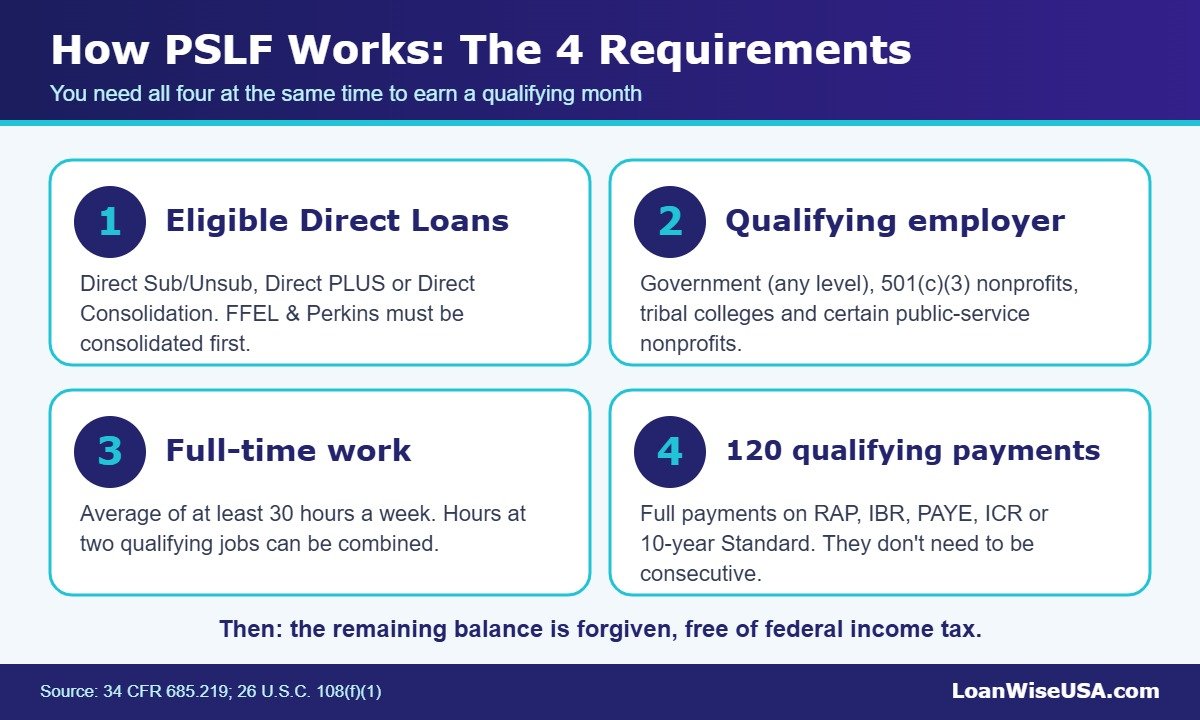
You need all four of these at the same time:
| Requirement | What it means | Common trap |
|---|---|---|
| Eligible loans | Direct Subsidized, Direct Unsubsidized, Direct PLUS or Direct Consolidation Loans | FFEL and Perkins loans don’t qualify until you consolidate them into a Direct Consolidation Loan |
| Qualifying employer | U.S. federal, state, local or tribal government (including the military), public child or family service agencies, 501(c)(3) nonprofits, tribal colleges, and certain other nonprofits that provide public services | For-profit companies, labor unions and partisan political groups don’t qualify, even if the work feels like public service |
| Full-time work | An average of at least 30 hours a week, which can be combined across more than one qualifying job | Part-time hours at a single employer that don’t reach 30 total |
| 120 qualifying payments | Full, on-time-enough payments under a qualifying repayment plan while employed full time by a qualifying employer | Payments on the wrong plan, or months spent in most forbearances |
You must also be working for a qualifying employer when you apply for and receive forgiveness, and your loans can’t be in default. If your loans are already in default, read our guide on what to do now that student loan defaults are back before anything else.
What counts as a qualifying employer?
Under the federal regulation (34 CFR 685.219), qualifying employers include government organizations at any level, 501(c)(3) tax-exempt organizations, public child or family service agencies and tribal colleges. Other nonprofits can qualify if most of their full-time staff work in areas such as emergency management, public safety, law enforcement, public interest law, early childhood education, public health, public education, library services or services for people with disabilities or the elderly. AmeriCorps and Peace Corps service also counts.
Your job title doesn’t matter. A janitor at a public school and a surgeon at a nonprofit hospital both qualify, because the test is who employs you, not what you do.
What happened to the new PSLF employer rule?
In October 2025 the Department of Education published a rule that would have let it disqualify employers it found had a “substantial illegal purpose,” starting July 1, 2026. On June 30, 2026, federal courts in Massachusetts and Washington, D.C. vacated that rule before it took effect. The government appealed in August, then dropped two of its three appeals on October 21, 2026; one appeal, brought by 22 states and D.C., was still pending at that date. For now, the rule is not in force and the long-standing employer categories above still apply.
How is full-time defined for teachers and adjuncts?
Teachers and professors on contracts of at least 8 months a year are treated as full time if they work at least 30 hours a week during the contract. For non-tenure-track faculty paid by the credit hour, each credit or contact hour taught per week is multiplied by at least 3.35, so a lecturer teaching 9 credit hours a week is credited with about 30 hours.
Which repayment plans count toward PSLF?
A payment counts only if it’s made under a qualifying repayment plan. Under the current regulation, those are:
- Repayment Assistance Plan (RAP), the new income-driven plan that launched July 1, 2026
- Income-Based Repayment (IBR) and the other income-driven plans that still exist (PAYE, and ICR for payments received on or before June 30, 2028)
- The 10-year Standard plan (or a consolidation Standard plan with a 10-year term)
- Any other plan whose monthly payment is at least what you’d pay on the 10-year Standard plan, except the alternative repayment plan
Borrowers moving off SAVE should pick RAP or IBR rather than letting their loans default to a plan that doesn’t help. Our breakdown of RAP vs. IBR payments for SAVE borrowers walks through that choice.
How much will I pay on RAP vs. IBR?
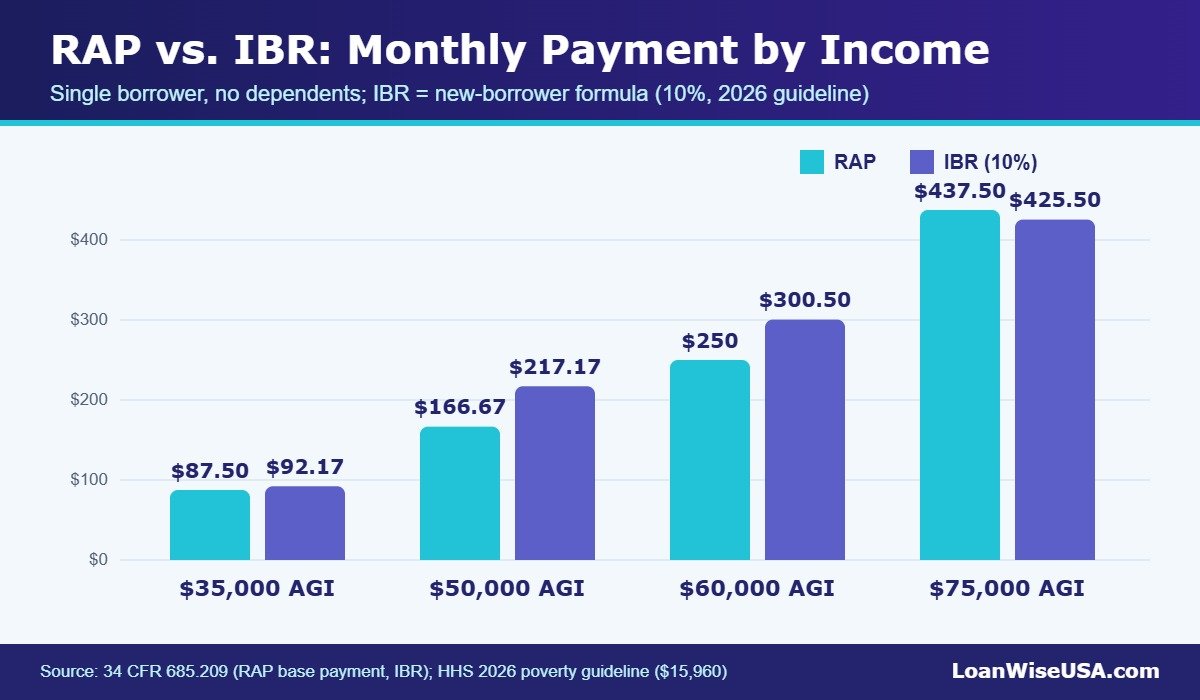
RAP charges a share of your entire adjusted gross income (AGI) based on its bracket: 1% of AGI from $10,001 to $20,000, rising one point per $10,000 of income, up to 10% above $100,000. The yearly amount is divided by 12, then reduced by $50 per month for each dependent. Borrowers with AGI of $10,000 or less pay $10 a month.
IBR charges 10% of discretionary income for “new” borrowers (no federal loan balance before July 1, 2014) or 15% for everyone else. Discretionary income is AGI minus 150% of the federal poverty guideline, which is $23,940 for a single person using the 2026 guideline of $15,960.
Here’s what that looks like for a single borrower with no dependents:
| AGI | RAP rate | RAP monthly | IBR monthly (new borrower, 10%) | Lower payment |
|---|---|---|---|---|
| $35,000 | 3% | $87.50 | $92.17 | RAP |
| $50,000 | 4% | $166.67 | $217.17 | RAP |
| $60,000 | 5% | $250.00 | $300.50 | RAP |
| $75,000 | 7% | $437.50 | $425.50 | IBR |
For PSLF, the lowest qualifying payment is usually the best one, because every dollar you don’t pay over 10 years is a dollar that gets forgiven instead. Have dependents? RAP’s $50-per-dependent credit can tilt the math further toward RAP.
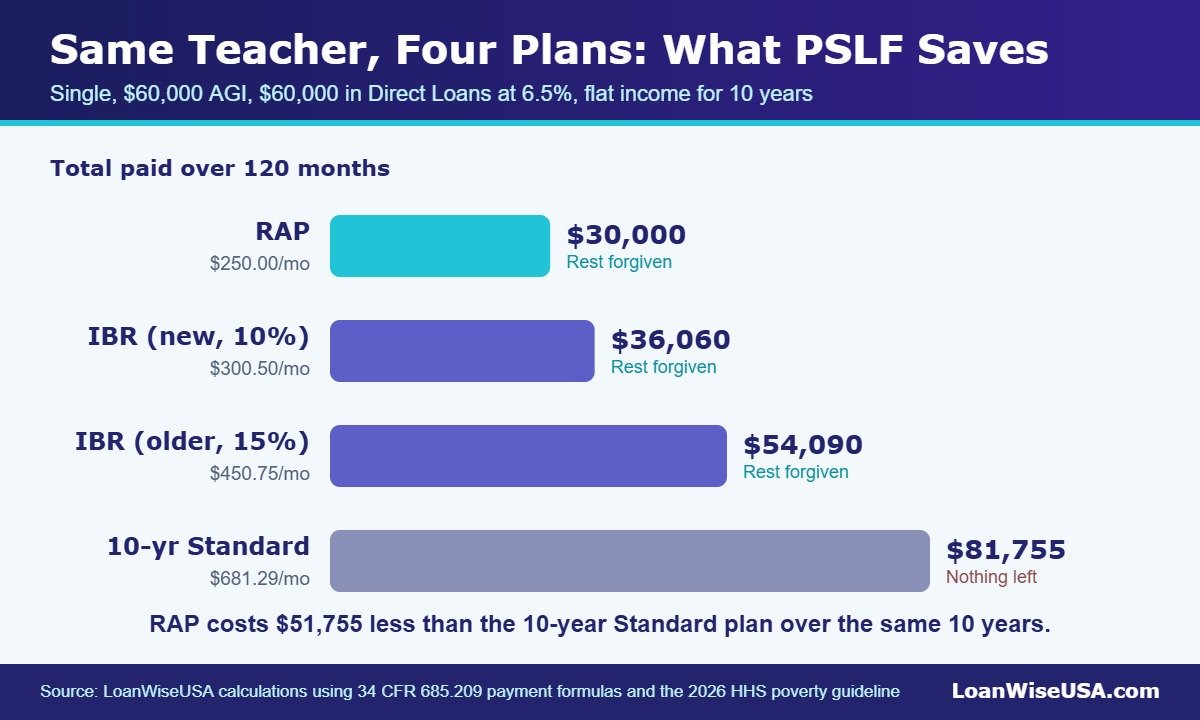
Worked example: a $60,000 teacher with $60,000 in loans
Maria is a single public school teacher earning $60,000 AGI with $60,000 in Direct Loans at 6.5%. To keep the math simple, assume her income stays flat for 10 years (in real life raises would push her income-driven payments up).
| Plan | Monthly payment | Total paid over 120 months | Forgiven under PSLF? |
|---|---|---|---|
| RAP | $250.00 | $30,000 | Yes, the remaining balance |
| IBR (new borrower, 10%) | $300.50 | $36,060 | Yes, the remaining balance |
| IBR (older borrower, 15%) | $450.75 | $54,090 | Yes, the remaining balance |
| 10-year Standard | $681.29 | $81,755 | Nothing left to forgive |
On RAP, Maria pays about $51,755 less over 10 years than she would on the Standard plan. That gap is the real value of PSLF. The Standard plan technically qualifies, but because it pays the loan off in exactly 10 years, there’s nothing left to forgive.
What counts as a qualifying payment?
A month counts if you pay the full scheduled amount under a qualifying plan while working full time for a qualifying employer at any point in that month. Some details that help:
- Partial installments count if together they add up to the full monthly amount.
- Paying ahead counts within limits: on an income-driven plan, until your next annual recertification; on the 10-year Standard plan, up to 12 months.
- Some deferments and forbearances count when you’re not on RAP, including cancer treatment, economic hardship and military service deferments, and AmeriCorps, National Guard and Department of Defense repayment forbearances.
- Most other forbearances don’t count, including the forbearance many borrowers were placed in while SAVE was blocked in court.
- Consolidation keeps your progress: if you consolidate Direct Loans, a weighted average of your prior qualifying payments carries over to the new consolidation loan.
Can I buy back months that didn’t count?
Yes. PSLF “buyback” lets you get credit for months spent in a non-qualifying deferment or forbearance if you were working full time for a qualifying employer. You make an extra payment equal to what you would have owed on a qualifying plan then, or get credit if you would have qualified for a $0 income-driven payment. Buyback doesn’t apply to periods when you were on RAP.
How to apply for PSLF: step by step
- Confirm your loan types. Log in to StudentAid.gov and check that every loan is a Direct Loan. If you have FFEL or Perkins loans, consolidate them into a Direct Consolidation Loan; payments made on those older loans before consolidating generally won’t count.
- Check your employer. Use the PSLF Help Tool on StudentAid.gov to search the employer database by your employer’s EIN.
- Get on a qualifying plan. Choose RAP or IBR if you want the most forgiveness. Avoid graduated, extended or other plans that don’t count.
- Certify your employment every year. Submit the PSLF form (employment certification) at least once a year and every time you change jobs. Your employer signs it electronically.
- Track your count. After each form is processed, check your qualifying payment count on StudentAid.gov and dispute errors quickly.
- Recertify income on time. Missing your income-driven recertification can bump your payment up or push you into a non-qualifying status.
- Stay employed until forgiveness. You must still work for a qualifying employer when you hit 120 payments and when you apply. If the Department already has enough information, it can forgive your loans without a separate application.
If your forgiveness or a payment count is denied, you have 90 days from the denial notice to request reconsideration.
Common PSLF mistakes to avoid
- Refinancing with a private lender. Private loans can never qualify for PSLF. If you’re weighing a refinance, read our guide on when refinancing student loans makes sense first, and skip it if PSLF is your plan.
- Waiting until year 10 to certify. Annual certification catches employer and plan problems while they’re still easy to fix.
- Assuming any nonprofit qualifies. 501(c)(3)s qualify, but other nonprofits have to meet the public service test.
- Prepaying aggressively. Extra payments don’t speed up PSLF; they only shrink the amount forgiven.
- Sitting in forbearance. Most forbearance months add nothing to your 120 count.
- Letting loans default. Defaulted loans can’t earn PSLF credit and can lead to wage garnishment of up to 15% of your pay.
What about Parent PLUS loans?
Parent PLUS loans can only reach PSLF through a Direct Consolidation Loan, and the parent (not the student) must be the one working in public service. These loans have historically qualified only through ICR, and the regulation counts ICR payments only if they’re received on or before June 30, 2028. New Parent PLUS loans made after July 1, 2026 have no income-driven option. If you’re a parent borrower, confirm your path with your servicer before counting on PSLF. Parents borrowing for a student who starts a new program now also face a $20,000-a-year, $65,000-total Parent PLUS cap, explained in our guide to the new federal student loan limits.
Frequently asked questions
Do the 120 PSLF payments have to be consecutive?
No. You can change jobs, take a break from public service or leave and return; qualifying payments you’ve already made keep counting toward 120.
Is PSLF forgiveness taxable?
Not at the federal level. Forgiveness for working a set period in qualifying public service is excluded from gross income under 26 U.S.C. 108(f)(1). State treatment can vary, so check your state.
Can I combine two part-time jobs to reach 30 hours?
Yes, as long as each job is with a qualifying employer and the total averages at least 30 hours a week.
Do RAP payments count for PSLF?
Yes. The Repayment Assistance Plan is listed as a qualifying repayment plan in the PSLF regulation.
Does PSLF still exist in 2026?
Yes. PSLF is written into federal law, and the 2026 changes affected repayment plans and a proposed employer rule (which courts vacated), not the core 120-payment program.
Does my payment amount or income affect how much is forgiven?
Yes. The lower your qualifying payments over 10 years, the larger the balance left to forgive. There’s no cap on the amount PSLF can forgive.
This article is general information, not financial, tax or legal advice. Student loan rules change, so confirm details with your loan servicer or StudentAid.gov before making decisions.
Share this infographic
Teachers, nurses, nonprofit staff and public employees ask how PSLF works all the time. Feel free to share our four-requirements infographic on your site or newsletter using the code below, with a link back to this guide.
<a href="https://loanwiseusa.com/how-pslf-works/"><img src="https://loanwiseusa.com/wp-content/uploads/2026/11/how-pslf-works-4-requirements-infographic.jpg" alt="How PSLF works: the 4 requirements infographic" width="1200" /></a><br />Source: <a href="https://loanwiseusa.com/how-pslf-works/">LoanWiseUSA – How PSLF Works: Who Qualifies, What Counts and How to Get Your Loans Forgiven</a>Related reading on LoanWiseUSA
- SAVE Plan Is Ending: Your Deadline, RAP vs. IBR Payments and What Happens If You Do Nothing
- Student Loan Wage Garnishment Is Coming Back: How to Stop It
- Student Loan Defaults Are Back: What Borrowers Need to Know Now
- Best Time to Refinance Student Loans Before Year-End 2026
Sources
- 34 CFR 685.219, Public Service Loan Forgiveness Program (eCFR)
- 34 CFR 685.209, Income-driven repayment plans and RAP (eCFR)
- 26 U.S.C. 108(f), Student loan discharge exclusion (Cornell LII)
- HHS ASPE, 2026 Poverty Guidelines
- Federal Student Aid, Public Service Loan Forgiveness
- The College Investor, PSLF employer rule appeals dropped (Oct. 21, 2026)


[…] Payments under the 10-year Standard plan can count toward PSLF, but Tiered Standard payments don’t, and Standard payments generally don’t count toward IDR forgiveness. Switching back to an IDR plan quickly limits the damage. For the full list of plans and payments that count, see our guide to how PSLF works. […]
[…] refinancing calculus for a lot of borrowers. If you work for a government agency or nonprofit, read how PSLF works before refinancing, because moving federal loans to a private lender permanently gives up Public […]
[…] discharge if the borrower dies or becomes totally and permanently disabled, and eligibility for Public Service Loan Forgiveness. Private loans don’t qualify for PSLF, which matters a lot for future doctors, nurses and […]