


Quick answer: A home equity loan gives you one lump sum at a fixed rate with the same payment every month. A HELOC (home equity line of credit) is a revolving line you draw from as needed, usually at a variable rate tied to the prime rate, with low interest-only payments at first and higher payments later. In early November 2026, Curinos data put the average HELOC rate at 7.83% and the average fixed home equity loan at 7.50% for strong-credit borrowers. Pick a home equity loan when you know the exact amount and want payment certainty; pick a HELOC when costs arrive in stages or you may not need all the money. Both put your house on the line if you can’t pay.
This guide is general information, not financial, tax or legal advice. Rates change daily and the offer you get depends on your credit, income and home value.
What is the difference between a HELOC and a home equity loan?
Both are second mortgages that let you borrow against your home equity, which is your home’s value minus what you still owe on it. The difference is how the money comes to you and how you pay it back.
- Home equity loan: a closed-end installment loan. You get the full amount at closing, pay a fixed rate in most cases, and repay it in equal monthly payments over a set term, often 5 to 30 years.
- HELOC: an open-end line of credit. During a draw period (commonly 10 years) you borrow, repay and borrow again up to your limit, often paying only interest. After that comes a repayment period (commonly 20 years) when you can’t draw anymore and pay principal plus interest.
| Feature | Home equity loan | HELOC |
|---|---|---|
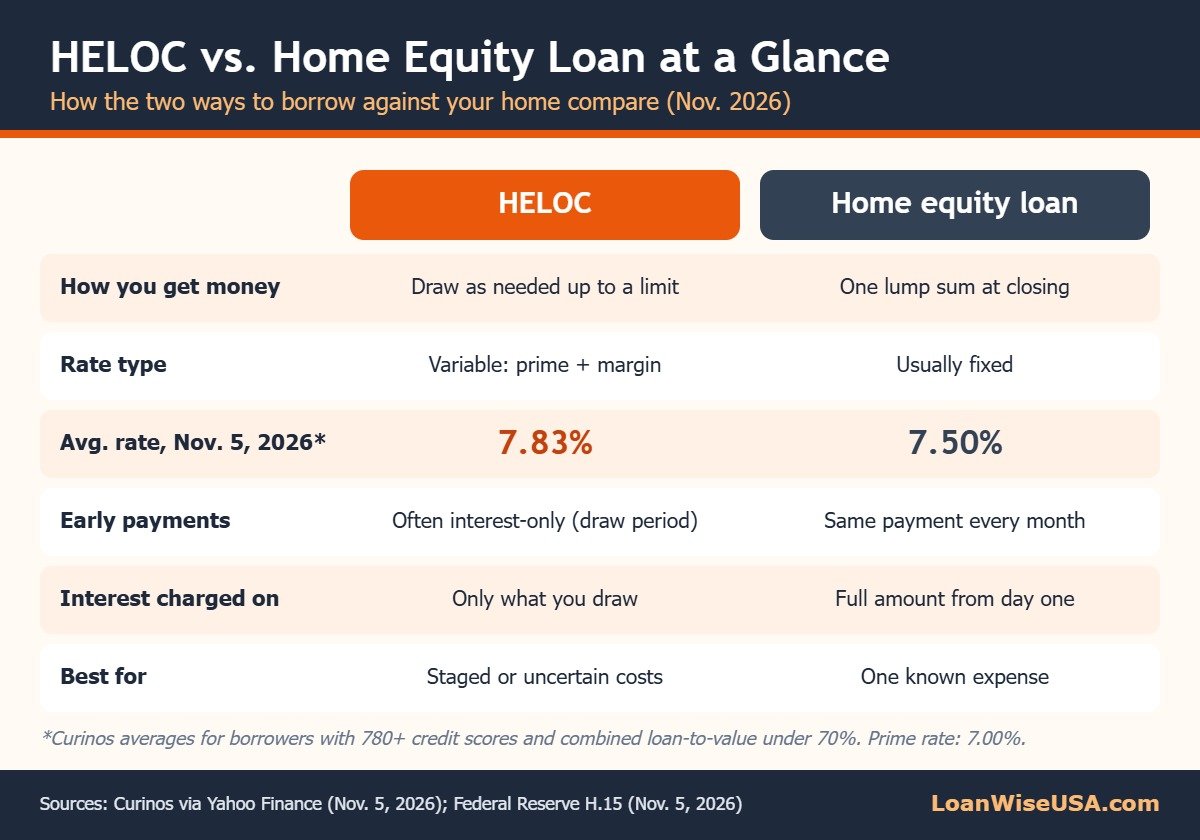
| How you get the money | One lump sum at closing | Draw as needed, up to a credit limit |
| Rate type | Usually fixed | Usually variable (prime + a margin) |
| Average rate, early Nov. 2026 (Curinos, 780+ score, CLTV under 70%) | 7.50% | 7.83% |
| Payments | Same principal-and-interest payment every month | Often interest-only in the draw period, then higher amortizing payments |
| You pay interest on | The full amount from day one | Only what you’ve drawn |
| Best for | One known cost: a roof, debt consolidation, a single big bill | Staged projects, ongoing or uncertain costs, a backup fund |
| Main risk | Paying interest on money you didn’t need | Rising rates and a payment jump when the draw period ends |
What are HELOC and home equity loan rates right now?
Rates depend heavily on who is quoting and for which borrower, so compare like with like:
| Source and borrower profile | HELOC | Home equity loan |
|---|---|---|
| Curinos via Yahoo Finance, Nov. 5, 2026 (credit score 780+, combined LTV under 70%) | 7.83% (2026 low: 7.09% in late August) | 7.50% fixed (2026 low: 7.31% in late June) |
| Bankrate survey of large lenders, Nov. 4, 2026 ($30,000 loan, 700 score, 80% CLTV) | n/a | 8.66% (5-yr), 8.77% (10-yr), 8.76% (15-yr) |
| Federal Reserve H.15 bank prime rate, Nov. 5, 2026 | 7.00% — the index most HELOCs are priced from | |
The prime rate moves with the Federal Reserve’s policy rate. After the Fed held its target at 3.75%–4% in October (see our breakdown of what the Fed’s October 2026 decision means for HELOCs and other loans), prime stayed at 7.00%. If the Fed raises or cuts later, a variable HELOC rate usually follows within a billing cycle or two. A fixed home equity loan rate does not change once you close.
Why is the HELOC rate higher than the home equity loan rate?
It isn’t always. HELOC rates track prime, while fixed home equity loan rates track longer-term market rates and lender pricing. In 2026 the two averages have been unusually close, within about a third of a percentage point. Some lenders also offer a low introductory HELOC rate for the first several months, so look at the rate after the intro period ends.
How much can you borrow against your home?
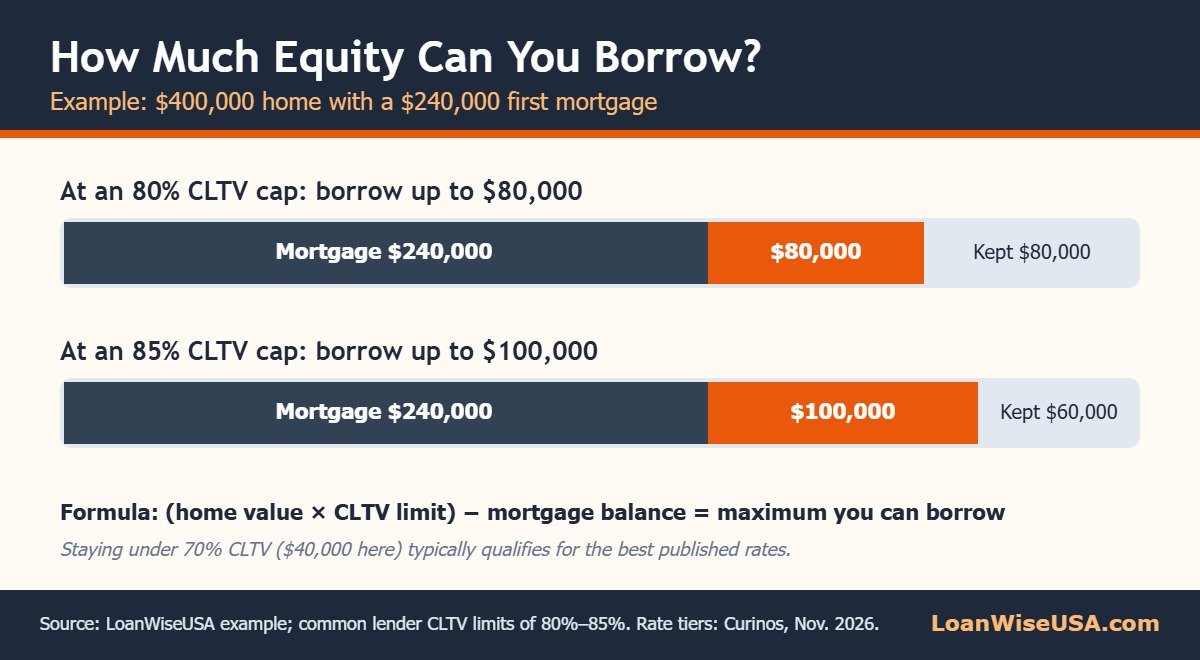
Lenders cap your combined loan-to-value ratio (CLTV): all the debt secured by the home divided by its appraised value. Many lenders stop at 80% to 85%, and a few go higher for very strong borrowers.
Worked example: Your home appraises at $400,000 and you owe $240,000 on your first mortgage (60% LTV).
- At an 80% CLTV cap: $400,000 × 0.80 = $320,000 − $240,000 = $80,000 maximum.
- At an 85% CLTV cap: $400,000 × 0.85 = $340,000 − $240,000 = $100,000 maximum.
Borrowing less than the maximum usually gets you a better rate, since the Curinos averages above assume a CLTV under 70%. In this example, staying under 70% means borrowing no more than $40,000.
What do the payments look like on $50,000?
Here is the same $50,000 borrowed three ways, using the early-November averages. HELOC math assumes you draw the full $50,000 at once, pay interest only for a 10-year draw period, then repay over 20 years.
| Option | Rate | Monthly payment | Total interest |
|---|---|---|---|
| Home equity loan, 15 years | 7.50% fixed | $463.51 | $33,431 |
| Home equity loan, 10 years | 7.50% fixed | $593.51 | $21,221 |
| HELOC, draw period (years 1–10, interest only) | 7.83% variable | $326.25 | $88,257 over 30 years if the rate never changes |
| HELOC, repayment period (years 11–30) | 7.83% variable | $412.95 | |
| HELOC repayment if the rate rises 2 points | 9.83% | $476.89 | $103,604 over 30 years |
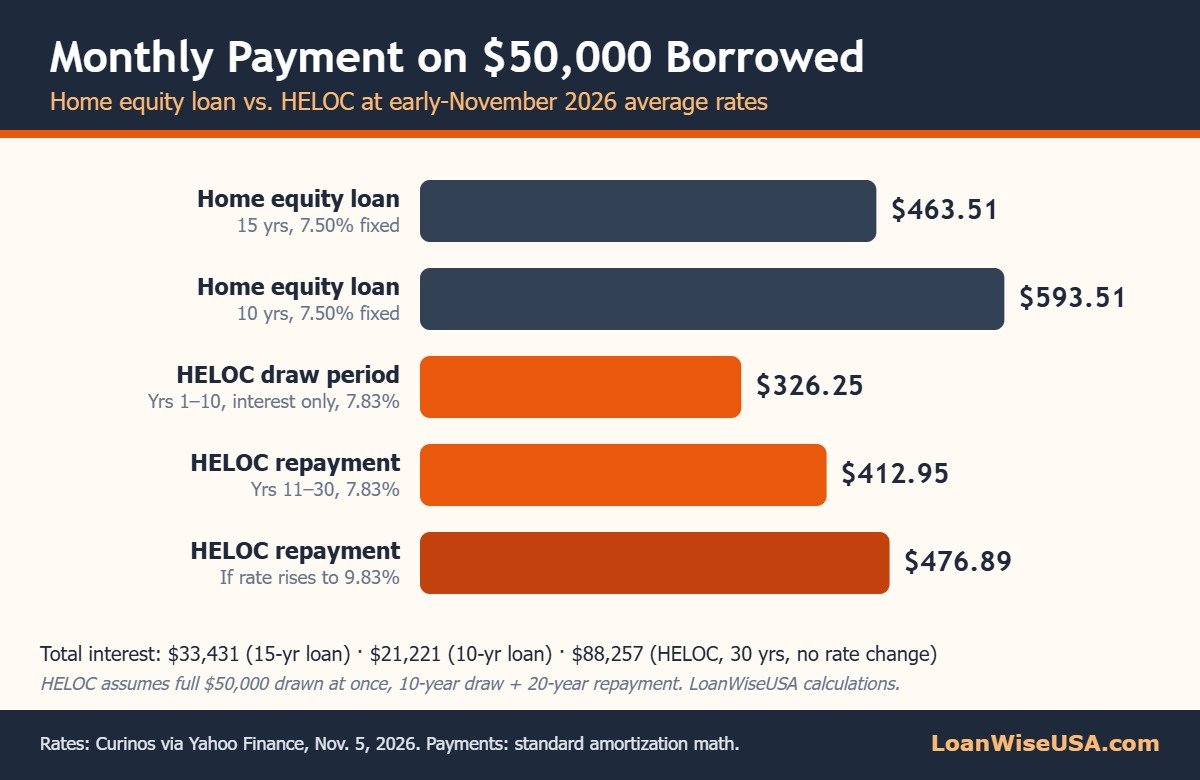
Two lessons stand out. First, the HELOC’s low starting payment is mostly an illusion of cheapness: paying interest only for a decade more than doubles the total interest compared with a 15-year home equity loan. Second, the jump from $326 to $413 when the draw period ends is a 27% payment increase even with no rate change, and 46% if rates are two points higher by then. You can avoid both problems by paying principal during the draw period.
When does a HELOC cost less?
When you don’t need all the money at once. Suppose you open a $50,000 line for a kitchen remodel but only $20,000 is billed in the first six months. At 7.83%, interest on $20,000 is about $130.50 a month, versus paying interest on the full $50,000 from day one with a lump-sum loan. If the project comes in under budget, you never borrow the rest.
Is home equity interest tax-deductible?
Sometimes. Under IRS rules, interest on a home equity loan or HELOC is deductible only if you use the money to buy, build or substantially improve the home that secures the loan, and only if you itemize. Your total qualifying mortgage debt is capped at $750,000 ($375,000 if married filing separately). The One Big Beautiful Bill Act, signed in July 2025, made these 2017-era limits permanent instead of letting them expire after 2025.
So a HELOC used for a new roof can qualify, while one used to pay off credit cards or buy a car does not. Because most households now take the standard deduction (see our guide to the 2027 standard deduction and tax brackets), many borrowers get no tax benefit either way. Keep receipts showing how you spent the money.
Which one should you choose?
| Your situation | Better fit | Why |
|---|---|---|
| One known expense (roof, medical bill, consolidating $30,000 of card debt) | Home equity loan | Fixed rate and payment; you need the whole amount now |
| Renovation paid in stages over 6–18 months | HELOC | Interest only on what’s drawn |
| Tuition paid each semester | HELOC | Draw each term instead of borrowing four years upfront |
| Tight budget that can’t absorb a payment increase | Home equity loan | No rate risk, no draw-period payment jump |
| Expect to repay within 1–3 years | HELOC | Flexible paydown; check for early-closure fees |
| You’d be tempted to keep borrowing | Home equity loan | A closed-end loan can’t be re-drawn |
If you’re consolidating high-rate debt, compare the payoff plan, not just the rate. Our debt avalanche vs. snowball guide shows how to sequence payoff so the equity you borrow doesn’t get used up twice. If you have limited equity or don’t want to risk your home, an unsecured option may make more sense; see how personal loans compare on cost.
How to get a HELOC or home equity loan: step by step
- Estimate your equity. Use a recent sale price for similar homes, subtract your mortgage balance, and apply an 80% CLTV cap to see a realistic maximum.
- Check your credit reports and score. The best published averages assume scores of 780 and up. Fix errors first; our guide on how to dispute a credit report error walks through it.
- Know your debt-to-income ratio. Lenders add the new payment to your existing debts. For a HELOC, many qualify you on a fully amortizing payment, not the interest-only one.
- Get quotes from at least three lenders, including your current bank and a credit union. For a HELOC, ask for the margin over prime, any rate cap, intro-rate terms, annual fees and the minimum draw.
- Compare all fees. Ask about origination, appraisal, title, recording and early-closure fees. A home equity loan comes with a Loan Estimate; a HELOC comes with its own required disclosures.
- Close, then use your cancellation window if needed. For a loan or line secured by your principal dwelling, federal law (Regulation Z) generally gives you until midnight of the third business day after closing (or after you receive the required notice and disclosures, if later) to cancel.
- Set a repayment plan on day one. For a HELOC, schedule a principal payment each month so the end of the draw period isn’t a shock.
Common mistakes to avoid
- Treating the interest-only payment as the real payment. Budget for the repayment-period payment from the start.
- Ignoring the variable rate. A 2-point rise on a $50,000 balance adds about $83 a month even during the interest-only period.
- Borrowing the maximum. A higher CLTV often means a higher rate and leaves no cushion if home values fall.
- Assuming the line will always be there. Federal rules let a lender freeze or lower a HELOC limit if your home’s value declines significantly or your finances change materially. Don’t rely on an unused HELOC as your only emergency fund.
- Using home equity for short-lived spending. Vacations or everyday bills turn unsecured costs into debt backed by your house.
- Forgetting about selling. Both loans must be paid off when you sell, which reduces your proceeds.
HELOC vs. cash-out refinance: which is better?
A cash-out refinance replaces your whole first mortgage with a bigger one. That can make sense if today’s mortgage rates are lower than your current rate, but most homeowners locked in lower rates years ago. With 30-year mortgage rates above 7% in late 2026, refinancing a 3% or 4% mortgage just to pull out $50,000 would raise the rate on your entire balance. A HELOC or home equity loan leaves your first mortgage untouched. If you are also weighing upfront costs on a new mortgage, see how mortgage points work.
FAQ
Is a HELOC or home equity loan easier to get?
Requirements are similar: enough equity (often 15%–20% left after borrowing), a solid credit score, and a manageable debt-to-income ratio. Some lenders are stricter on HELOCs because they qualify you on a future fully amortizing payment.
Can I pay off a HELOC early?
Usually yes, but some lenders charge an early-closure fee if you close the line within the first few years. Paying the balance to zero while keeping the line open typically has no penalty. Check your agreement.
Can a HELOC rate go up?
Yes. Most HELOCs are variable and adjust when the prime rate moves. Ask whether your line has a lifetime rate cap and whether you can convert part of the balance to a fixed rate.
What happens if I can’t make the payments?
Both are secured by your home, so prolonged missed payments can lead to foreclosure. Contact the lender early to ask about hardship options.
Do I need an appraisal?
Often, though some lenders use automated valuations for smaller amounts. The value they use sets your maximum borrowing.
Does opening a HELOC hurt my credit?
The application typically triggers a hard inquiry, which may lower your score slightly for a short time. Large balances and missed payments matter far more over time.
Share this infographic
Writing about home equity borrowing? You are welcome to share our HELOC vs. home equity loan comparison on your site. Copy the code below to embed it with a credit link back to this guide.
<a href="https://loanwiseusa.com/heloc-vs-home-equity-loan/"><img src="https://loanwiseusa.com/wp-content/uploads/2026/11/heloc-vs-home-equity-loan-comparison.jpg" alt="HELOC vs. home equity loan comparison infographic" width="1200" /></a><br />Source: <a href="https://loanwiseusa.com/heloc-vs-home-equity-loan/">LoanWiseUSA – HELOC vs. Home Equity Loan: Which Costs Less in 2026? (With $50,000 Examples)</a>Related reading on LoanWiseUSA
- How Much House Can I Afford on a $100K Salary? The 28/36 Rule With Real Numbers
- How Mortgage Points Work: Cost, Break-Even Math and When They Pay Off
- How to Get a Personal Loan With Bad Credit: Options, Real Costs and a Step-by-Step Plan
- Debt Avalanche vs. Snowball: Which Payoff Method Saves More
Sources
- Yahoo Finance (Curinos data), “HELOC and home equity loan rates today, Thursday, November 5, 2026”
- Bankrate, “Current Home Equity Loan Rates” (survey as of Nov. 4, 2026)
- Federal Reserve, H.15 Selected Interest Rates, bank prime loan rate (Nov. 6, 2026 release)
- IRS, Publication 936, Home Mortgage Interest Deduction
- CPA Practice Advisor, “Secure the best deductions for mortgage interest payments under the new tax law (OBBBA)”
- CFPB, Regulation Z §1026.23, Right of rescission
- CFPB, Regulation Z §1026.40, Requirements for home equity plans

[…] a HELOC or home equity loan, because it turns card debt into debt backed by your house; see our HELOC vs. home equity loan guide for the trade-offs. The same goes for pay-later plans; see our look at the buy now, pay later debt […]