

2027 Tax Brackets Are Out: New Standard Deduction, Child Tax Credit and How Much You’ll Save
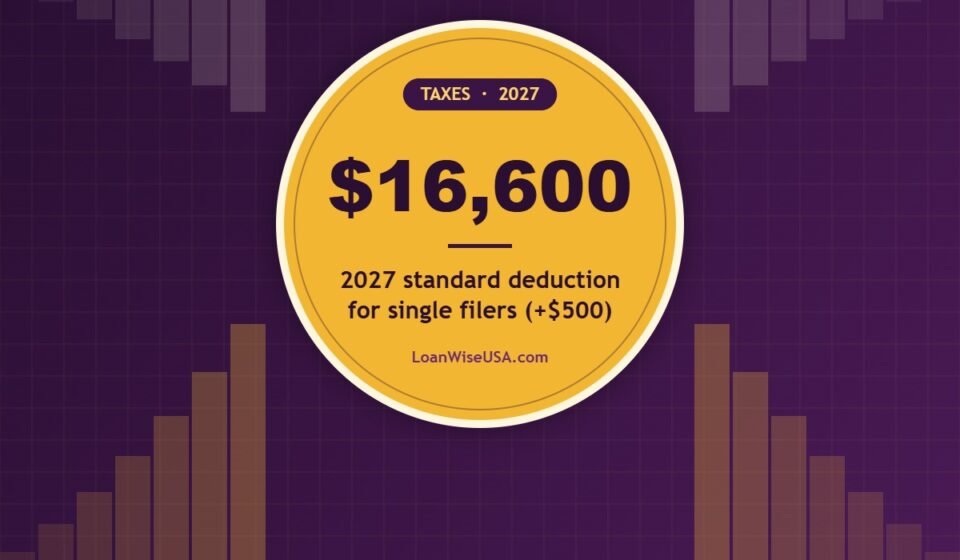
Quick answer: On Nov. 5, 2026, the IRS released its tax year 2027 inflation adjustments. The standard deduction rises to $16,600 for single filers, $24,925 for heads of household and $33,200 for married couples filing jointly, and every bracket threshold moves up by roughly 2.5%–3%. The maximum child tax credit goes to $2,300 per child. These numbers apply to income you earn in 2027 and the return you file in early 2028, not the return you file next spring.
The seven tax rates themselves (10%, 12%, 22%, 24%, 32%, 35% and 37%) are unchanged. What changes is how much income fits into each bracket, which means most people who earn the same amount in 2027 as in 2026 will owe a little less federal income tax. Below we break down the new brackets, show worked dollar examples, and list what you can do now to use the new numbers in your planning.
What did the IRS announce for 2027?
The IRS published the adjustments in news release IR-2026-133 and the full details in Revenue Procedure 2026-35. They cover almost 70 provisions. The ones that affect the most households are:
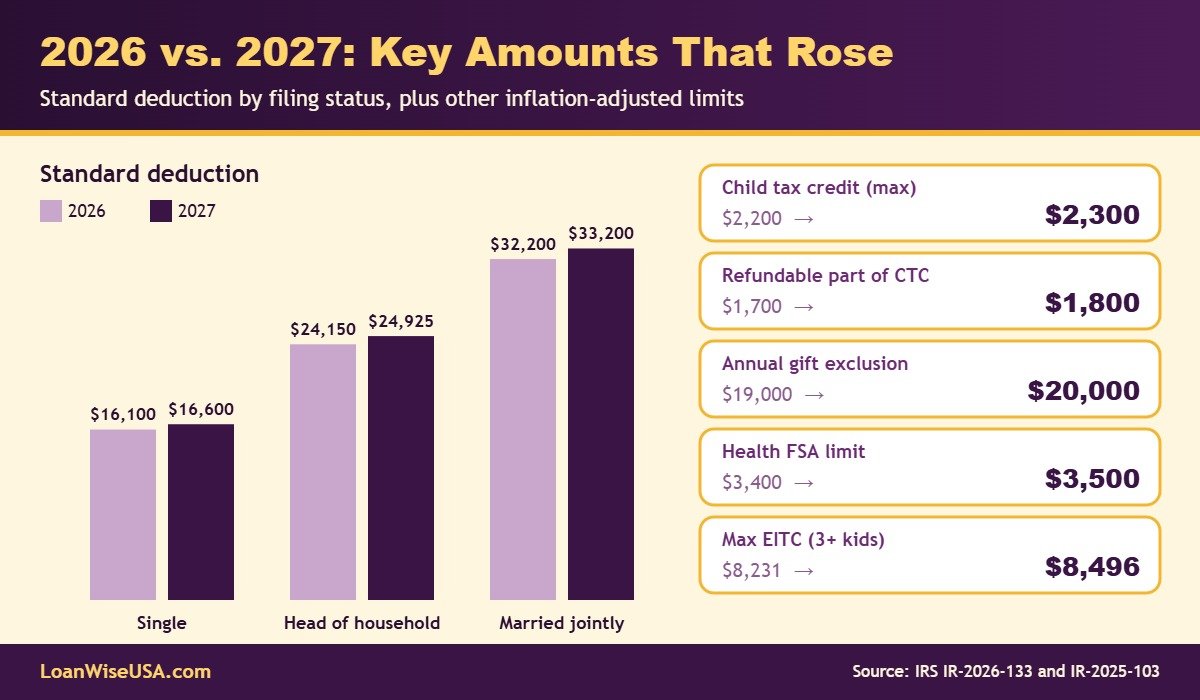
- Standard deduction: $16,600 single (up $500), $24,925 head of household (up $775), $33,200 married filing jointly (up $1,000).
- Child tax credit: up to $2,300 per qualifying child (up $100), with up to $1,800 refundable (up $100).
- Earned income tax credit: maximum of $8,496 for families with three or more qualifying children (up from $8,231).
- Health FSA: salary-reduction limit of $3,500 (up $100), with a carryover limit of $700 where the plan allows it.
- Gift tax annual exclusion: $20,000 per recipient (up from $19,000).
- Estate tax basic exclusion: $15,480,000 per person (up from $15,000,000).
The adjustments are required by law to keep inflation from pushing people into higher brackets even when their real income hasn’t grown (often called “bracket creep”).
What are the 2027 federal income tax brackets?
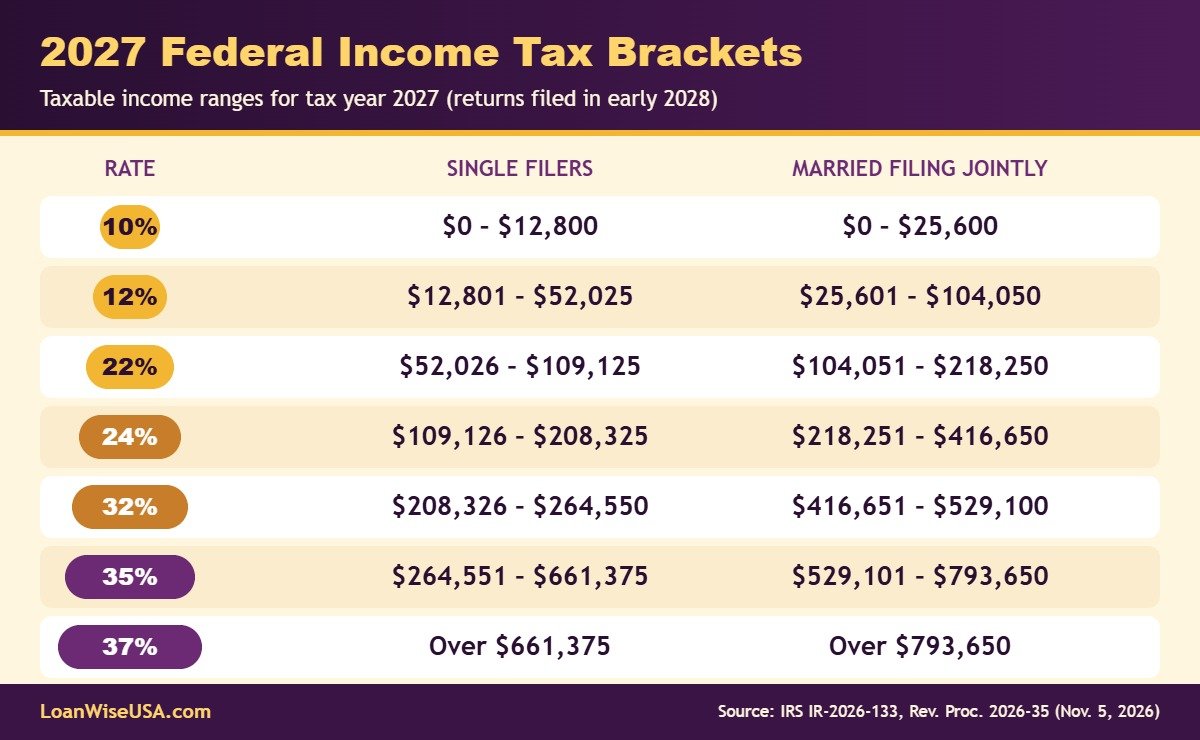
These ranges apply to taxable income, meaning income after the standard deduction or itemized deductions and any other deductions you qualify for.
| Tax rate | Single filers | Married filing jointly |
|---|---|---|
| 10% | $0 – $12,800 | $0 – $25,600 |
| 12% | $12,801 – $52,025 | $25,601 – $104,050 |
| 22% | $52,026 – $109,125 | $104,051 – $218,250 |
| 24% | $109,126 – $208,325 | $218,251 – $416,650 |
| 32% | $208,326 – $264,550 | $416,651 – $529,100 |
| 35% | $264,551 – $661,375 | $529,101 – $793,650 |
| 37% | Over $661,375 | Over $793,650 |
Head of household and married-filing-separately brackets are listed in Revenue Procedure 2026-35 on the IRS website.
How do the 2027 brackets compare with 2026?
| Rate | Single: 2026 top of bracket | Single: 2027 top of bracket | Joint: 2026 top of bracket | Joint: 2027 top of bracket |
|---|---|---|---|---|
| 10% | $12,400 | $12,800 | $24,800 | $25,600 |
| 12% | $50,400 | $52,025 | $100,800 | $104,050 |
| 22% | $105,700 | $109,125 | $211,400 | $218,250 |
| 24% | $201,775 | $208,325 | $403,550 | $416,650 |
| 32% | $256,225 | $264,550 | $512,450 | $529,100 |
| 35% | $640,600 | $661,375 | $768,700 | $793,650 |
For example, a single filer can have $52,025 of taxable income in 2027 before any of it is taxed at 22%, compared with $50,400 in 2026. That extra $1,625 is taxed at 12% instead of 22%.
Does moving into a higher bracket mean all my income is taxed more?
No. The U.S. uses marginal rates, so each rate applies only to the slice of income inside that bracket. If a raise pushes $1,000 of your taxable income from the 12% bracket into the 22% bracket, only that $1,000 is taxed at 22%. Your take-home pay never falls just because you crossed a bracket line.
How much is the 2027 standard deduction?
| Filing status | 2026 | 2027 | Change |
|---|---|---|---|
| Single or married filing separately | $16,100 | $16,600 | +$500 |
| Head of household | $24,150 | $24,925 | +$775 |
| Married filing jointly | $32,200 | $33,200 | +$1,000 |
Most households take the standard deduction because it is larger than their itemized deductions (mortgage interest, state and local taxes, charitable gifts and similar items). If your itemized total is close to these numbers, it is worth adding them up each year rather than assuming one method is always better.
What about taxpayers 65 and older?
Older taxpayers can still claim the regular additional standard deduction for age or blindness, whose 2027 amounts are listed in Revenue Procedure 2026-35. Separately, the 2025 tax law (which the IRS now calls the Working Families Tax Cuts) created a temporary senior deduction of up to $6,000 per eligible person age 65 or older for tax years 2025 through 2028. It phases out for modified adjusted gross income above $75,000 ($150,000 for joint filers). If you are planning around next year’s Social Security increase, our breakdown of the 2027 Social Security COLA shows how much your check is set to rise.
What other 2027 tax amounts changed?
| Item | 2026 | 2027 |
|---|---|---|
| Maximum child tax credit (per child) | $2,200 | $2,300 |
| Refundable portion of child tax credit | $1,700 | $1,800 |
| Maximum EITC (3+ qualifying children) | $8,231 | $8,496 |
| Health FSA salary-reduction limit | $3,400 | $3,500 |
| Transit and parking benefit (monthly) | $340 | $350 |
| Annual gift tax exclusion | $19,000 | $20,000 |
| AMT exemption (unmarried) | $90,100 | $93,000 |
| Estate tax basic exclusion | $15,000,000 | $15,480,000 |
| Maximum adoption credit | $17,670 | $18,250 |
Some items are not adjusted for inflation. Personal exemptions remain at $0, and the income range where the Lifetime Learning Credit phases out stays at $80,000–$90,000 ($160,000–$180,000 for joint returns).
How much less tax will I pay in 2027? Worked examples
To isolate the effect of the new numbers, the examples below assume the same income in 2026 and 2027, the standard deduction, no other deductions or credits (except where noted), and federal income tax only. They do not include Social Security, Medicare or state taxes.
Example 1: Single filer earning $75,000
- 2026: $75,000 − $16,100 = $58,900 taxable. Tax = $1,240 (10%) + $4,560 (12%) + $1,870 (22%) = $7,670.
- 2027: $75,000 − $16,600 = $58,400 taxable. Tax = $1,280 (10%) + $4,707 (12%) + $1,402.50 (22%) = $7,389.50.
- Difference: about $280.50 less, or roughly $23 a month.
Example 2: Married couple earning $150,000 with two children
- 2026: $150,000 − $32,200 = $117,800 taxable. Tax before credits = $2,480 + $9,120 + $3,740 = $15,340. Child tax credit = 2 × $2,200 = $4,400. Net = $10,940.
- 2027: $150,000 − $33,200 = $116,800 taxable. Tax before credits = $2,560 + $9,414 + $2,805 = $14,779. Child tax credit = 2 × $2,300 = $4,600. Net = $10,179.
- Difference: about $761 less ($561 from the brackets and deduction, $200 from the larger credit).
| Household (same income both years) | 2026 federal income tax | 2027 federal income tax | Estimated savings |
|---|---|---|---|
| Single, $40,000 | $2,620 | $2,552 | $68 |
| Single, $75,000 | $7,670 | $7,389.50 | $280.50 |
| Married jointly, $100,000 | $7,640 | $7,504 | $136 |
| Married jointly, $150,000 | $15,340 | $14,779 | $561 |
| Married jointly, $250,000 | $37,468 | $36,779 | $689 |
In real life, many people get a raise that roughly matches inflation, so the dollar savings will be smaller than shown. The point of indexing is that a cost-of-living raise shouldn’t raise your tax rate. If you also bought a new car this year, check whether you qualify for the car loan interest deduction, which can lower taxable income further.

When do the 2027 numbers start to matter?
There are three dates to keep straight:
- Early 2027 (filing season): you file your 2026 return using the 2026 brackets and the $16,100 / $24,150 / $32,200 standard deduction. The 2027 figures don’t apply yet.
- January 2027 paychecks: employers update federal withholding using new IRS tables, so your paycheck withholding will begin to reflect the 2027 brackets.
- Early 2028 (filing season): you file your 2027 return using the new brackets and amounts in this article.
What should I do now?
The new numbers are most useful for planning. A few practical moves:
- Check your withholding in January. Compare your first 2027 pay stub with your last 2026 stub. If you owed money last year or expect a big life change, run the IRS Tax Withholding Estimator and update your Form W-4.
- Revisit your bracket before year-end moves. If you are deciding whether to take a bonus, sell investments or do a Roth conversion in December 2026 or January 2027, the slightly wider 2027 brackets may change which year makes sense.
- Use your health FSA wisely. Open enrollment for many employer plans happens now. You can set aside up to $3,500 for 2027. If you’re comparing health plans, our guide to ACA open enrollment for 2027 covers premiums and subsidy deadlines.
- Plan gifts with the new exclusion. Starting Jan. 1, 2027, you can give up to $20,000 per person without filing a gift tax return.
- If you can’t pay a tax bill, don’t ignore it. An IRS payment plan usually costs far less than letting penalties pile up or putting the balance on a high-interest credit card.
Your 2027 tax checklist
- ☐ Note your filing status and the 2027 standard deduction that applies to you.
- ☐ Estimate your 2027 taxable income and find your top bracket in the table above.
- ☐ Compare January 2027 withholding with December 2026.
- ☐ Update Form W-4 after marriage, divorce, a new child or a second job.
- ☐ Set your 2027 health FSA election (up to $3,500).
- ☐ Confirm each child qualifies for the $2,300 child tax credit (Social Security number and age rules apply).
- ☐ Keep records for deductions you may claim, such as qualified car loan interest or the senior deduction.
Frequently asked questions
Are the 2027 tax brackets used for the return I file in April 2027?
No. The return you file in early 2027 covers tax year 2026 and uses the 2026 brackets. The 2027 brackets apply to income earned in 2027, reported on returns filed in early 2028.
Did tax rates go up or down for 2027?
Neither. The seven rates (10% to 37%) are the same. Only the income thresholds, the standard deduction and many credits and limits were raised for inflation.
How much is the child tax credit in 2027?
Up to $2,300 per qualifying child, with up to $1,800 of it refundable, according to the IRS. Income limits and eligibility rules still apply.
Have the 2027 401(k) and IRA limits been announced?
Retirement plan limits are announced separately from these income tax adjustments. Check the IRS website for the official 2027 figures rather than relying on projections.
Will I definitely pay less tax in 2027?
Not necessarily. If your income rises faster than inflation, or if you lose a deduction or credit, your tax could go up. The examples above hold income constant to show only the effect of the new numbers.
Share this infographic
Bloggers, newsletters and educators are welcome to share our 2027 tax bracket infographic. Copy the code below to embed it on your site with a credit link back to this article.
<a href="https://loanwiseusa.com/2027-tax-brackets/"><img src="https://loanwiseusa.com/wp-content/uploads/2026/11/2027-tax-brackets-infographic.jpg" alt="2027 federal income tax brackets for single and married filing jointly – LoanWiseUSA infographic" width="1200" /></a><br />Source: <a href="https://loanwiseusa.com/2027-tax-brackets/">LoanWiseUSA – 2027 Tax Brackets Are Out: New Standard Deduction, Child Tax Credit and How Much You’ll Save</a>Related reading on LoanWiseUSA
- Car Loan Interest Deduction 2026: Final IRS Rules and Who Qualifies for Up to $10,000
- How to Set Up an IRS Payment Plan: Fees, Interest and Step-by-Step Guide
- 2027 Social Security COLA Is 3.6%: What Changes in Your Check
- ACA Open Enrollment 2027: Premiums, the Subsidy Cliff and Your Deadline
Sources
- IRS, IR-2026-133: IRS releases tax inflation adjustments for tax year 2027 (Nov. 5, 2026)
- IRS, Revenue Procedure 2026-35 (PDF)
- IRS, IR-2025-103: Tax year 2026 inflation adjustments (Oct. 9, 2025)
- IRS, Federal income tax rates and brackets
- IRS, One Big Beautiful Bill provisions (senior deduction and other changes)
This article is general information, not financial, tax or legal advice. Tax rules depend on your situation; consider talking with a qualified tax professional before making decisions. Dollar examples are LoanWiseUSA estimates based on IRS figures and simplified assumptions.


[…] buy a car does not. Because most households now take the standard deduction (see our guide to the 2027 standard deduction and tax brackets), many borrowers get no tax benefit either way. Keep receipts showing how you spent the […]