

New Federal Student Loan Limits Are Pushing Borrowers to Private Lenders: The 2026 Caps and How to Fill the Gap
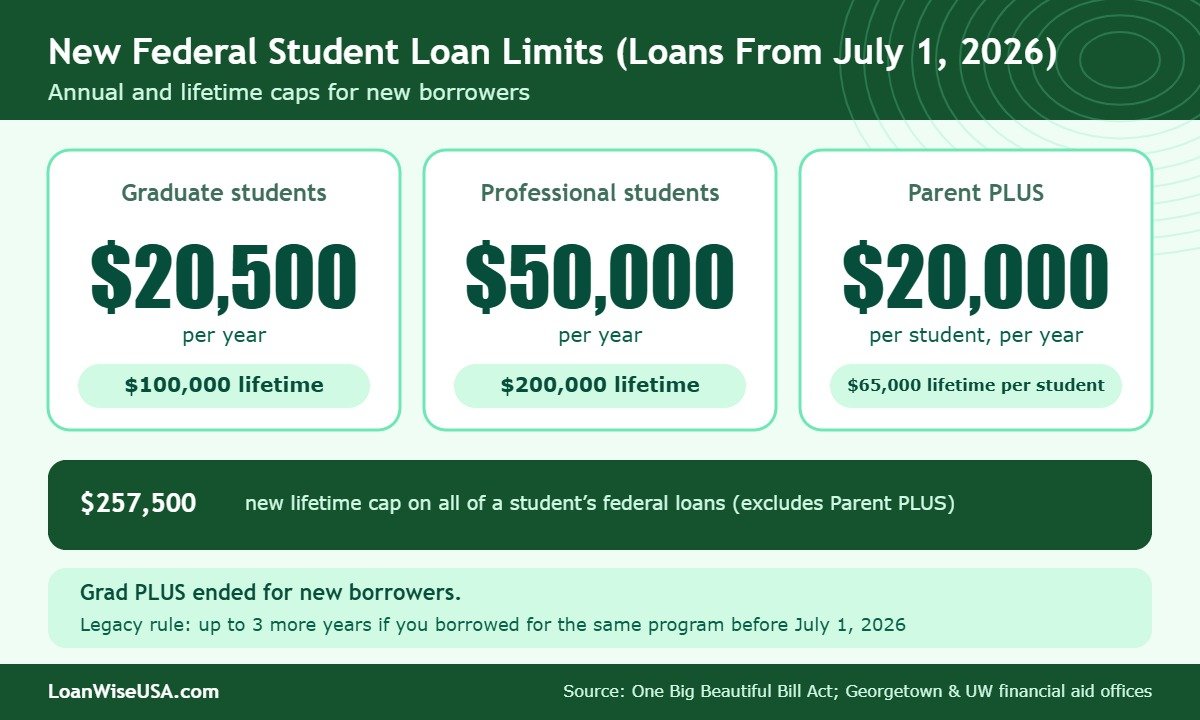
Quick answer: For new borrowers since July 1, 2026, Grad PLUS loans are gone and federal borrowing is capped: most graduate students can borrow $20,500 a year ($100,000 total), students in designated professional programs $50,000 a year ($200,000 total), and parents $20,000 a year per student through Parent PLUS ($65,000 total). Anyone whose costs exceed those caps has to cover the gap with savings, school aid or private loans, which is why private student lending is surging this fall. If you already borrowed for your current program before July 1, 2026, a legacy provision may let you keep borrowing under the old rules for up to three more years.
Why is everyone talking about student loan limits right now?
An Associated Press report published Nov. 6, 2026 found that the new caps are steering many graduate students and families toward private lenders. SoFi said its student loan originations hit $2.9 billion in the third quarter, nearly double a year earlier, and Sallie Mae said graduate loans were up 119% year over year. Schools delayed some aid packages because the definition of a “professional” program was fought in court until days before the July 1 start date.
For students now planning the spring term, or the 2027–28 school year, the practical questions are simple: how much can I still borrow from the government, how big is my gap, and what is the least risky way to fill it?
What are the new federal student loan limits?
The One Big Beautiful Bill Act, signed in July 2025, rewrote federal loan limits for loans first disbursed on or after July 1, 2026. Undergraduate Direct Loan limits did not change. The big changes hit graduate students and parents.
| Borrower | Annual limit | Aggregate (lifetime) limit | What changed |
|---|---|---|---|
| Graduate student (master’s, most PhDs) | $20,500 | $100,000 (excludes undergrad loans) | Grad PLUS no longer available to new borrowers |
| Professional student (e.g., MD, JD, PharmD, DDS) | $50,000 | $200,000 (excludes undergrad loans) | Higher cap replaces Grad PLUS |
| Parent PLUS (per dependent student) | $20,000 | $65,000 | Previously up to cost of attendance |
| All federal student loans combined | — | $257,500 (excludes Parent PLUS) | New lifetime cap |
| Dependent undergraduate | $5,500–$7,500 | $31,000 | No change |
Two other changes matter. First, loan amounts are now prorated for students enrolled less than full time, so a part-time student gets less than the full annual limit. Second, the Department of Education’s list of professional programs includes 11 core fields (medicine, osteopathic medicine, dentistry, pharmacy, veterinary medicine, law, optometry, podiatry, chiropractic, theology and clinical psychology). After a federal court paused part of the rule in late June, the department published interim classifications, and the AP reports that nursing, physical therapy and several other graduate fields can borrow at the higher professional limit, at least for now. Confirm your own program’s classification with your financial aid office.
Who keeps the old rules?
The legacy provision protects students already in the pipeline. If you were enrolled in a program and received a federal loan for that program before July 1, 2026, you can keep borrowing under the old rules, including Grad PLUS up to the cost of attendance, for up to three academic years or the rest of the program, whichever is shorter, as long as you stay in the same program. Parents get a similar protection if they took out a Parent PLUS loan for the same student and program before July 1, 2026. Switch programs or start a new degree and the new caps apply.
How much do federal student loans cost in 2026–27?
Rates are fixed for the life of each loan and are set once a year. For loans first disbursed between July 1, 2026 and June 30, 2027:
- Undergraduate Direct Loans: 6.52% fixed, 1.057% origination fee
- Graduate/professional Direct Unsubsidized Loans: 8.07% fixed, 1.057% fee
- PLUS loans (parent and legacy Grad PLUS): 9.07% fixed, 4.228% fee
The fee comes off the top. A graduate student who borrows the full $20,500 pays about $217 in fees, so roughly $20,283 reaches the school, but the full $20,500 must be repaid.
How big is your funding gap? Three worked examples
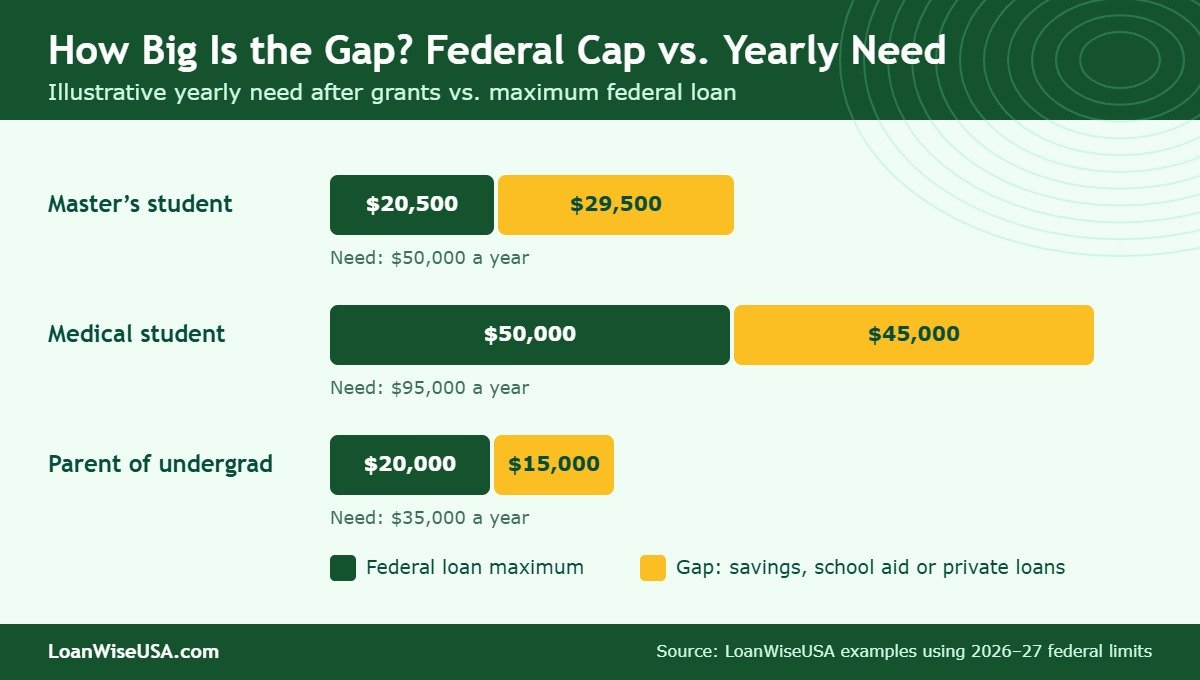
These examples use round, illustrative costs. Your cost of attendance (tuition, fees, housing, food, books and transportation) comes from your school’s aid offer.
| Example | Yearly need after grants | Federal max per year | Gap to fill |
|---|---|---|---|
| Master’s student | $50,000 | $20,500 | $29,500 |
| Medical student | $95,000 | $50,000 | $45,000 |
| Parent of an undergrad | $35,000 | $20,000 (Parent PLUS) | $15,000 |
Master’s student: Under the old rules, the $29,500 gap could have been covered with Grad PLUS at 9.07%. Now it has to come from savings, an assistantship, an employer or a private lender. Over a two-year program that is $59,000 of non-federal funding.
Medical student: At $50,000 a year, four years of school reaches exactly the $200,000 professional cap. If the yearly need is $95,000, that leaves $180,000 to finance elsewhere over four years.
Parent PLUS: At $20,000 a year, parents of a full-time student hit the $65,000 lifetime cap partway through the fourth year: $20,000 in years one through three, then only $5,000 left for year four.
What does a private loan cost compared with a federal loan?
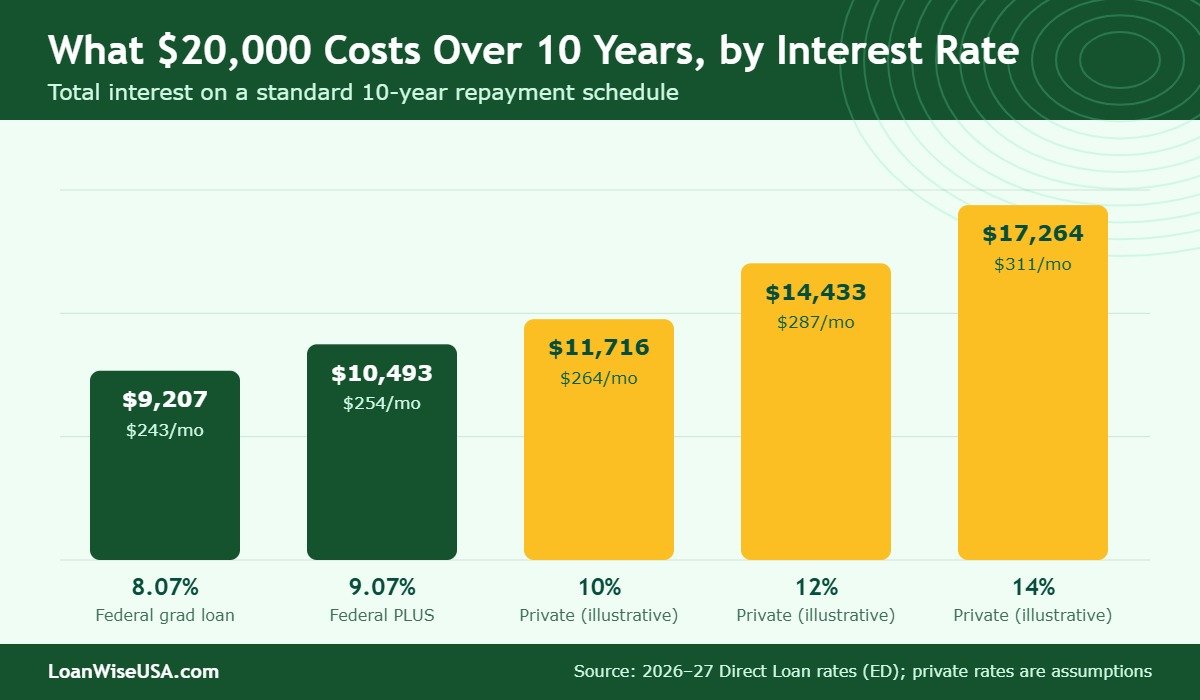
Private student loan rates depend on credit, so a borrower with a strong cosigner may beat the federal PLUS rate, while a thin-credit borrower may pay much more. The table shows the cost of borrowing $20,000 on a standard 10-year repayment schedule at different fixed rates. The 10%, 12% and 14% rows are illustrative assumptions, not lender quotes.
| Fixed rate | Monthly payment | Total interest over 10 years |
|---|---|---|
| 8.07% (federal grad unsubsidized) | $243 | $9,207 |
| 9.07% (federal PLUS) | $254 | $10,493 |
| 10% (illustrative private) | $264 | $11,716 |
| 12% (illustrative private) | $287 | $14,433 |
| 14% (illustrative private) | $311 | $17,264 |
Interest is only part of the comparison. Federal loans come with protections most private loans don’t: income-driven repayment through the new Repayment Assistance Plan (see our breakdown of RAP vs. IBR payments), deferment and forbearance rights, discharge if the borrower dies or becomes totally and permanently disabled, and eligibility for Public Service Loan Forgiveness. Private loans don’t qualify for PSLF, which matters a lot for future doctors, nurses and lawyers planning careers at nonprofit hospitals or in government.
What’s the smartest order to fill the gap?
- Free money first. Ask about scholarships, assistantships, fellowships and tuition waivers. The AP, citing the American Enterprise Institute, reports that at least 40 schools have cut the price of some programs since the caps took effect, and some schools have launched need-based scholarships or their own loan programs.
- Employer and service programs. Tuition assistance, military benefits and service-based repayment programs can reduce how much you borrow.
- Federal loans up to the cap. Federal Direct Loans have fixed rates, no credit check for unsubsidized loans and the strongest protections. Use them before private debt.
- Private loans only for the remaining gap. Borrow the exact shortfall, not the maximum a lender approves.
What to compare before you sign a private student loan
- APR, not just the rate: APR includes fees, so it lets you compare offers fairly.
- Fixed vs. variable: A variable rate can start lower but rises when market rates do. With the Fed still debating its next move (see our October Fed decision explainer), a fixed rate gives you certainty.
- Cosigner release: Check how many on-time payments it takes before a parent or relative can be released.
- Hardship options: Ask how long forbearance lasts and whether payments can be reduced if your income drops.
- Death and disability discharge: Make sure the debt is cancelled, not passed to a cosigner, if the student dies or becomes disabled.
- In-school repayment: Paying even the interest while in school stops it from being added to your balance.
Before applying with a cosigner, both of you should pull your credit reports and fix any mistakes; our guide on how to dispute a credit report error walks through it. Avoid using general-purpose personal loans or credit cards to pay tuition, as they usually cost more and lack student loan protections.
Checklist: what to do before your next aid deadline
- Log in to StudentAid.gov and total your outstanding federal loans to see how close you are to the $100,000, $200,000 or $257,500 caps.
- Ask your aid office whether you qualify for the legacy provision and how your program is classified (graduate or professional).
- Check whether you’ll be enrolled full time, because part-time enrollment reduces your federal limit.
- Calculate your gap: cost of attendance minus grants, scholarships and federal loans.
- Get prequalified rates from at least three private lenders (prequalification usually uses a soft credit check).
- Compare APR, fixed vs. variable rates, cosigner release and hardship options side by side.
- Estimate your monthly payment against a realistic starting salary in your field.
- Keep federal loans separate from private loans if you might pursue PSLF, since refinancing federal loans into a private loan ends federal protections. (Our post on when refinancing student loans makes sense explains the trade-off.)
FAQ
Did undergraduate federal loan limits change?
No. Dependent undergraduates can still borrow $5,500 to $7,500 a year in Direct Loans, up to $31,000 total. What changed for undergrads is the Parent PLUS cap and the proration for part-time enrollment.
Is Grad PLUS completely gone?
For new borrowers, yes, as of July 1, 2026. Students covered by the legacy provision can still use it for up to three academic years in the same program.
Does the $257,500 lifetime cap include Parent PLUS loans?
No. The lifetime cap covers a student’s own federal loans. Parent PLUS loans have their own $65,000-per-student limit.
Can I get a federal loan for the gap if I’m turned down by private lenders?
No. Once you hit the federal annual or aggregate limit, there is no federal loan for the remainder. Options include a creditworthy cosigner, school-based loans, payment plans, a lighter course load or a less expensive program.
Do private student loans qualify for income-driven repayment or PSLF?
No. Those programs are only for federal Direct Loans. Some private lenders offer temporary hardship programs, but terms vary by lender.
This article is general information, not financial advice. Loan limits, program classifications and rates can change, so confirm details with your school’s financial aid office and StudentAid.gov before you borrow.
Share this infographic
Writing about the new federal student loan caps? You are welcome to share our “New Federal Student Loan Limits” infographic on your site. Just copy the code below so it links back to this article as the source.
<a href="https://loanwiseusa.com/federal-student-loan-limits-2026/"><img src="https://loanwiseusa.com/wp-content/uploads/2026/11/federal-student-loan-limits-2026-limits-at-a-glance.jpg" alt="New federal student loan limits 2026: graduate $20,500/yr, professional $50,000/yr, Parent PLUS $20,000/yr, $257,500 lifetime cap" width="1200" /></a><br />Source: <a href="https://loanwiseusa.com/federal-student-loan-limits-2026/">LoanWiseUSA – New Federal Student Loan Limits Are Pushing Borrowers to Private Lenders: The 2026 Caps and How to Fill the Gap</a>Related reading on LoanWiseUSA
- How PSLF Works: Who Qualifies, What Counts and How to Get Your Loans Forgiven
- SAVE Plan Is Ending: Your Deadline, RAP vs. IBR Payments and What Happens If You Do Nothing
- Best Time to Refinance Student Loans Before Year-End 2026
- Student Loan Defaults Are Back — What Borrowers Need to Know Now
Sources
- Associated Press: New limits on federal student loans are steering many borrowers toward private lenders (Nov. 6, 2026)
- Georgetown University Office of Student Financial Aid: Key Changes to Federal Student Loans Effective in July 2026
- University of Washington Student Financial Aid: Federal Loan Updates for 2026–27
- Catholic University of America: Direct Loan Fixed Interest Rates and Fees 2026–2027
- Federal Student Aid (StudentAid.gov): Direct Subsidized and Unsubsidized Loans
- Consumer Financial Protection Bureau: Student loans

[…] federal borrowing caps, which is pushing more of them toward private loans; our breakdown of the 2026 federal student loan limits shows how big that gap can […]