


Quick answer: If you bought a new, U.S.-assembled car, SUV, pickup, van or motorcycle for personal use with a loan taken out after Dec. 31, 2024, you can deduct up to $10,000 of the interest you pay each year from 2025 through 2028 — even if you take the standard deduction. The deduction shrinks once modified AGI passes $100,000 (single) or $200,000 (joint). The IRS’s final regulations, published Sept. 8, 2026, take effect Nov. 9, 2026, and 2026 is the first year lenders must send the new Form 1098-VLI without the 2025 transition relief.
The “no tax on car loan interest” break from the One Big Beautiful Bill Act has been on the books since 2025, but a lot of details were fuzzy until the Treasury Department finalized the rules this fall. If you’re shopping for a car before year-end or already making payments on a 2025 or 2026 purchase, here’s what the final rules mean for your 2026 tax return — with real dollar examples.
What changes on Nov. 9, 2026?
Treasury and the IRS published final regulations (T.D. 10054) in the Federal Register on Sept. 8, 2026, and they become effective on Nov. 9, 2026. They replace the proposed rules issued at the end of 2025 (REG-113515-25) and settle several questions that borrowers and lenders had been asking:
- Vehicle definitions: The final rules list the eligible vehicle types as cars, minivans, vans, SUVs, pickup trucks and motorcycles with a gross vehicle weight rating under 14,000 pounds, and they loosened the earlier weight-based definitions of SUVs, pickups and motorcycles.
- “Secured by a first lien”: The loan must be secured by a first lien on the vehicle. The final rules explain how this works when a lien is recorded late because of processing delays.
- What can be financed: Items customarily financed with a car, such as sales tax, title and registration fees, service plans and extended warranties, can count as part of the qualifying loan. Negative equity rolled in from a trade-in does not count, and neither do insurance premiums.
- Lender reporting: Lenders that receive $600 or more of interest from an individual on a qualifying loan must report it on Form 1098-VLI. The 2025-only transition relief (Notice 2025-57) is not being repeated in the final rules, so expect a formal statement for 2026 interest.
Who qualifies for the car loan interest deduction?
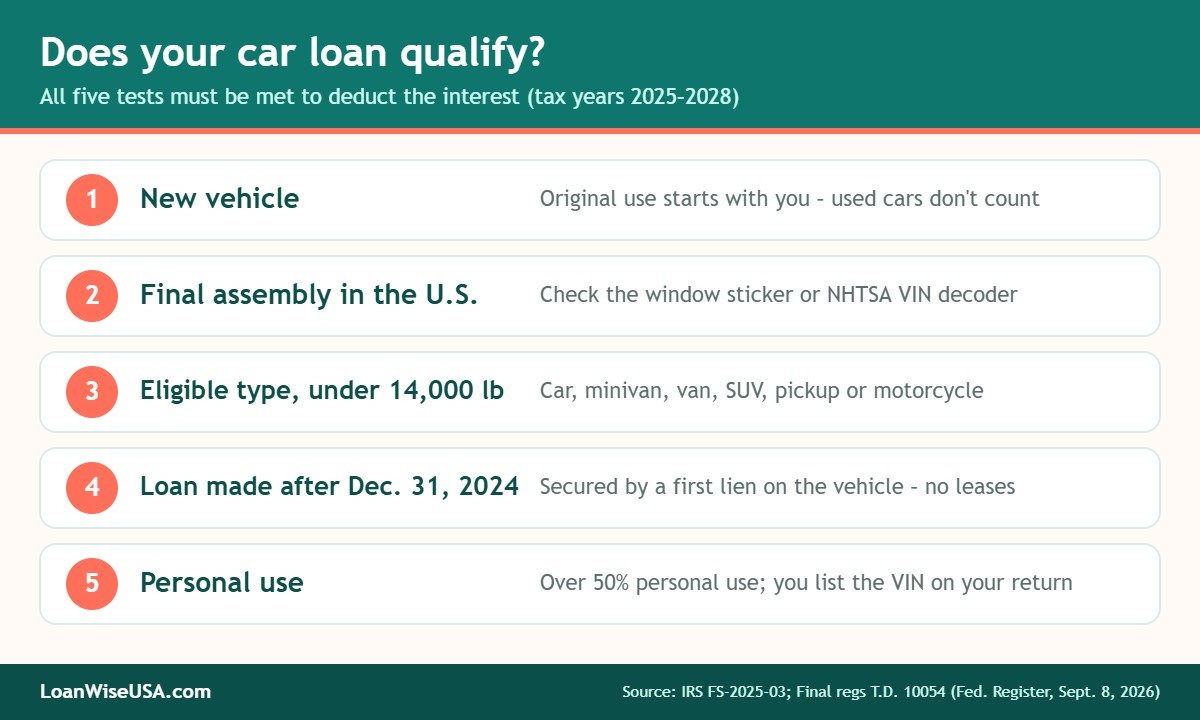
You need to pass three sets of tests: one for the vehicle, one for the loan and one for your income.
Does my vehicle qualify?
| Requirement | What it means |
|---|---|
| New vehicle | The original use must start with you. Used cars do not qualify, and dealer demo vehicles generally don’t either. |
| Final assembly in the U.S. | Check the “final assembly point” on the window sticker or decode the VIN with NHTSA’s free VIN decoder. |
| Eligible type | Car, minivan, van, SUV, pickup truck or motorcycle built mainly for public roads. |
| Weight | Gross vehicle weight rating under 14,000 pounds. |
| Personal use | Expected to be used more than 50% for personal (not business) purposes when you take out the loan. |
Does my loan qualify?
- It was originated after Dec. 31, 2024, to buy the vehicle.
- It is secured by a first lien on that vehicle.
- It is not a lease. Lease payments don’t qualify, and buying out a leased car at the end of the lease generally fails the new-vehicle test.
- It is not credit card debt, and it is not a loan used for business use of the car.
- If you refinance, the new loan still qualifies, but only up to the balance left on the original loan. Cash-out amounts and refinancing charges don’t qualify.
Only the interest is deductible, never the principal. If you’re still deciding how to finance a car, it’s also worth checking your credit file first: an error can push you into a higher rate tier. Our guide on how to dispute a credit report error walks through the process.
How much can I deduct?
The cap is $10,000 per tax return per year, regardless of filing status. Married couples filing jointly do not get $20,000; if you have two qualifying loans, you add the interest together and then apply the $10,000 cap.
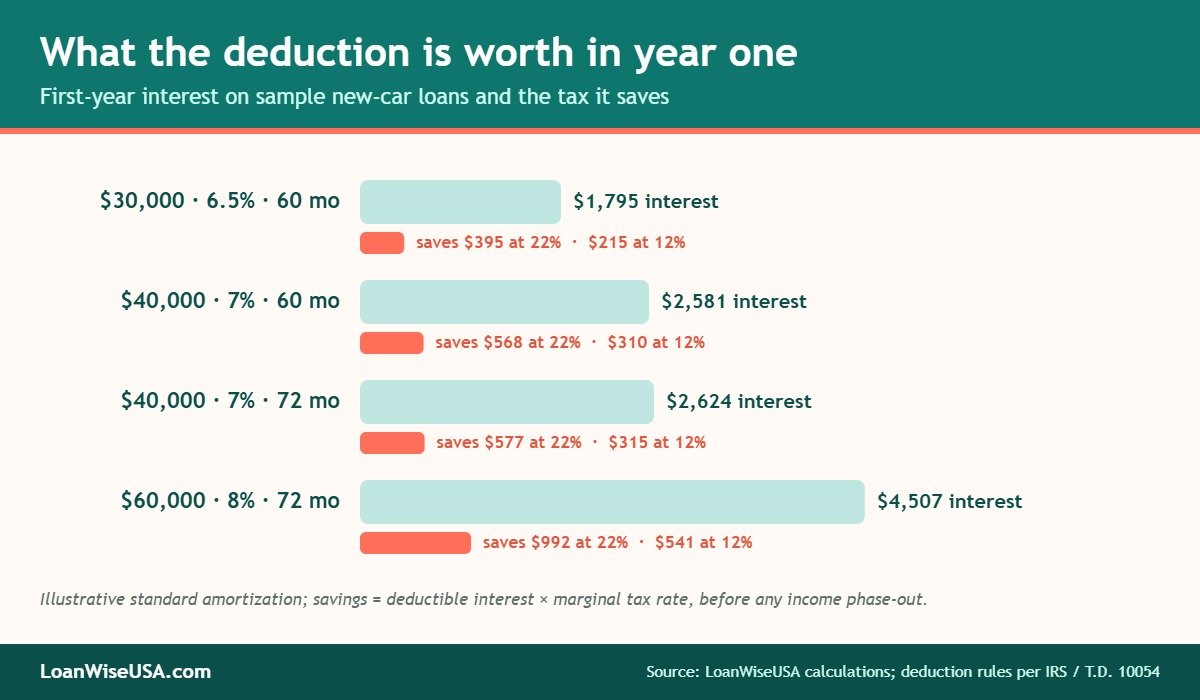
Most borrowers won’t come close to the cap. Here is what first-year interest looks like on a few typical loans (illustrative examples using standard amortization):
| Loan | Monthly payment | Interest in year 1 | Tax saved at 12% rate | Tax saved at 22% rate |
|---|---|---|---|---|
| $30,000, 6.5%, 60 months | $587 | $1,795 | $215 | $395 |
| $40,000, 7%, 60 months | $792 | $2,581 | $310 | $568 |
| $40,000, 7%, 72 months | $682 | $2,624 | $315 | $577 |
| $60,000, 8%, 72 months | $1,052 | $4,507 | $541 | $992 |
Interest falls each year as you pay down the balance. On the $40,000, 7%, 60-month loan, deductible interest drops from about $2,581 in year one to $2,080 in year two and $1,543 in year three.
Does the deduction save as much as it sounds?
No. A deduction reduces taxable income, not your tax bill dollar for dollar. Your savings equal the deductible interest times your marginal tax rate. A $2,581 deduction saves about $310 in the 12% bracket and about $568 in the 22% bracket. That’s helpful, but it shouldn’t be the reason to buy a more expensive car or accept a higher interest rate.
How does the income phase-out work?
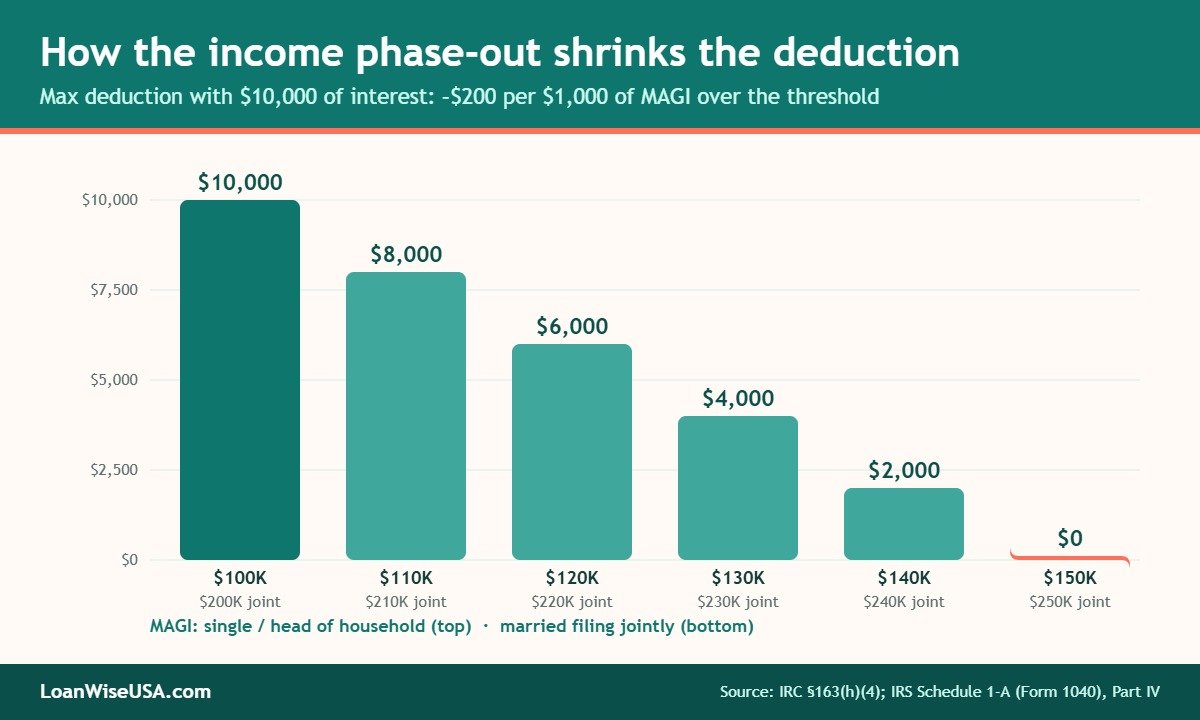
The deduction is reduced by $200 for every $1,000 (or part of $1,000) of modified adjusted gross income above $100,000 for single and head-of-household filers, or $200,000 for married couples filing jointly. The reduction comes off your actual deduction (your interest, up to $10,000), not just the cap.
- Single filer, MAGI $112,500, $4,507 of interest: $12,500 over the threshold rounds up to 13 × $200 = $2,600 reduction. Deduction: $4,507 − $2,600 = $1,907.
- Married filing jointly, MAGI $210,000, $2,581 of interest: $10,000 over = 10 × $200 = $2,000 reduction. Deduction: $581.
- Single filer, MAGI $150,000 or more: the reduction is at least $10,000, so no deduction is left even with the maximum interest.
Because the phase-out is steep, someone just over the threshold with modest interest can lose the deduction entirely. A single filer with $1,795 of interest loses it entirely once MAGI tops about $108,000.
Do I need to itemize?
No. This is one of the few interest deductions available to people who take the standard deduction. On a 2025 return it was claimed on Schedule 1-A (Form 1040), Part IV, “No Tax on Car Loan Interest,” and the result flows to line 13b of Form 1040. Expect the same approach for 2026 returns, but confirm with the 2026 form and instructions when they’re released.
You must list the vehicle identification number (VIN) of each qualifying vehicle on your return for every year you claim the deduction. If you owe tax and can’t pay it all at once next spring, read our walkthrough on how to set up an IRS payment plan before you file.
What is Form 1098-VLI?
Form 1098-VLI, the Vehicle Loan Interest Statement, is the new information return lenders use to report qualifying car loan interest. A lender that receives $600 or more of interest from you in a calendar year on a qualifying loan has to file it with the IRS and send you a copy. It shows the interest received, the principal balance at the start of the year, the loan origination date, and the vehicle’s year, make, model and VIN.
For 2025 interest only, Notice 2025-57 let lenders satisfy the rule by simply making the yearly interest total available, such as on an online portal or annual statement. The final regulations don’t extend that relief, so 2026 is the first full year of formal 1098-VLI reporting. The statement must also warn that not all of the interest shown may be deductible, because the lender doesn’t know your income or whether the vehicle meets every test.
Should I buy a car before Dec. 31 to get the deduction?
Probably not for tax reasons alone. The deduction applies to interest you actually pay during the year. A loan signed in mid-December with a first payment due in January may generate little or no deductible interest for 2026. The deduction will still be there for 2027 and 2028 on the same loan, so timing a purchase around the calendar rarely changes the total much.
What matters far more is the rate you lock in. Auto rates move with broader borrowing costs; see our recap of the Fed’s October 2026 rate decision for context. A 1-point lower APR on a $40,000, 60-month loan saves roughly $1,100 in interest over the life of the loan, which usually beats the tax benefit.
What if I have weak credit or want to refinance?
The deduction doesn’t change who gets approved. If your credit is bruised, compare credit unions and banks before accepting dealer financing, and don’t let a monthly-payment pitch hide a long term or high APR. Our guide to borrowing with bad credit covers how to compare real costs. If you refinance a qualifying loan later, remember that only the portion up to your old balance stays deductible.
Checklist: before you claim car loan interest on your 2026 return
- Confirm the vehicle was new and that original use began with you.
- Check final assembly in the U.S. on the window sticker or with the NHTSA VIN decoder.
- Confirm the loan date is after Dec. 31, 2024, and that the loan is secured by the vehicle.
- Estimate your modified AGI and apply the $200-per-$1,000 phase-out.
- Watch for Form 1098-VLI (or your lender’s year-end statement) showing 2026 interest.
- Subtract any interest tied to negative equity, cash-out refinancing or business use.
- Write down the VIN for your return.
- Keep the purchase contract, window sticker and loan documents with your tax records.
FAQ
Can I deduct interest on a used car loan?
No. The vehicle must be new, with original use starting with you.
Does a leased car qualify?
No. Lease payments are not loan interest, and buying out a lease generally fails the new-vehicle test.
Do foreign-brand cars qualify?
Brand doesn’t matter; the final assembly location does. Many foreign-brand models are assembled in the U.S., and some domestic-brand models aren’t. Check the specific vehicle’s VIN or window sticker.
Is the deduction permanent?
No. It applies for tax years 2025 through 2028 unless Congress extends it.
Can both spouses claim $10,000 on a joint return?
No. The $10,000 limit applies per return. Married couples filing separately can each claim up to $10,000, subject to their own phase-out rules.
This article is general information, not tax, legal or financial advice. Tax rules can change, and your situation may differ; consider talking with a qualified tax professional before making decisions.
Share this infographic
Bloggers, credit unions, tax preparers and newsrooms are welcome to republish our “Does your car loan qualify?” checklist. Copy the code below to embed it on your site with a credit link to LoanWiseUSA.
<a href="https://loanwiseusa.com/car-loan-interest-deduction-2026/"><img src="https://loanwiseusa.com/wp-content/uploads/2026/11/car-loan-interest-deduction-2026-qualify-checklist.jpg" alt="Does your car loan qualify for the car loan interest deduction? 5-point checklist" width="1200" /></a><br />Source: <a href="https://loanwiseusa.com/car-loan-interest-deduction-2026/">LoanWiseUSA – Car Loan Interest Deduction 2026: Final IRS Rules Take Effect Nov. 9 — Who Qualifies for Up to $10,000</a>Related reading on LoanWiseUSA
- How to Set Up an IRS Payment Plan: Fees, Interest and Step-by-Step Guide
- How to Get a Personal Loan With Bad Credit: Options, Real Costs and a Step-by-Step Plan
- How to Dispute a Credit Report Error: Step-by-Step Guide
- Fed Holds Rates at 3.75%–4% on Oct. 28, 2026: What It Means for Your Borrowing Costs
Sources
- Federal Register: Car Loan Interest Deduction, final regulations (T.D. 10054), Sept. 8, 2026
- IRS IR-2025-129: Treasury, IRS provide guidance on the new deduction for car loan interest
- IRS FS-2025-03: Tax deductions for working Americans and seniors
- IRS IR-2025-105 / Notice 2025-57: 2025 transition relief for lender reporting
- IRS: About Form 1098-VLI, Vehicle Loan Interest Statement
- IRS Schedule 1-A (Form 1040)
- NHTSA VIN Decoder