

How Much House Can I Afford on a $100K Salary? The 28/36 Rule With Real Numbers

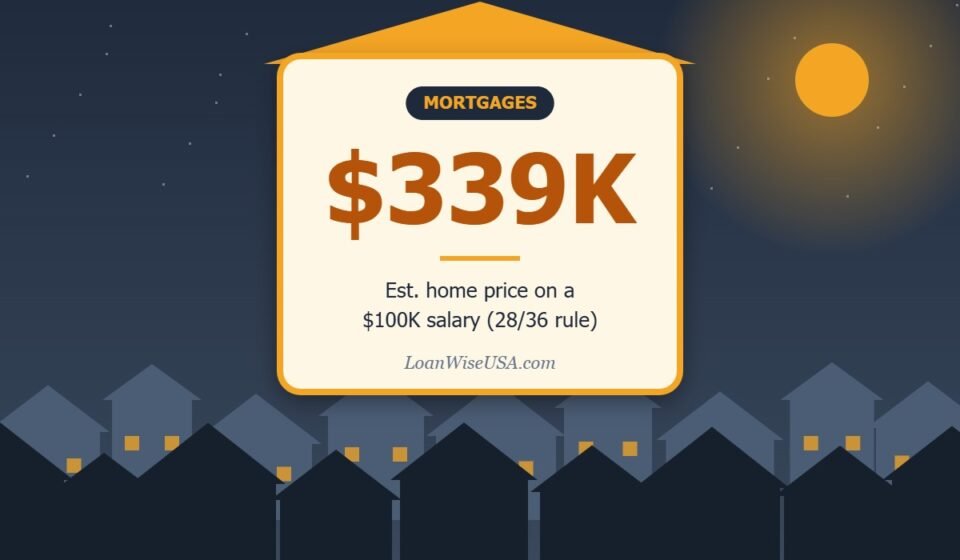
Quick answer: On a $100,000 salary, the classic 28/36 rule caps your total housing payment at about $2,333 a month (28% of $8,333 gross monthly income). At Freddie Mac’s latest average 30-year fixed rate of 7.24%, with 20% down, a 1% property tax rate and $200 a month for homeowners insurance, that buys a home of roughly $339,000. Existing debt, a smaller down payment, higher taxes or a higher rate can push that number down fast, while lenders may approve you for much more than is comfortable.
“How much house can I afford?” is one of the most searched money questions in America, and online calculators often give answers that are either too rosy or impossible to check. This guide shows the actual math, step by step, so you can plug in your own numbers. We use a $100,000 salary as the main example, then show how the answer changes at $50,000 to $150,000, with different debts, and at different mortgage rates.
What is the 28/36 rule?
The 28/36 rule is a long-standing guideline used by lenders and financial planners. It has two parts:
- 28% (front-end ratio): your total monthly housing cost (principal, interest, property taxes, homeowners insurance, plus mortgage insurance and HOA dues if you have them, often shortened to PITI) should be no more than 28% of your gross monthly income.
- 36% (back-end ratio): your housing cost plus all other monthly debt payments (car loans, student loans, credit card minimums, personal loans, child support) should be no more than 36% of gross monthly income.
The back-end figure is your debt-to-income ratio, or DTI. The Consumer Financial Protection Bureau defines DTI as all your monthly debt payments divided by your gross monthly income, meaning pay before taxes and deductions. Whichever of the two limits is lower is the one that sets your budget.
How much house can I afford on a $100K salary? The step-by-step math
Here is the full calculation for a single buyer (or couple) earning $100,000 a year with no other debts.
Step 1: Find your gross monthly income
$100,000 ÷ 12 = $8,333 a month.
Step 2: Apply the 28% and 36% limits
28% × $8,333 = $2,333 maximum housing payment. 36% × $8,333 = $3,000 maximum for housing plus all other debts. With no other debts, the $2,333 housing limit is the binding one.
Step 3: Subtract taxes and insurance
Your mortgage payment is only part of the bill. We assume a 1% annual property tax rate and $200 a month for homeowners insurance. Both vary widely by state and county, so check local figures. On a $339,000 home, taxes are about $283 a month, leaving roughly $1,850 for principal and interest.
Step 4: Turn the payment into a loan amount
At a 7.24% rate on a 30-year fixed loan, every $1,000 borrowed costs about $6.81 a month in principal and interest. So $1,850 ÷ $6.81 × $1,000 ≈ $271,500 loan.
Step 5: Add your down payment
With 20% down, a $271,500 loan is 80% of the price, so the home price is about $339,400 and the down payment is about $67,900 (plus closing costs).
| Line item ($100K salary, 20% down, 7.24%) | Monthly |
|---|---|
| Principal and interest on $271,532 loan | $1,850 |
| Property tax (1% of $339,415 per year) | $283 |
| Homeowners insurance (assumed) | $200 |
| Total housing payment (28% of income) | $2,333 |
Monthly payment figures are rounded. Your own numbers will differ with your rate, tax bill, insurance quote and any HOA dues.
How much house can you afford at other salaries?
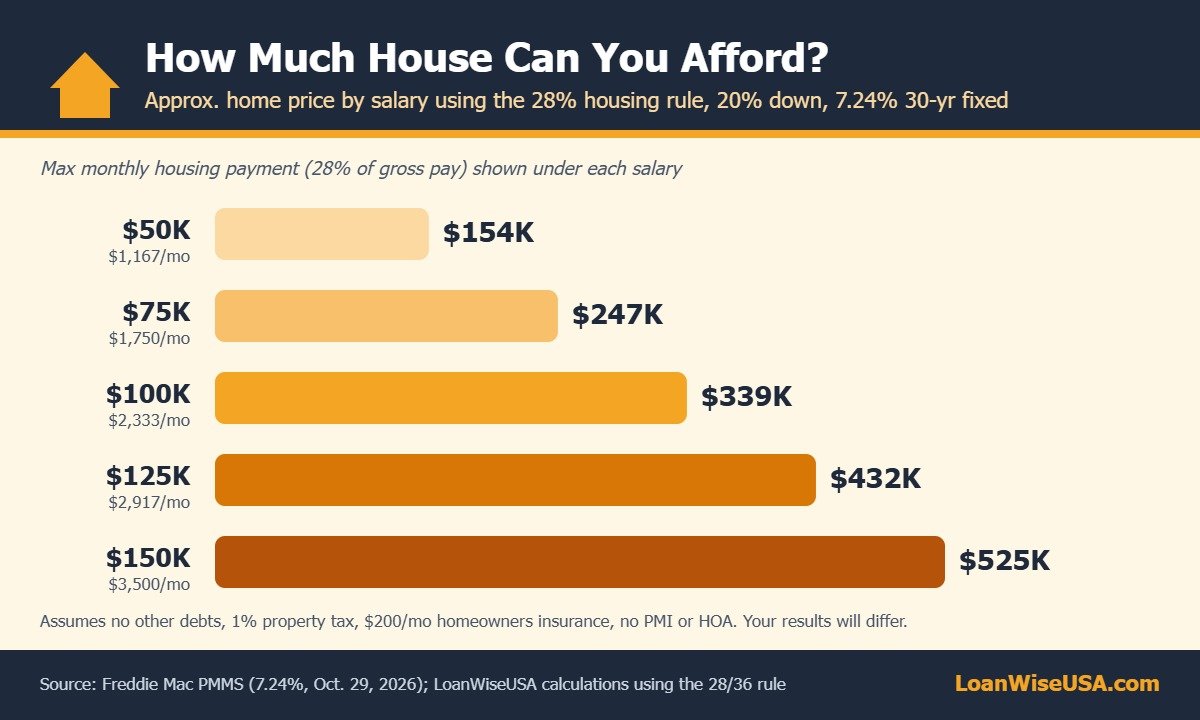
Using the same assumptions (28% housing ratio, no other debts, 20% down, 7.24% 30-year fixed, 1% property tax, $200 a month insurance), here is the rough price range by income:
| Annual salary | Max housing payment (28%) | Approx. home price | 20% down payment |
|---|---|---|---|
| $50,000 | $1,167 | $153,800 | $30,760 |
| $75,000 | $1,750 | $246,600 | $49,320 |
| $100,000 | $2,333 | $339,400 | $67,880 |
| $125,000 | $2,917 | $432,200 | $86,440 |
| $150,000 | $3,500 | $525,000 | $105,000 |
Notice that the insurance cost is a fixed $200 in every row. That is why the lowest salary buys proportionally less house: fixed costs eat a bigger share of a smaller budget.
How do my other debts change what I can afford?
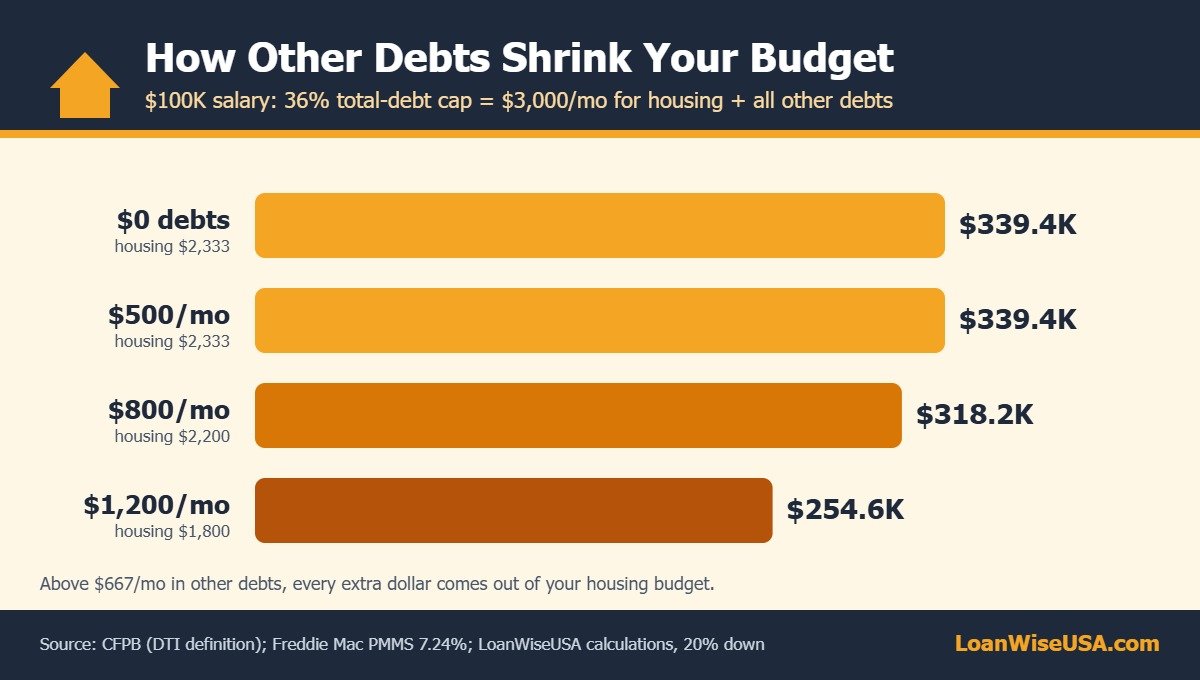
This is where many buyers get surprised. The 36% back-end limit means every dollar of other debt payments can reduce your housing budget once your debts pass a certain point. For a $100,000 earner, the 36% cap is $3,000 a month. As long as other debts are $667 a month or less, the 28% housing limit still binds. Above that, each extra dollar of debt comes straight out of the housing budget.
| Other monthly debts ($100K salary) | Max housing payment | Approx. home price |
|---|---|---|
| $0 | $2,333 | $339,400 |
| $500 (e.g., one car loan) | $2,333 | $339,400 |
| $800 (car + student loan) | $2,200 | $318,200 |
| $1,200 (car + student loan + cards) | $1,800 | $254,600 |
Going from $0 to $1,200 a month in other payments cuts the affordable price by about $85,000 under the 28/36 rule. If you carry student loans, check what your new monthly payment will be under the current repayment plans; our guide to RAP vs. IBR payments after the SAVE plan walks through the numbers. Paying off a small balance before applying, or avoiding a new car loan until after closing, can make a real difference.
How much do mortgage rates change what I can afford?
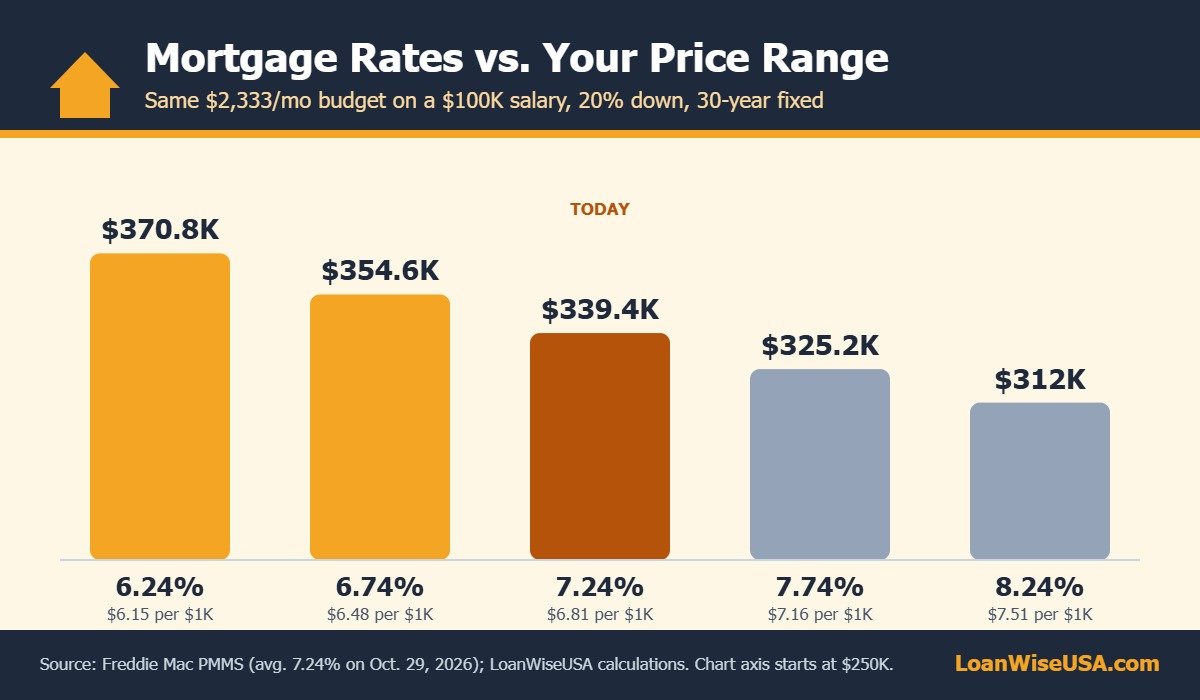
Rates matter almost as much as income. Keeping the same $2,333 payment budget and 20% down for a $100,000 earner:
| 30-year fixed rate | P&I per $1,000 borrowed | Approx. home price |
|---|---|---|
| 6.24% | $6.15 | $370,800 |
| 6.74% | $6.48 | $354,600 |
| 7.24% (Freddie Mac avg., Oct. 29, 2026) | $6.81 | $339,400 |
| 7.74% | $7.16 | $325,200 |
| 8.24% | $7.51 | $312,000 |
Each half-point move in rates shifts the affordable price by roughly $13,000 to $16,000 at this income. That is why the Federal Reserve’s decisions get so much attention from buyers; see our breakdown of the Fed’s October 2026 rate decision for how policy rates flow into mortgage pricing. One way to lower your own rate is to buy discount points, which makes sense only if you keep the loan long enough to pass the break-even point; our guide to how mortgage points work shows the math.
What if I put down less than 20%?
You do not need 20% down to buy a home. Conventional loans backed by Fannie Mae and Freddie Mac allow as little as 3% down for eligible buyers, and FHA loans allow 3.5% down with a credit score of 580 or higher. But a smaller down payment has two costs: a bigger loan, and mortgage insurance on top of the payment.
Example: the same $100,000 earner putting 5% down, with private mortgage insurance assumed at 0.5% of the loan per year for illustration (actual PMI pricing depends on your credit score, down payment and insurer):
| Scenario ($2,333 budget, 7.24%) | 20% down | 5% down |
|---|---|---|
| Approx. home price | $339,400 | $276,900 |
| Cash for down payment | $67,900 | $13,800 |
| Loan amount | $271,500 | $263,100 |
| Principal and interest | $1,850 | $1,793 |
| Property tax + insurance | $483 | $431 |
| Mortgage insurance | $0 | $110 |
With the same monthly budget, the low-down-payment buyer can afford about $62,500 less house, because the loan has to cover 95% of the price instead of 80%, and PMI takes another slice of the budget. The trade-off is that you can buy years sooner instead of waiting to save $68,000.
What will a lender actually approve?
The 28/36 rule is a comfort guideline, not a hard legal limit. Lenders often approve higher ratios:
| Loan type | Typical maximum total DTI | Source |
|---|---|---|
| Conventional, manually underwritten | 36%, up to 45% with credit score and reserve requirements | Fannie Mae Selling Guide B3-6-02 |
| Conventional, Fannie Mae Desktop Underwriter | Up to 50% | Fannie Mae Selling Guide B3-6-02 |
| FHA, manually underwritten (no compensating factors) | 31% housing / 43% total | HUD Handbook 4000.1 |
A 50% DTI on a $100,000 salary allows $4,167 a month in total debt payments. With no other debts, that could stretch the price toward $540,000 under our assumptions, about $200,000 more than the 28/36 rule suggests. Being approved for that amount does not mean it fits your budget. Remember that DTI uses gross income: after federal and state income tax, Social Security, Medicare, retirement contributions and health insurance, a $4,167 payment could take well over half of your take-home pay.
What other costs should I budget for?
- Closing costs: lender fees, title insurance, appraisal and prepaid items are due at closing. Your Loan Estimate lists them; compare estimates from at least three lenders.
- Cash reserves: keep an emergency fund after closing. Some loan programs require a set number of months of reserves.
- Maintenance and repairs: roofs, water heaters and HVAC systems wear out on their own schedule, not yours.
- HOA dues: these count in the 28% housing ratio and can be several hundred dollars a month in some condo buildings.
- Rising taxes and insurance: both can increase after you buy, which raises your escrow payment even on a fixed-rate loan.
- Utilities and commuting: a bigger or farther-out home can cost more every month even if the mortgage looks affordable.
How to figure out your own budget: a 6-step checklist
- Calculate gross monthly income. Use stable income a lender can document (salary, consistent bonuses, two years of self-employment income).
- List every monthly debt payment that will show on your credit report, plus child support or alimony.
- Find your two limits: 28% of income for housing, and 36% of income minus your other debts. Use the lower number.
- Get local tax and insurance numbers. Look up the county’s property tax rate and get an insurance quote for the type of home you want.
- Check your credit before applying. A higher score usually means a lower rate. Pull your free reports and fix any mistakes first; our guide on how to dispute a credit report error explains the process and the 30-day timeline.
- Get preapproved, then shop below the maximum. Compare Loan Estimates, and set your own ceiling based on your take-home pay and savings goals, not the lender’s approval amount.
Common mistakes to avoid
- Treating the preapproval amount as a target. It is the most a lender will lend, not the amount you should spend.
- Forgetting taxes, insurance and HOA dues. A $1,850 principal-and-interest payment can become $2,333 or more once these are added.
- Taking on new debt before closing. Financing furniture, a car or using buy now, pay later plans can change your DTI and even derail an approval.
- Draining all savings for the down payment. Leave room for closing costs, moving expenses and an emergency fund.
- Ignoring rate changes. A preapproval at one rate does not lock that rate; a half-point rise can cut your price range by about $15,000 at a $100,000 income.
Frequently asked questions
Is $100K a good salary to buy a house?
It depends heavily on where you live. Under the 28/36 rule with 20% down and today’s average rate, $100,000 supports a home price of about $339,000. That works in many areas but falls short in high-cost metros. A larger down payment, a co-borrower’s income or a lower rate would raise the figure.
Should I use gross or take-home pay?
Lenders use gross income for DTI. For your personal budget, also check the payment against take-home pay; many people feel more comfortable when housing stays well below a third of what actually lands in their bank account.
Does the 28/36 rule include property taxes and insurance?
Yes. The 28% housing figure covers principal, interest, property taxes, homeowners insurance, and mortgage insurance and HOA dues if they apply.
Can I buy a house with a DTI above 43%?
Possibly. Fannie Mae allows DTIs up to 50% for loans underwritten through its Desktop Underwriter system, and FHA can allow higher ratios with compensating factors. But higher DTIs leave little room for surprises.
How much should I have saved before buying?
Plan for the down payment, closing costs and an emergency fund that still exists after closing. With 20% down on a $339,000 home, the down payment alone is about $68,000.
The bottom line
On a $100,000 salary, a home price around $339,000 is a reasonable starting point at today’s rates, assuming 20% down and no large debts. Run the five-step math with your own taxes, insurance, debts and rate quote, and treat the lender’s maximum as a ceiling, not a goal.
This article is general information, not financial advice. Mortgage rates, taxes, insurance and loan guidelines change, and your situation is unique. Talk to a licensed loan officer or a HUD-approved housing counselor before making a decision.
Share this infographic
Want to share the salary-to-home-price chart on your own site or blog? Copy the code below and paste it into your page. Please keep the source link so readers can find the full guide.
<a href="https://loanwiseusa.com/how-much-house-can-i-afford-100k-salary/"><img src="https://loanwiseusa.com/wp-content/uploads/2026/11/how-much-house-can-i-afford-by-salary-infographic.jpg" alt="How much house can you afford by salary – LoanWiseUSA infographic" width="1200" /></a><br />Source: <a href="https://loanwiseusa.com/how-much-house-can-i-afford-100k-salary/">LoanWiseUSA – How Much House Can I Afford on a $100K Salary? The 28/36 Rule With Real Numbers</a>Related reading on LoanWiseUSA
- How Mortgage Points Work: Cost, Break-Even Math and When They Pay Off
- Fed Holds Rates at 3.75%–4% on Oct. 28, 2026: What It Means for Your Mortgage
- How to Dispute a Credit Report Error: Step-by-Step Guide
- How to Get a Personal Loan With Bad Credit
Sources
- Freddie Mac, Primary Mortgage Market Survey (30-year fixed 7.24%, week of Oct. 29, 2026)
- Consumer Financial Protection Bureau, What is a debt-to-income ratio?
- Fannie Mae Selling Guide, B3-6-02 Debt-to-Income Ratios
- HUD, Single Family Housing Policy Handbook 4000.1
- CFPB, Buying a House: Tools and Resources for Homebuyers



[…] daily lender quotes to move first. To see how rate moves change your own budget, our guide to how much house you can afford on a $100K salary shows the price range at rates from 6.24% to […]