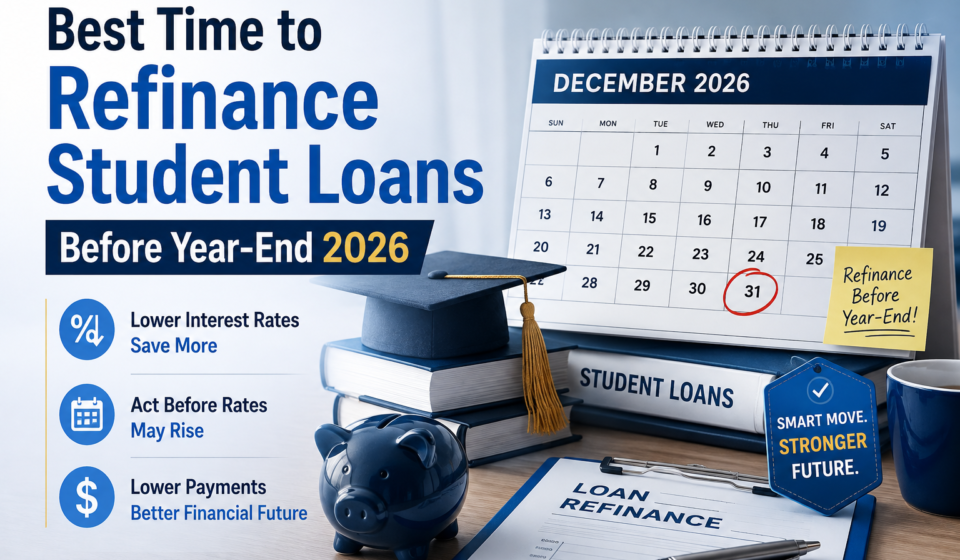

If you’ve been sitting on private student loan debt and watching interest rate headlines all year, the next few months matter more than most. Multiple rate cuts are expected before December, refinance rates are already easing off their 2026 highs, and a handful of federal policy changes are reshaping who actually benefits from refinancing right now. Here’s how to think about timing your move before the calendar flips to 2027.
Why Year-End Is a Realistic Window This Time
Rate forecasters have been pointing to additional Federal Reserve cuts in the final months of 2026, with some analysts floating the possibility of a larger-than-usual cut if inflation data cooperates. Lower Fed rates don’t instantly translate into lower student loan refinance rates, but private lenders do tend to adjust their offers downward as borrowing costs fall across the market.
That’s part of why December has historically been a reasonable time to look into refinancing: locking in a rate before year-end can put you in a better position heading into the new year, especially if your credit has improved since you first borrowed.
The Bigger Factor: Who Should Actually Refinance Right Now
Rate timing is only half the picture. 2026 also brought real structural changes to federal student loans that change the refinancing calculus for a lot of borrowers.
You might be a strong candidate to refinance before year-end if:
- You hold private student loans only, since these were never eligible for federal forgiveness or income-driven repayment protections in the first place.
- Your credit score has climbed since you originally borrowed, which is one of the clearest signals that you’ll qualify for a meaningfully lower rate than what you’re currently paying.
- You’re not relying on Public Service Loan Forgiveness. If you’re mid-way through the 10-year PSLF clock, refinancing federal loans into a private loan forfeits that benefit permanently, and it’s rarely worth it this close to a tax-free payoff.
- You have a stable, predictable income. Refinancing federal loans strips away income-driven repayment safety nets, which matter more for freelancers, early-stage founders, or anyone with seasonal income swings.
- Your outstanding balance is large enough that a rate reduction actually moves the needle. On smaller balances, even a decent rate cut may only save you a few hundred dollars over the life of the loan, which may not be worth losing federal protections for.
You may want to wait if:
- You have federal loans originated before July 1, 2026. These borrowers currently fall under a multi-year transition window tied to recent federal loan policy changes, and the practical effects are still shaking out. Locking into a private refinance before understanding how that transition applies to you can be a costly, irreversible decision.
- You’re a Parent PLUS borrower. Recent changes mean PLUS loans taken out on or after July 1, 2026 lose access to income-driven repayment, which changes the refinancing trade-off math significantly and is worth researching before you refinance either the new or existing loan.
- You’re still counting on loan forgiveness under an income-driven plan.
What Current Rates Actually Look Like
As of this year, federal loan rates for the 2026–27 school year were set at roughly 6.52% for undergraduate direct loans and 8.07% for graduate unsubsidized loans, both fixed by formula rather than market conditions. Private refinance rates, by contrast, move with the market and currently span a wide range, generally landing somewhere between the mid-single digits and the mid-teens depending on credit profile, loan term, and whether you choose a fixed or variable rate.
That spread matters. It means two borrowers with identical balances but different credit scores could see wildly different outcomes from refinancing the same debt, which is exactly why prequalifying with more than one lender before you commit is worth the extra 20 minutes.
A Simple Year-End Refinancing Checklist
- Check your credit score first. Most private lenders want at least good-to-excellent credit to offer their best rates, and some set a hard minimum around the 650 mark.
- Prequalify with 2–3 lenders. This typically uses a soft credit pull, so you can compare real rate offers without dinging your score.
- Compare fixed vs. variable carefully. Variable rates are lower today but can rise later; fixed rates lock in certainty, which matters more the longer your remaining loan term is.
- Run the numbers on total interest, not just monthly payment. A lower monthly payment stretched over a longer term can sometimes cost more in total interest than staying put.
- Confirm what you’re giving up. Before signing anything, get clear on whether you’re forfeiting PSLF eligibility, income-driven repayment access, or any federal forbearance options.
- Apply with enough lead time. Year-end brings higher loan volume industry-wide; online lenders generally process faster than banks, but starting in November rather than the week before New Year’s gives you a real cushion.
Bottom Line
Year-end 2026 is shaping up to be a genuinely useful window for a specific group of borrowers: private-loan holders with improved credit, stable income, and no forgiveness program on the table. For federal borrowers still navigating the post-2026 transition rules, or anyone pursuing PSLF, the smarter move may be watching the rate environment through December while holding off on an irreversible refinance until the new federal repayment landscape fully settles.