


Most engineering teams don’t get into trouble because they lack talent. They get into trouble because a deployment goes out on a Friday afternoon, something breaks in a way nobody caught in testing, and the next four hours turn into a scramble across Slack channels trying to figure out which of the six changes bundled into that release actually caused the problem. That scenario is still incredibly common — and it’s also almost entirely avoidable with the tooling available in 2026.
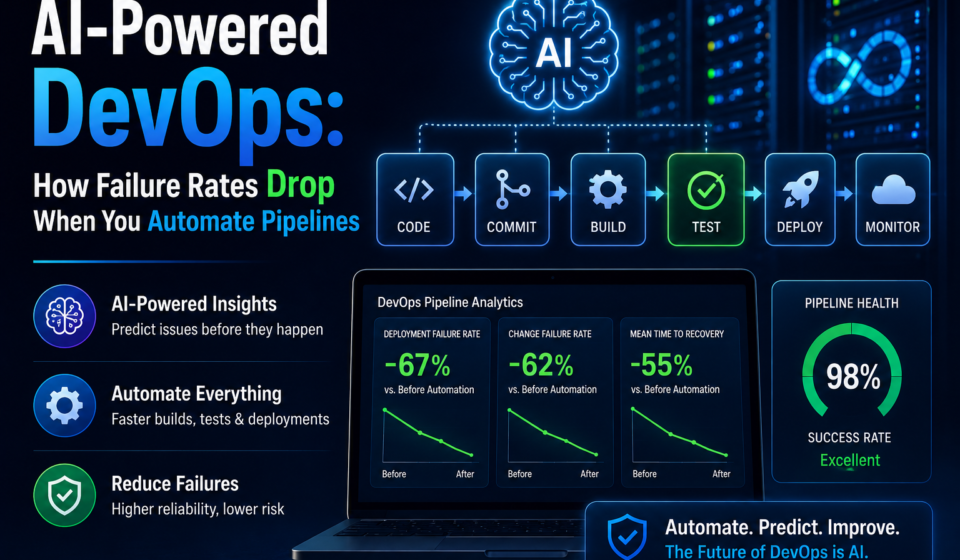
There’s a research group under Google Cloud called DORA (DevOps Research and Assessment) that has spent over a decade studying what separates high-performing engineering teams from everyone else. Their numbers are stark. Teams with mature, automated CI/CD pipelines run a change failure rate somewhere between 5 and 15 percent. Teams still leaning on manual deployment processes routinely see failure rates above 30 percent, sometimes climbing past 46 percent. Put plainly: a manual deployment breaks something roughly one out of every three to five times. An automated one breaks something closer to one out of every ten to twenty. That’s not a marginal improvement — it’s the difference between shipping with confidence and shipping while holding your breath.
Why the Gap Is Bigger Than the Numbers Show
The failure rate itself only tells part of the story. What actually matters more, in practice, is how fast you find out something’s wrong.
When a manual deployment fails, it usually isn’t caught by the team — it’s caught by a customer. Someone notices a broken checkout flow or a 500 error on a page that used to work fine, and they either complain or they just leave. By the time that ticket makes its way back to engineering, the problem might have been live for hours.
An automated pipeline behaves completely differently. Monitoring is baked into the process, so anomalies get flagged within minutes of a bad deploy. Rollback happens automatically or with a single approval, rather than someone having to SSH into a server at 11pm trying to remember which commit to revert to. That gap in detection speed and recovery time is often the real difference between a minor blip nobody remembers next week and a full-blown incident review.
Where AI Actually Fits Into This
“AI in DevOps” gets thrown around a lot right now, and a fair amount of it is marketing noise. But there are a few places where it’s making a genuinely measurable difference, not just a theoretical one.
Predictive test selection. Instead of running your entire test suite on every single commit — which on a large codebase can take twenty, thirty, forty minutes — AI models look at what actually changed and run only the tests relevant to that change. Teams using this approach are reporting CI run times dropping by 30 to 60 percent. That’s not a small quality-of-life improvement; it’s the difference between a developer staying in flow while they wait for a build and that same developer getting distracted, switching tasks, and losing momentum for the rest of the afternoon.
Flaky test detection. Every team with a test suite older than a year has at least a few tests that fail intermittently for no real reason — a timing issue, a race condition, something environmental. These erode trust in the whole pipeline, because eventually people start ignoring failures altogether, assuming “it’s probably just flaky.” AI-based detection flags these patterns automatically instead of relying on someone noticing after the fifth false alarm.
Risk-based deployment routing. Not every change carries the same risk. A copy tweak on a marketing page and a change to your payment processing logic shouldn’t go through the same approval gate. More teams are now automatically routing low-risk changes straight to production with no human sign-off required, while anything touching sensitive systems gets flagged for explicit review. This is what people mean by “staged automation” — it’s not all-or-nothing, it’s automation applied where it’s safe and friction preserved where it isn’t.
Automated root cause analysis. When something does break, AI tooling can now scan logs, recent commits, and deployment history to surface a likely cause in minutes rather than someone manually digging through five different dashboards. It doesn’t replace the engineer who fixes the problem, but it cuts the investigation time down considerably.
The teams combining these capabilities are reportedly completing deployment-related tasks up to 55 percent faster — though it’s worth being honest here: that number only holds up when the fundamentals are already in place. AI on top of a chaotic, undocumented pipeline just gets you chaos at a faster pace.
The Metrics That Actually Matter
If you’re trying to figure out whether your pipeline is actually improving or just feels busier, DORA’s four metrics are still the clearest way to measure it:
- Deployment frequency — how often you successfully ship to production
- Lead time for changes — how long it takes from a commit landing to that code running live
- Change failure rate — the percentage of deployments that require a hotfix, rollback, or patch
- Mean time to restore — how long it takes to recover once something does break
The important part is that these four need to move together. A team that starts deploying five times a day but doubles its failure rate hasn’t actually improved anything — they’ve just found a faster way to break production. Real progress looks like deployment frequency going up while change failure rate and recovery time go down at the same time.
Infrastructure as Code Deserves More Credit Than It Gets
One of the less flashy findings in recent DevOps research is that treating infrastructure configuration the same way you treat application code — version controlled, peer reviewed, tested before it ships — reduces deployment failures by roughly 40 percent on its own, before AI even enters the picture. Manually configured servers drift over time. Someone changes a setting during an incident at 2am and forgets to document it, and six months later nobody can reproduce the environment that’s actually running in production. Infrastructure as Code eliminates that entire category of problem, because the configuration lives in the same repository, under the same review process, as everything else.
It’s not exciting work. Nobody writes a case study about how satisfying it was to move their server configs into Terraform. But it’s often the highest-leverage change a team can make before layering anything AI-driven on top.
A Realistic Starting Point
For teams that are still mostly manual, the jump to “fully autonomous, AI-driven pipeline” can feel overwhelming, and honestly, trying to do it all at once usually backfires. The sequence that tends to actually work is fundamentals first — solid CI/CD, infrastructure as code, and a real automated test suite — followed by security integration, then observability, and only after that layering in AI-assisted risk routing and predictive testing. Skipping straight to the AI layer without the foundation underneath it just means automating a process that was already broken.
The organizations seeing dramatic drops in failure rates aren’t the ones with the newest tools. They’re the ones that got the boring parts right first, and then let automation do what it’s actually good at: catching problems faster than a human would, and recovering from them before anyone outside the team notices.



[…] instinct is to think of no-code as the beginner option and custom development as the “serious” one. That’s not really how the tradeoff works in 2026. No-code […]