

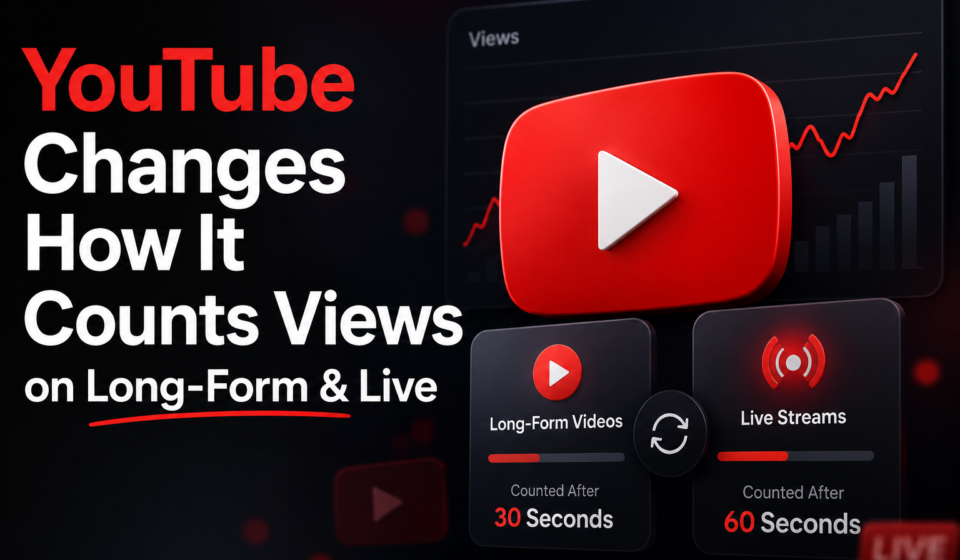

If you’re a YouTube creator, get ready for your view counts to jump — but not because your content suddenly got more popular. YouTube just announced a major change to how it defines a “view,” and it’s going to reshape how creators, marketers, and brands read one of the platform’s most-watched numbers.
What’s Actually Changing
Starting August 24, 2026, YouTube will count a public view the moment a video begins to play — from the very first frame, with no minimum watch time required. This applies across every format: long-form videos, live streams, podcasts, and Shorts.
That’s a real shift from how the platform has historically worked. Until now, standard long-form videos generally needed roughly 30 seconds of watch time before the public counter ticked up, even though YouTube never officially confirmed that exact threshold. Keeping the counting method vague was intentional — it made the system harder for bots and view-farming schemes to game. Shorts, on the other hand, already switched to this first-frame model back in March 2025, bringing it in line with how TikTok and Instagram Reels count views.
Now, YouTube is closing that gap. Every format on the platform will use the same rule: press play, and it counts.
Why YouTube Is Making This Change
According to YouTube’s own community post, announced through a Google employee’s account on the Help Center forum, the company said it had historically run multiple different view-counting systems depending on video format, and creators had been asking for a simpler, more consistent way to understand their real exposure and compare performance across formats. In plain terms: it was confusing to compare a Short’s view count to a long-form video’s view count when they were being measured completely differently.
Your View Counts Are Going Up — But Here’s the Catch
This is the part every creator needs to understand clearly: your public view numbers will very likely increase after August 24, but that doesn’t mean more people are actually watching your content. It just means the bar for what counts as a “view” has been lowered. Someone who clicks play and leaves within two seconds will now count toward your total, the same way someone who watches the entire video does.
Existing videos won’t get a retroactive boost — their historical view counts stay exactly as they are. But any new views those older videos pick up after August 24 will be counted under the new, looser system, which means older and newer performance data won’t compare cleanly against each other going forward.
Monetization Is Not Affected
Here’s the good news for creators worried this might change their income: it doesn’t. YouTube has been clear that earnings and eligibility for the YouTube Partner Program will continue to be based on a separate metric called “Engaged Views,” alongside “engaged watch hours” — both of which still require genuine viewer attention, not just a click.
Engaged Views will remain available inside YouTube Analytics under Advanced Mode, and for Shorts specifically, that metric captures viewers who stick around past the first few seconds. For long-form video and live content, YouTube’s current metrics glossary defines Engaged Views the same way it defines regular Views — so expect more clarity on that distinction as the rollout gets closer.
What This Means for Marketers and Brand Deals
This change effectively hands marketers two separate numbers where there used to be one. The public view count becomes a pure reach metric — how many times a video was exposed to someone. Engaged Views becomes the attention metric — how many people actually watched with intent. Brand deals, media plans, and campaign reports that have treated “views” as a stand-in for content quality will need to get specific about which number they’re actually citing, especially once a creator’s August 2026 numbers stop lining up neatly against their July numbers.
Advertisers should also keep this separate from paid ad metrics like TrueView, which are governed by their own billing and reporting standards and aren’t affected by this update.
What Creators Should Actually Do
- Don’t panic about a sudden view spike — it reflects a measurement change, not a performance breakthrough.
- Lean on Engaged Views for real insight. If you’re trying to understand whether your content is actually connecting with your audience, that’s the number to track, not the public-facing view count.
- Be transparent in brand pitches. If you’re pitching sponsorships, it’s worth proactively explaining the difference between reach (views) and attention (engaged views) so brands don’t misread your numbers.
- Expect a messy comparison period. Performance data from before and after August 24 won’t be apples-to-apples, especially for long-form and live content that previously required real watch time to register a view.
The Bottom Line
YouTube’s update isn’t really about changing how people watch — it’s about changing how the platform reports what happens when they click play. By aligning long-form and live content with the same first-frame counting system already used for Shorts, TikTok, and Instagram, YouTube is simplifying its metrics on paper while making the headline view count a less reliable signal of genuine engagement on its own. For creators and marketers, the real takeaway is simple: start paying closer attention to Engaged Views, because public view counts are about to get a lot less meaningful by themselves.