
Table of Contents
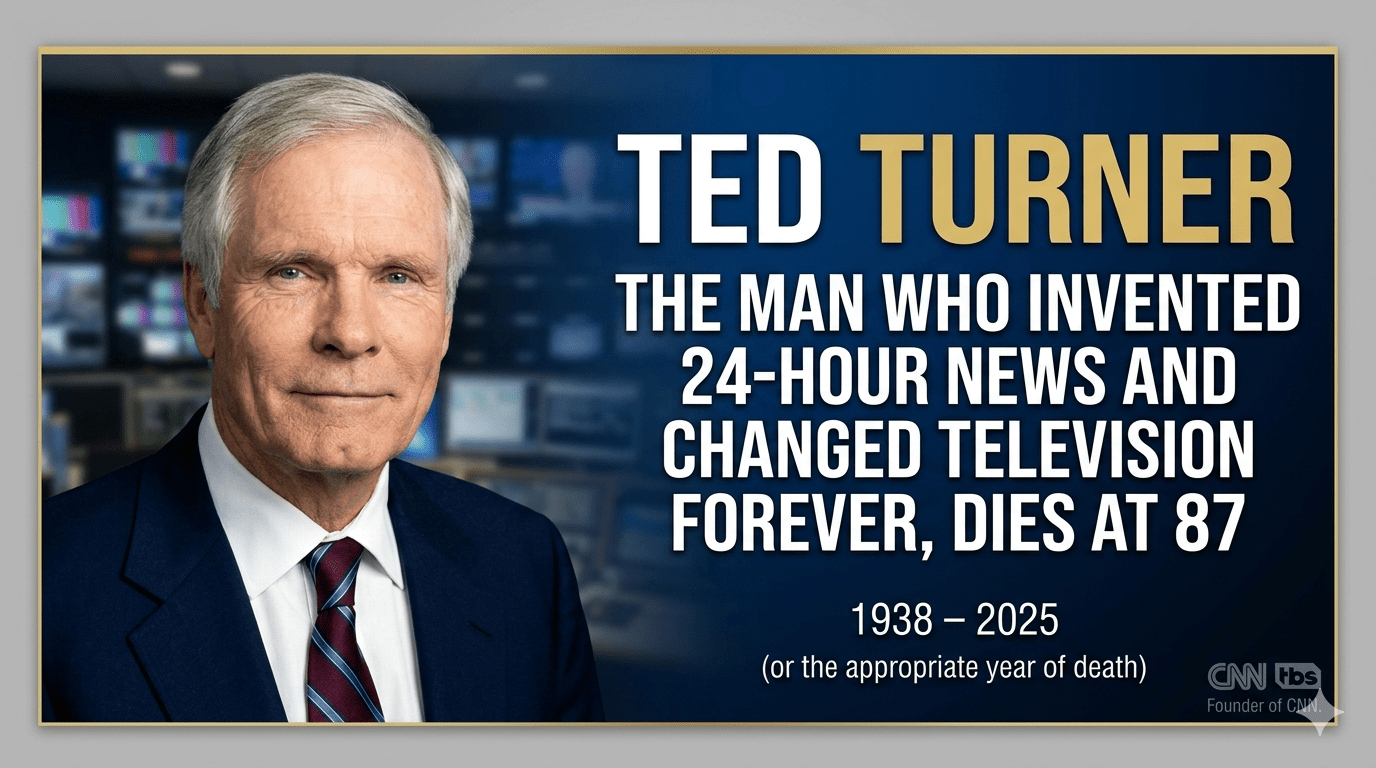
He was the son of a billboard salesman who once lost nearly everything in a single bad corporate bet. He was a sailor who won the America’s Cup and a baseball owner who once managed his own team for a single game. He founded a cable news channel that nearly every expert said would fail — and then watched it broadcast a war live from inside Baghdad. Ted Turner, who died peacefully on Wednesday May 6, 2026, surrounded by his family at the age of 87, did not just build a media empire. He rewired the way the world receives information, and no one who watched news on television in the decades after 1980 can claim his life did not shape theirs.
87
Age at death May 6, 2026
$2.8B
Net worth at death (Forbes)
$1B
Donated to un foundation
2M
Acres of land he owned
1980
Year CNN launched
Sources: Turner Enterprises, CNN, Forbes 2026 Billionaires List, Variety, Deadline, Celebrity Net Worth
The man the world lost today
Ted Turner died on Wednesday, May 6, 2026, according to a news release from Turner Enterprises, the private holding company that managed his affairs in his later years. His death was confirmed by CNN, the network he founded and that remains his most enduring creation. He was 87 years old and had been battling Lewy body dementia — a progressive brain disorder affecting memory and cognitive function — since publicly disclosing his diagnosis in September 2018. He passed away peacefully, surrounded by family, on the same day that the world was still absorbing everything he had given it.
CNN chairman and CEO Mark Thompson, in a statement released within hours of the news, said: “Ted was an intensely involved and committed leader, intrepid, fearless and always willing to back a hunch and trust his own judgment. He was and always will be the presiding spirit of CNN. Ted is the giant on whose shoulders we stand, and we will all take a moment today to recognize him and his impact on our lives and the world.”
At the time of his death, Forbes estimated Ted Turner’s net worth at approximately $2.8 billion — a figure that tells two very different stories simultaneously. At his peak, Turner was worth close to $10 billion. He lost more than $7 billion in roughly three years following the catastrophic AOL-Time Warner merger. The fact that he died a billionaire despite donating over $1 billion of his personal fortune to the United Nations Foundation, and despite one of the most painful financial collapses any American mogul has ever endured, says everything about the scale of what he built.
“Ted was the presiding spirit of CNN. He is the giant on whose shoulders we stand.” — Mark Thompson, CNN Chairman and CEO, May 6, 2026
From a billboard company to a broadcasting revolution

Robert Edward Turner III was born in Cincinnati and grew up in Atlanta, where his father Ed Turner ran a struggling billboard company. When his father died by suicide in 1963, Ted inherited the business at just 24 years old. Most people in his position would have sold it. Turner instead decided to build it — and then pivot entirely into something his father could never have imagined.
In 1970, he purchased a money-losing UHF television station in Atlanta, Channel 17, which was hemorrhaging more than $500,000 a year. The conventional wisdom at the time was that local UHF stations were dead ends. Turner saw something different. He started counterprogramming against the major networks — running old movies, classic TV reruns like The Andy Griffith Show, and Atlanta Braves baseball games — and by 1972 the station was breaking even. By December 1976, the station had a satellite transmission and was renamed WTBS, becoming what Turner called a “superstation” reaching 2 million cable subscribers across the country. By 1986, that number had grown to 34 million viewers, with annual profits surpassing $70 million.
The superstation model was itself a revolution — the idea that a single local broadcaster could reach the entire country through satellite, without a network deal, without New York’s permission, and without anyone’s playbook. Turner invented it because no one had told him it was impossible.
The Doomsday Video: Before CNN even launched its first broadcast in 1980, Turner commissioned a short video to play in the event the world was ending — featuring military bands performing “Nearer, My God, to Thee” outside CNN’s Atlanta headquarters. He famously declared CNN would stay on the air “until the world ends.” The tape remained locked in CNN’s archives for decades before a copy surfaced publicly in 2015. Today, it is one of the most extraordinary artifacts in American media history.
June 1, 1980: The day that changed news forever
On June 1, 1980, CNN — the Cable News Network — launched as the first 24-hour all-news television channel in the history of the world. Cable carriers had refused to help with startup costs. Competitors mocked it as “Chicken Noodle News.” Turner funded its launch personally, selling one of his independent stations in Charlotte, North Carolina to come up with the $21 million needed to get the channel on the air.
“I’m often asked if we ever did any formal research on the viability of a 24-hour cable news channel,” Turner wrote in his 2008 memoir “Call Me Ted,” “and my answer is no. I had spent over five years thinking about it, and it was time to get going.”
For the first several years, CNN survived on sheer stubbornness. Turner used profits from WTBS to keep the news channel afloat while it built its audience and its reputation. Then came January 16, 1991. The United States began its bombing campaign against Iraq in Operation Desert Storm, and while every other network pulled their journalists back, CNN’s team stayed in Baghdad. Anchor Bernard Shaw reported live from inside a hotel as bombs fell around him. The world watched a war unfold in real time for the first time in history. Time magazine named Turner its Man of the Year in 1991, crediting him with turning viewers into “instant witnesses of history” and changing news from “something that has happened to something that is happening at the very moment you are hearing it.”
That moment — and the decade of infrastructure building that made it possible — is Ted Turner’s most consequential contribution to modern civilization. Every breaking news broadcast you have ever watched, every live war coverage, every election night special, every disaster unfolding in real time on your screen — all of it traces a direct line back to what Turner built on June 1, 1980.
Sports, MGM, and an empire that kept expanding
Turner’s ambitions never stopped at news. In 1976 and 1977, he purchased the Atlanta Braves baseball team and the Atlanta Hawks basketball franchise — in calculated moves to fill his superstation’s programming schedule with live sports content. He bought the baseball team specifically because he needed games to broadcast. What he got, eventually, was a World Series championship in 1995. He briefly managed the Braves himself for a single game in an early season, a stunt that delighted fans and horrified baseball purists in equal measure.
In 1986, Turner paid $1.6 billion for MGM/UA Entertainment, primarily to acquire its library of more than 4,000 classic films. He sold the studio and the MGM name back almost immediately but kept the library — the crown jewel of the deal. That library became the foundation for Turner Network Television (TNT), launched in 1988, and Turner Classic Movies (TCM), launched in 1993, which remains to this day the world’s most respected repository of cinema history. He also created the Cartoon Network, acquired the Hanna-Barbera animation library, and launched an international version of CNN in 1985.
Beyond media, Turner was an elite competitive sailor. He won the 1977 America’s Cup aboard his yacht Courageous — reportedly accepting the trophy while, by his own admission, slightly intoxicated — and was named yachtsman of the year four separate times: 1970, 1973, 1977, and 1979. His nickname, “Captain Outrageous,” was earned honestly.
“Be sure to set your goals so high that you can’t possibly accomplish them in one lifetime. That way you’ll always have something ahead of you.” — Ed Turner, Ted’s father, as quoted in “Call Me Ted,” 2008
The AOL collapse: losing $7 billion and surviving it
In 1996, Turner sold Turner Broadcasting to Time Warner in a deal valued at $7.5 billion. He became the company’s vice chairman and its largest shareholder. Within nine months, his personal fortune grew by another $1 billion as Time Warner’s stock surged. It was the peak of everything he had built.
Then came the AOL-Time Warner merger in 2000 — what would later be described as the single worst merger in corporate history. Time Warner agreed to be acquired by AOL for nearly $200 billion at the height of the dot-com bubble. The Internet bubble burst. AOL Time Warner sustained a record $99 billion loss in a single year. Turner, whose wealth was almost entirely in company stock, watched his fortune collapse from $10 billion to $2 billion in roughly 30 months. By his own calculation, he was losing nearly $10 million per day for two and a half years.
He lost control of CNN, the Atlanta Braves, the Hawks, and his entire broadcasting empire. He resigned as AOL Time Warner’s vice chairman in 2003. He was, by most measures, finished in the media business. What he did next said more about his character than any of his victories. He went to his ranches, he expanded his philanthropy, and he kept going.
The philanthropist who gave away a third of everything
In 1997, following the Time Warner deal that had temporarily made him richer than ever, Turner stood up at a United Nations gala dinner and announced he would donate $1 billion to create the United Nations Foundation — one-third of his personal wealth at that moment. It was the largest single philanthropic gift by a living American to that point in history.
“All the money is in the hands of these few rich people and none of them give any money away,” he said in an interview around that time. “It’s dangerous for them and the country.” He challenged other billionaires to give while they were alive rather than waiting to bequeath money in a will — a philosophy that would later be adopted by Warren Buffett and Bill Gates in their Giving Pledge. Turner was ahead of that movement by a decade.
The United Nations Foundation funded campaigns that cut malaria nearly in half by distributing more than 1 million mosquito nets across Africa and Asia through its Nothing But Nets campaign. Turner also created the Nuclear Threat Initiative in 2001, the Better World Society, and the Turner Foundation, all focused on causes he considered existential: nuclear disarmament, climate change, overpopulation, and conservation. He was one of the earliest major corporate voices warning about fossil fuels and nuclear weapons — positions that earned him ridicule from some quarters and respect from many more.
His conservation work was not just financial. Turner became the largest single private landowner in the United States, accumulating approximately 2 million acres of ranch and environmental preserve land across six states. He maintained the world’s largest private bison herd — estimated at around 45,000 animals — and in 2002 opened Ted’s Montana Grill, a chain of eco-friendly restaurants whose signature dish is a bison burger from cattle raised on his own land. At his death he retained most of these holdings, spending his final years on his 113,000-acre ranch near Bozeman, Montana.
Ted Turner’s life: a timeline
1938
Born Robert Edward Turner III in Cincinnati, Ohio. Family moves to Atlanta when he is nine years old.
1963
Father Ed Turner dies by suicide. Ted inherits the struggling Turner billboard company at age 24 and refuses to sell.
1970
Purchases failing Atlanta UHF television station Channel 17 for a fraction of its estimated value. Named yachtsman of the year for the first time.
1976
WTBS becomes America’s first satellite-delivered cable “superstation,” reaching homes nationwide. Purchases Atlanta Braves baseball team.
1977
Wins the America’s Cup sailing race aboard Courageous. Earns the nickname “Captain Outrageous.”
1980
Launches CNN on June 1 — the world’s first 24-hour all-news television channel — with $21 million of his own money.
1986
Acquires MGM/UA for $1.6 billion to secure its 4,000-film library. Sells the studio back but keeps the films — which become TNT and TCM.
1991
CNN broadcasts the Gulf War live from inside Baghdad — the moment that puts 24-hour news permanently on the map. Named Time magazine’s Man of the Year.
1995
Atlanta Braves win the World Series under his ownership.
1996
Sells Turner Broadcasting to Time Warner for $7.5 billion. Becomes vice chairman and the company’s largest shareholder.
1997
Donates $1 billion — one third of his personal wealth — to create the United Nations Foundation. Largest individual philanthropic gift in American history to that point.
2001
AOL-Time Warner merger collapses. Turner loses more than $7 billion in roughly 30 months — nearly $10 million per day.
2018
Publicly discloses diagnosis of Lewy body dementia.
2026
Dies peacefully on May 6, surrounded by family, at age 87. Net worth estimated at $2.8 billion. Survived by five children, 14 grandchildren, and two great-grandchildren.
The man behind the legend — complicated and completely human
People who knew Turner well describe someone who was impossible to fully categorize. He described himself as having bipolar depression, but avoided psychiatry and resisted too much self-analysis. In his 2008 memoir “Call Me Ted,” his third wife Jane Fonda described his childhood as one of “complete toxicity” — beatings, psychological manipulation, and an emotional unavailability that followed him throughout his adult life. She described a “fear of abandonment deeper than with anyone I’ve ever known,” and said his restless energy “almost crackles in the air.”
Dick Parsons, who was president of Time Warner when it acquired Turner’s company, recalled his first meeting with Turner vividly. Turner was discussing overcoming adversity and looked at Parsons and said, “You were born black — bad break! But you know, you worked hard and you overcame it.” Parsons said he nearly fell out of his chair, but concluded that Turner “doesn’t possess the self-censorship mechanism that prevents most people from blurting out inappropriate ideas. But because he’s such a fundamentally guileless and genuine guy, he gets away with it.”
His feud with Rupert Murdoch is the stuff of media legend. What began over a yachting accident escalated into decades of public confrontation — Turner challenged Murdoch to fistfights on multiple occasions, declared in 2003 that Murdoch had helped push the United States into the Iraq War through Fox News advocacy, and in 2011 publicly called for Murdoch’s resignation from News Corp in the wake of the phone hacking scandal. He was never wrong, exactly, but he was always loud. The “Mouth of the South” was a nickname that fit.
He was married three times. His first two marriages ended in divorce. His ten-year marriage to actress Jane Fonda, from 1991 to 2001, was the most publicly scrutinized. He is survived by five children, 14 grandchildren, and two great-grandchildren.
What Ted Turner leaves behind
It is genuinely difficult to overstate what Ted Turner’s legacy means for the modern world. CNN, for all its current struggles to find its place in a fragmented media landscape, set the template for breaking news coverage that every outlet on earth now follows. The idea that news is a 24-hour, real-time, continuous enterprise — that a war can be broadcast live, that a disaster can be followed minute by minute, that information does not wait for the evening broadcast — that is entirely Turner’s invention.
His impact on sports broadcasting is equally transformative. By putting Atlanta Braves games on a national satellite feed, he invented the concept of a “national” sports team that did not play in New York or Los Angeles. The model he pioneered — owning both the team and the broadcast rights and using one to amplify the other — is now standard across every major American sports league.
His philanthropy changed what it means to be wealthy in America. By giving away a billion dollars while he was still alive and healthy enough to direct its use, he helped establish the expectation that the ultra-rich have an obligation to give generously and publicly, not just at the end of their lives. Warren Buffett and Bill Gates later formalized that idea into the Giving Pledge. Turner was there first, arguing for it loudly in 1997 when such positions were far less fashionable among the billionaire class.
He was, as fellow media mogul John Malone once put it, a man who lived as if “God were on his side.” He bet on himself constantly, lost catastrophically at least once, gave away a fortune freely, and died having shaped the world in ways that will outlast any of the specific businesses he built. The 24-hour news cycle he invented will keep running — as he promised — until the world ends.
FAQ’s: Ted Turner
When did Ted Turner die?
Ted Turner died on Wednesday, May 6, 2026. His death was announced by Turner Enterprises, his private holding company, and confirmed by CNN — the network he founded. He passed away peacefully, surrounded by his family. He was 87 years old at the time of his death.
What was Ted Turner’s net worth at the time of his death?
At the time of his death in May 2026, Ted Turner’s net worth was estimated at approximately $2.8 billion according to Forbes, and $2.2 billion according to Celebrity Net Worth. His peak wealth had reached nearly $10 billion before the disastrous AOL-Time Warner merger in 2000 erased more than $7 billion from his fortune. Despite that collapse and donating over $1 billion to the United Nations Foundation, Turner remained a billionaire through holdings in land, ranching, media assets, and private businesses until his death.
What did Ted Turner die of?
Ted Turner died at age 87 after a years-long battle with Lewy body dementia, a progressive brain disorder that affects memory and other cognitive functions. Turner publicly disclosed his diagnosis in September 2018. Lewy body dementia is one of the most common types of progressive dementia and causes a gradual decline in thinking, reasoning, and movement. No additional details about his immediate cause of death were released by his family or Turner Enterprises.
Who founded CNN and when was it started?
CNN — the Cable News Network — was founded by Ted Turner and launched on June 1, 1980. It was the world’s first 24-hour all-news television channel. Turner funded its launch personally with $21 million raised from the sale of one of his independent television stations in Charlotte, North Carolina. Cable carriers refused to help with startup costs, and industry experts widely predicted the channel would fail. CNN went on to become the most influential news network in the world, permanently transforming how news is delivered and consumed globally.
How much did Ted Turner donate to the United Nations?
In 1997, Ted Turner donated $1 billion to create the United Nations Foundation — one third of his personal wealth at that time and the largest individual philanthropic gift in American history to that point. The donation came shortly after his sale of Turner Broadcasting to Time Warner. Turner challenged other billionaires to give away their money while still alive rather than bequeathing it in a will. The United Nations Foundation funded causes including child mortality reduction, malaria prevention through mosquito net distribution, nuclear disarmament, and environmental protection.
What companies did Ted Turner own?
Ted Turner owned and built an extensive media and business empire over his lifetime. His major properties included Turner Broadcasting System (TBS), CNN (founded 1980), Turner Network Television (TNT), Turner Classic Movies (TCM), the Cartoon Network, Headline News, and an international version of CNN launched in 1985. He also owned the MGM film library of over 4,000 classic films, the Atlanta Braves baseball team, the Atlanta Hawks basketball franchise, Ted’s Montana Grill restaurant chain, and approximately 2 million acres of ranch and conservation land across six U.S. states. He sold Turner Broadcasting to Time Warner in 1996 for $7.5 billion.
Was Ted Turner married to Jane Fonda?
Yes. Ted Turner and Jane Fonda were married from 1991 to 2001 — a ten-year marriage that was his third and most publicly scrutinized. Turner had previously been married to Judy Nye from 1960 to 1964, with whom he had two children — Laura Lee and Robert Edward IV — and to Jane Smith from 1965 to 1988, with whom he had three children — Rhett, Beauregard, and Jennie. All three of his marriages ended in divorce. In Turner’s 2008 memoir “Call Me Ted,” Jane Fonda described his childhood as one of “complete toxicity” and wrote that he carried a “fear of abandonment deeper than with anyone I’ve ever known.”
How much land did Ted Turner own?
Ted Turner owned approximately 2 million acres of ranch and conservation land across six U.S. states, including his flagship 113,000-acre ranch near Bozeman, Montana, where he spent most of his final years. At one point, he was the largest single private landowner in the United States before being surpassed by Liberty Media founder John Malone. Turner used his land primarily for conservation, ranching, and bison restoration — he maintained the world’s largest private bison herd, estimated at around 45,000 animals. His Ted’s Montana Grill restaurant chain served bison meat raised on his own land.
What was Ted Turner’s biggest financial loss?
Ted Turner’s biggest financial loss came from the AOL-Time Warner merger in 2000, which is widely regarded as the worst corporate merger in American history. Time Warner, which had acquired Turner Broadcasting in 1996, agreed to be purchased by AOL for nearly $200 billion at the height of the dot-com bubble. When the bubble burst in 2001, AOL Time Warner sustained a record $99 billion loss in a single year. Turner’s net worth collapsed from approximately $10 billion to $2 billion in roughly 30 months — a loss of more than $7 billion, which he calculated as nearly $10 million per day for two and a half years.
Who did Ted Turner have a famous feud with?
Ted Turner had one of the most famous feuds in media history with Rupert Murdoch, the founder of Fox News and News Corp. The rivalry began over a yachting accident and escalated into decades of public confrontation. Turner challenged Murdoch to fistfights on multiple occasions. In 2003, Turner publicly accused Murdoch of helping push the United States into the Iraq War through Fox News advocacy. In 2011, Turner called for Murdoch’s resignation from News Corp in the wake of the British phone hacking scandal. Turner also clashed with Murdoch’s Fox News, which directly competed with CNN for news viewers from the mid-1990s onward.
What is the Ted Turner Doomsday Video?
The Ted Turner Doomsday Video is a short recording commissioned by Turner before CNN launched in 1980, intended to be CNN’s final broadcast if the world were coming to an end. The clip features members of the U.S. Army, Navy, Air Force, and Marine bands performing the hymn “Nearer, My God, to Thee” outside CNN’s original Atlanta headquarters. Turner declared that CNN would remain on the air “until the world ends” and promised the hymn would play as the network’s absolute final sign-off. The video remained locked in CNN’s archives for decades under strict “hold for release” instructions before a copy surfaced publicly in 2015 when a former CNN intern leaked it online.
How many children did Ted Turner have?
Ted Turner had five children across his first two marriages. With his first wife Judy Nye, he had two children: Laura Lee and Robert Edward Turner IV. With his second wife Jane Smith, he had three children: Rhett, Beauregard, and Jennie. He had no children with his third wife Jane Fonda. At the time of his death on May 6, 2026, Ted Turner was survived by all five of his children, 14 grandchildren, and two great-grandchildren.