
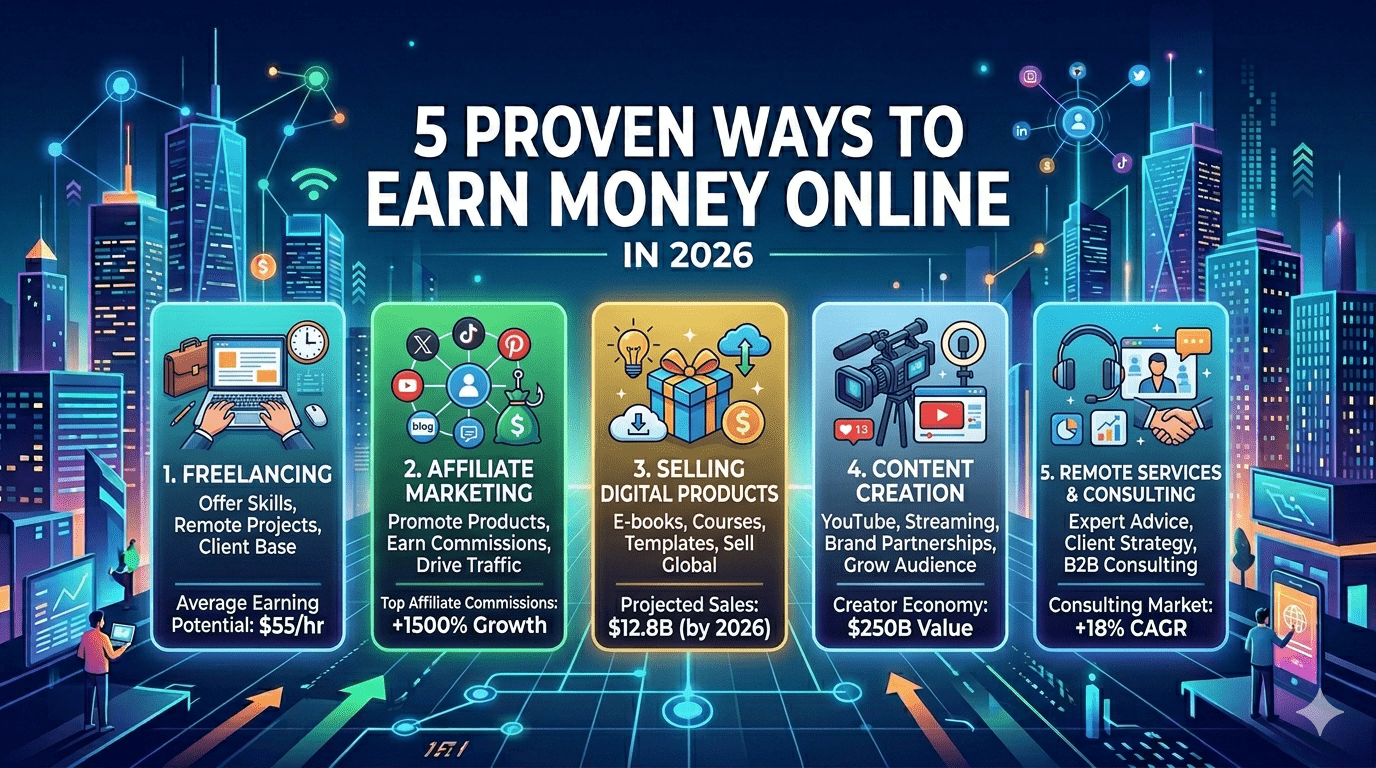
Table of Contents
Over 51% of Americans ran a side hustle in the past year. The global freelance economy generated $1.5 trillion in 2024. And yet most articles about earning money online are either embarrassingly vague or quietly trying to sell you a course. This one is different. These are five methods that actually work in 2026 — with the real numbers behind them, the real platforms you need, and the real expectations you should set before you start.
| $1.5T | 76.4M | 51% | $99K | 5.6M |
| US freelance economy 2024 | Americans freelancing 2026 | Americans with a side hustle | Avg US freelancer annual income | Avg earning $100K+ freelancing |
Sources: Upwork Future Workforce Index 2025, MBO Partners State of Independence 2025, MarketWatch Guides, ZipRecruiter May 2025
Before we get into the five ways, one thing needs to be said plainly: there is no online income method that works without effort, consistency, or a learning curve. Anyone promising $500 a day from a single afternoon of clicking is lying to you. What the data does show, consistently, is that Americans who commit to one digital income stream for six to twelve months almost always see results — and those who diversify across two or three streams build something that actually replaces or supplements a full-time salary. With that said, here is what is working right now.
01. Freelancing — The Fastest Path From Zero to Paid

If you have a skill — any marketable skill — freelancing is the fastest way to turn it into online income in 2026. The numbers are genuinely staggering. 76.4 million Americans are now freelancing, representing roughly 38% of the entire U.S. workforce, according to Upwork’s Future Workforce Index. Skilled freelancers collectively contributed $1.5 trillion to the U.S. economy in 2024 alone. A record 5.6 million independent U.S. workers earned more than $100,000 from freelancing in 2025 — the highest figure MBO Partners has ever recorded in its annual State of Independence report.
The average U.S. freelancer earns $47.71 per hour according to DemandSage, with ZipRecruiter reporting an average annual income of $99,230 for full-time freelancers. Rates vary dramatically by skill. Freelance web developers command $50 to $100 per hour. UX and UI designers average $85 per hour. AI specialists — the fastest-growing category by a wide margin — charge between $100 and $200 per hour, with prompt engineering jobs growing 240% and AI-related job postings rising 300% year-on-year through 2025.
The most important finding in the current data is this: 70% of freelancers report earning more than they did in their previous full-time job, and 18% have crossed the six-figure mark. That is not a promise — it is a documented outcome for a large segment of people who committed to independent work. The flip side is equally documented: 63% of freelancers cite income instability as their biggest challenge, and the feast-or-famine cycle is real, particularly in the first year.
What to do with this: Start on Upwork or Fiverr with your existing skills. Optimize your profile with portfolio samples — freelancers with portfolio websites earn 35% more than those relying solely on platform profiles. Do not try to undercut on price. Target the skill categories that are growing: AI tools, data analysis, video production, cybersecurity consulting, and complex writing. Avoid basic data entry, simple translation, and basic writing — these categories are declining as AI handles more of that work.
Best platforms: Upwork ($4.1B gross services volume), Fiverr, Toptal (top 3% only, highest rates), Contra (0% commission), Freelancer.com (70M+ registered users)
02. Affiliate Marketing — Earning While You Sleep Is Real, Just Slow
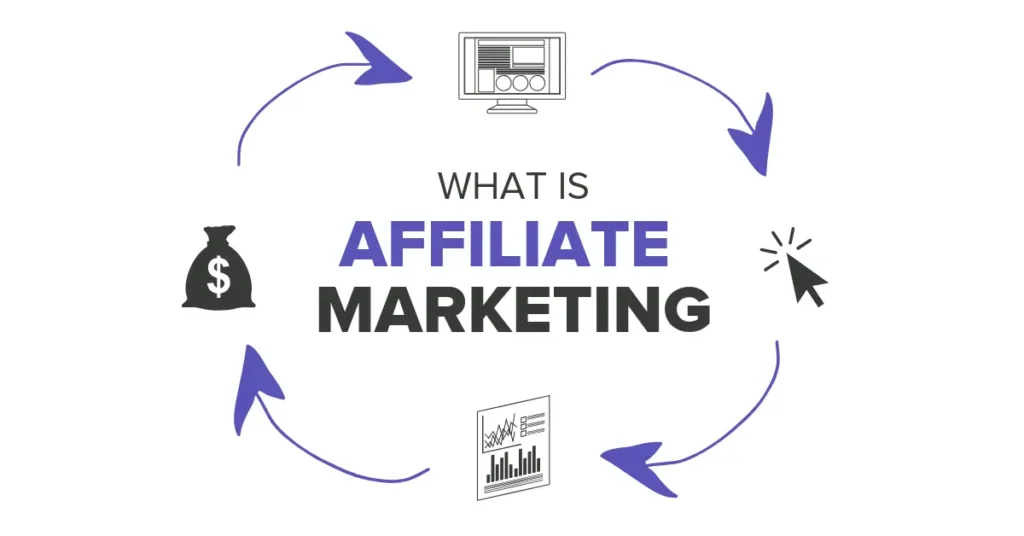
Affiliate marketing is one of the most misunderstood online income methods in existence. Half the internet tells you it is a passive income miracle. The other half says it is dead. The truth, backed by actual data, sits uncomfortably in the middle. The global affiliate marketing industry is now worth between $18.5 billion and $27.8 billion globally depending on measurement methodology, with U.S. affiliate marketing spend projected to reach $13 billion in 2026, up from $10.72 billion in 2024. That is real, growing money flowing through the ecosystem.
The commission structure is what makes it genuinely worth understanding. Retail and e-commerce programs typically pay 3% to 10% per sale. Software and SaaS programs often provide 20% to 50% recurring commissions — meaning you earn every single month a customer you referred stays subscribed. Finance programs, which are directly relevant to anyone in the lending or personal finance space, are among the highest paying in the entire industry: affiliates earn $50 to $200 per qualified lead. The average return on investment across the industry is a reported 12:1 — for every dollar spent on affiliate marketing, advertisers get $12 back, which is why more than 90% of e-commerce businesses are expected to run affiliate programs by 2026.
The honest income picture: over 57% of affiliate marketers earn below $10,000 annually. However, approximately 11% earn over $100,000 per year, and 1% earn above $1 million. The highest-earning niches in 2025 were eLearning and education at an average of $15,551 per month, followed by travel at $13,847 per month. Personal finance and investment affiliates averaged $9,296 per month. What separates the top earners from everyone else is almost always audience trust and traffic quality — not volume.
“In 2026, the people making money with affiliate links are actually using the products, showing how they fit into their real life, and recommending fewer things, but better ones. You don’t need a massive audience — you need trust.” — The Wanderlover, April 2026
What to do with this: Choose a niche where you have genuine knowledge or interest. Build content — a blog, a YouTube channel, a newsletter, or a social media presence — that earns trust before it earns commissions. Finance, software tools, health, and education are the highest-paying niches. Use SEO as your primary traffic source — around 78% of top affiliates rely on search traffic. Always disclose affiliate relationships clearly per FTC guidelines updated in 2025. Patience is not optional: most successful affiliate sites take six to eighteen months to become profitable.
Best programs: Amazon Associates (broadest product range), ShareASale, CJ Affiliate, Impact, individual SaaS company programs (often 30-50% recurring), finance and loan comparison programs ($50-$200 per lead)
03. Selling Digital Products — Create Once, Sell Forever
The economics of digital products are unlike any other business model. You create something once — a template, an ebook, a course, a preset, a design asset, a spreadsheet tool — and you sell it an unlimited number of times with zero additional cost per unit. There is no inventory, no shipping, no manufacturing, no restock. The margin on a digital product, once created, is effectively 100% minus platform fees. That is an extraordinary economic model, and in 2026 it is more accessible than at any point in history.
The numbers behind digital products are harder to pin down than freelancing because the category is so broad, but the directional data is clear. Etsy sellers offering digital downloads report that digital products generate consistent passive income once listings gain traction — some reporting $2,000 to $10,000 per month from a library of digital templates. Udemy instructors on popular courses earn between $1,000 and $50,000 per month depending on course quality and marketing. The e-learning industry itself is projected to reach $840 billion by 2030, growing at over 13% annually, which means the market for educational digital products is expanding faster than almost any other sector online.
The biggest shift in 2026 is that buyers have become far more sophisticated. They no longer want vague, generic information packaged into a PDF and sold for $97. What sells now is specificity: a template that solves one exact problem, a mini-course that teaches one specific skill, a Notion dashboard that handles one specific workflow. AI tools have made the creation of digital products dramatically faster — but paradoxically, they have also raised the bar for quality because the market is more crowded than ever. The products that win are the ones that reflect genuine expertise and solve a real, specific problem that buyers can name.
What to do with this: Start with what you already know. If you are a graphic designer, sell Canva templates. If you are an accountant, sell financial tracking spreadsheets. If you are a personal trainer, sell workout programs. The initial revenue will likely be slow — plan for three to six months before significant sales — but the compounding nature of digital product libraries means income tends to accelerate rather than plateau once you have several products live.
Best platforms: Gumroad (simple setup, low fees), Etsy (massive built-in audience for templates and downloads), Teachable and Kajabi (full course platforms), Udemy (existing student marketplace), Payhip (no monthly fee option)
04. Content Creation — The Long Game That Pays the Biggest

Content creation is the slowest method on this list and the highest ceiling. The people who started a YouTube channel, a blog, or a newsletter three years ago and kept going are, in many cases, now earning full-time incomes from those platforms. The people who started three years ago and quit after six months are not. That distinction is almost entirely what separates the two groups — not talent, not luck, not a viral moment.
The data on content creation income is more encouraging in 2026 than at any previous point. YouTube’s Partner Program now pays creators once they reach 1,000 subscribers and 4,000 watch hours, and average CPM rates in 2025 ranged from $3 to $10 per 1,000 views for general content and $15 to $40 per 1,000 views for finance, business, and legal content. A channel with 100,000 monthly views in the personal finance space could earn between $1,500 and $4,000 from ads alone — before sponsorships, which typically pay far more. For bloggers, new sites realistically earn $50 to $200 per month after six to twelve months of consistent publishing, scaling to $2,000 to $10,000 per month over two to three years with strong SEO.
The most important content creation stat for 2026 is this: nearly half of Gen Z already has an online side hustle, and over half of Gen Z plans to leave traditional employment to pursue full-time digital income. That generation understands something that older workers are still learning — that building an audience is an asset that appreciates over time and generates multiple revenue streams simultaneously. A single content platform can generate ad revenue, affiliate commissions, sponsorship income, digital product sales, and consulting opportunities all at once, from the same content library.
What to do with this: Pick one platform and one niche and commit to both for at least twelve months. Finance, health, business, technology, and education content consistently commands the highest advertising rates and sponsorship budgets. Treat the first six months as pure investment with no expectation of income. By month twelve, if you have published consistently, you will have an audience, SEO traction, and enough data to know exactly what your audience responds to.
Best platforms: YouTube (highest ad revenue ceiling), Substack (newsletter monetization, growing fast), Medium Partner Program (paid reads), TikTok and Instagram (brand deals and affiliate income), personal blog with Mediavine or Raptive display ads
05. Remote Services and Online Consulting — Your Expertise Is Worth More Than You Think

The fifth method is also the most underestimated by people who already have professional experience. Remote consulting and online services — selling your knowledge, judgment, and time directly to clients who need it — is frequently the highest hourly rate available to someone entering the online income space. The reason is simple: expertise built over years in a traditional career commands a premium that a beginner freelancer or brand-new content creator cannot yet access.
The remote work revolution has permanently expanded what “professional services” means. In 2026, there are people earning $150 to $400 per hour consulting remotely on marketing strategy, financial planning, HR policy, legal research, supply chain management, software architecture, and dozens of other domains — entirely online, with clients they have never met in person. 48% of CEOs are planning to increase freelance hiring this year according to Upwork, and 29% of executives say freelancers are “highly essential” to their operations. The demand for senior-level remote expertise has never been higher, and the supply of people offering it online is still far below what the market needs.
The entry point for consulting is a clearly defined service — not “I am a marketing expert” but “I help e-commerce brands under $5 million reduce their customer acquisition cost by 20% in 90 days.” The more specific your offer, the more easily clients can evaluate it, the less price resistance you face, and the more authority you project. AI-enabled consultants are already commanding 40% higher rates than peers who do not use AI tools — meaning the fastest way to increase your consulting income in 2026 is to learn which AI tools are transforming your industry and position yourself as the person who knows how to deploy them.
What to do with this: Write down the three problems you have solved repeatedly in your professional career. Build a one-page website describing exactly how you help clients solve those specific problems. Price at the high end of what feels uncomfortable — most new consultants dramatically underprice their time. Get your first two clients through your existing professional network. Once you have two case studies with results, referrals will come without advertising.
Best platforms: LinkedIn (highest ROI for B2B consulting), Clarity.fm (pay-per-minute expert calls), your own website, Toptal (for technical consultants willing to pass their vetting), direct outreach through your existing professional network
The bottom line: which one is right for you?
The honest answer is that the best method is the one you will actually stick with for long enough to see results. All five of these approaches work in 2026. None of them work in thirty days. Freelancing has the fastest time to first dollar but requires active time investment forever. Affiliate marketing and content creation take the longest to gain traction but generate the most passive income over time. Digital products sit in the middle — meaningful upfront work, but genuinely passive once the product exists and the traffic is there. Consulting offers the highest hourly rate for experienced professionals but scales less easily than the other methods.
The Americans who are building genuine online income in 2026 are not the ones who picked the “best” method. They are the ones who picked one method, learned everything about it, started before they felt ready, and kept going when the first month’s results were disappointing. The $1.5 trillion freelance economy does not care which approach you choose. It just rewards the people who show up.
FAQ’s: Online Earning in 2026
Answers to the most common questions about earning money online
What is the fastest way to earn money online in 2026?
The fastest way to earn money online in 2026 is freelancing. If you have a marketable skill — writing, design, coding, marketing, video editing, data analysis, or AI tools — you can create a profile on Upwork or Fiverr and begin receiving paid work within days to weeks. Unlike affiliate marketing or content creation, which take months to generate income, freelancing allows you to exchange your skills for money immediately. The average U.S. freelancer earns $47.71 per hour, and a record 5.6 million Americans earned over $100,000 from freelancing in 2025 alone.
How much can a beginner realistically earn online per month?
A realistic range for a beginner earning online depends entirely on the method. A new freelancer with a marketable skill can earn $500 to $2,000 in their first month if they are actively applying for work on platforms like Upwork or Fiverr. A new blogger or affiliate marketer will likely earn close to zero in the first three to six months, then $50 to $500 per month in months six to twelve as content builds traction. A new digital product seller might earn $100 to $500 in the first few months if they have an existing audience, and much less without one. The top 25% of Gen Z workers earn an average of $825 per month through side hustles according to MarketWatch Guides, which is a reasonable one-year target for most beginners who start with one focused method.
Is affiliate marketing still worth it in 2026?
Yes, affiliate marketing is still worth it in 2026, but the landscape has changed significantly. U.S. affiliate marketing spend is projected to reach $13 billion in 2026, up from $10.72 billion in 2024, and more than 90% of e-commerce businesses are expected to run affiliate programs. However, the easy wins from generic review sites are gone. What works in 2026 is highly specific, trust-based content that recommends fewer products with genuine expertise. Finance, software, education, and health remain the highest-paying niches. Approximately 11% of affiliate marketers earn over $100,000 annually. It is absolutely viable — but it requires six to eighteen months of consistent content creation before generating meaningful income.
What skills are most in demand for freelancers in 2026?
The most in-demand freelance skills in 2026 are heavily AI-adjacent. Prompt engineering job postings grew 240% since the launch of ChatGPT, AI content editing grew 180%, and overall AI-related job postings grew 300% year-on-year through 2025 according to Upwork data. Beyond AI, the strongest demand is in software and web development (34% of Upwork activity), digital marketing, UX and UI design, cybersecurity consulting, and video production. AI-enabled freelancers already command approximately 40% higher rates per hour than peers who do not use AI tools. Skills in decline include basic data entry, simple translation, and basic writing, as AI handles more of that work.
Can I earn money online without any experience or skills?
Yes, though the options are more limited and the income lower without existing skills. Entry-level options for beginners include usability testing on platforms like UserTesting, which pays $10 to $60 per test, completing paid surveys (typically $1 to $5 each, supplemental income only), microtask platforms like Amazon Mechanical Turk for simple data tasks, and print-on-demand selling on Redbubble or Merch by Amazon where you upload designs without holding inventory. These methods generate supplemental income, not a living wage. The most reliable path from no experience to meaningful online income is skill building — learning a single marketable skill like Canva design, basic copywriting, video editing, or social media management — and then freelancing that skill. Most of these can be learned to a beginner-professional level within 60 to 90 days using free resources.
How long does it take to earn money from a blog in 2026?
Most new blogs take six to twelve months to generate any meaningful income in 2026, and twelve to twenty-four months to become consistently profitable. New blogs realistically earn $50 to $200 per month after six to twelve months of consistent publishing with good SEO practices, scaling to $2,000 to $10,000 per month over two to three years for blogs that stay consistent and build domain authority. The timeline has lengthened compared to five years ago due to increased competition, Google algorithm updates that favor established sites, and the rise of AI-generated content flooding many niches. Finance, legal, medical, and parenting niches face additional scrutiny from Google as YMYL (Your Money or Your Life) categories. The blogs succeeding in 2026 publish original research, genuine first-hand experience, and content that clearly demonstrates real expertise.
What is the best platform to sell digital products online?
The best platform to sell digital products depends on your product type. Etsy is ideal for templates, printables, and digital design assets because it has a massive built-in audience of buyers actively searching for those products. Gumroad is the simplest option for ebooks, guides, and simple digital downloads with low fees and fast setup. Teachable and Kajabi are best for full online courses that require a structured learning environment. Udemy gives you access to its existing marketplace of millions of students but takes a significant commission on sales. For maximum control and the highest margins, selling directly from your own website using tools like WooCommerce or Shopify avoids platform fees entirely but requires you to drive your own traffic. Most successful digital product sellers use multiple platforms simultaneously.
Is it possible to earn $100,000 a year online?
Yes, earning $100,000 a year online is achievable, and more Americans are doing it than ever before. A record 5.6 million U.S. independent workers crossed the $100,000 annual income threshold from freelancing alone in 2025, according to MBO Partners. Approximately 18% of all freelancers have reached six-figure income. Among affiliate marketers, roughly 11% earn over $100,000 annually. For consultants with specialized expertise, $100,000 annually is realistic within one to two years of establishing a client base. Reaching this level typically requires two to four years of consistent work in a high-value skill area, a strong professional reputation, and either a diversified income across multiple streams or a single very high-value service at premium rates.