

When discussions about border security dominate the news cycle, the focus is almost exclusively on the political and social implications. However, for financial professionals, economists, and everyday taxpayers, there is another, equally critical lens through which to view these developments: the macroeconomic impact of unprecedented federal spending.
Currently, lawmakers are navigating a massive legislative package using the budget reconciliation process. This move aims to secure up to $70 billion in new funding for Immigration and Customs Enforcement (ICE) and Customs and Border Protection (CBP). For readers at Loan Wise USA who keep a close eye on fiscal policy, government borrowing, and market stability, understanding the mechanics and economic fallout of this house reconciliation ICE CBP funding is essential.
Here is a deep dive into the numbers, the legislative process driving them, and what these historic budgetary shifts mean for the U.S. economy and the national debt.
Understanding the Vehicle: The Power of Budget Reconciliation
To understand the magnitude of this funding, one must first understand the mechanism being used to pass it. In the United States Senate, most legislation requires a 60-vote supermajority to overcome a filibuster. In a deeply divided political climate, reaching that threshold for controversial topics like immigration enforcement is notoriously difficult.
Enter budget reconciliation. Created by the Congressional Budget Act of 1974, reconciliation is a special legislative process designed to expedite the passage of certain tax, spending, and debt limit legislation. The most crucial feature of a reconciliation bill is that it is immune to the filibuster, meaning it can pass the Senate with a simple majority of 51 votes (or 50 votes plus the Vice President’s tie-breaker).
By attaching massive DHS appropriations 2026 to a reconciliation package, lawmakers are effectively fast-tracking billions of dollars in spending while bypassing traditional bipartisan negotiations. However, the “Byrd Rule” strictly dictates that reconciliation bills must primarily affect federal revenues and spending—they cannot be purely policy-driven. Therefore, the debate inherently becomes a financial one, shifting the spotlight directly onto federal outlays, budget deficits, and debt management.
By the Numbers: Historic ICE and CBP Budget Statistics
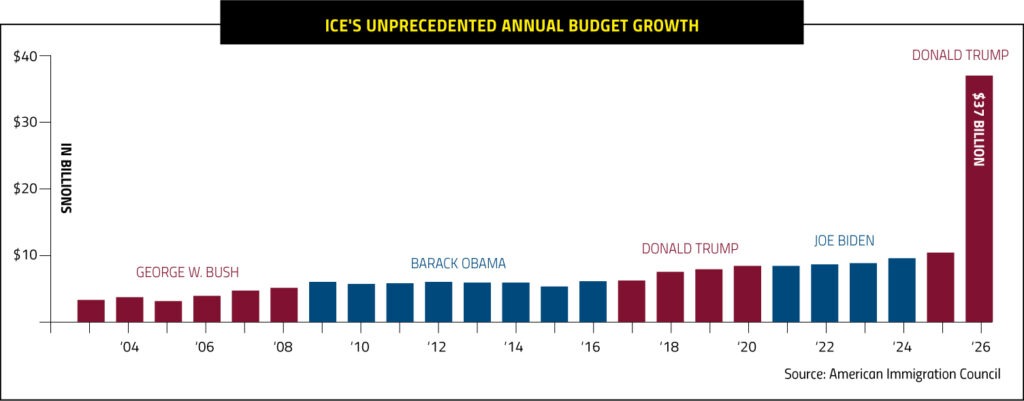
The scale of the proposed funding is historic and represents a fundamental shift in border security funding trends. We are moving away from standard, incremental agency growth and toward supercharged, multi-billion-dollar surges in capital and operational expenditures.
The $70 Billion Senate Package The current reconciliation maneuver aims to inject a staggering $70 billion into the Department of Homeland Security’s enforcement arms. This capital is intended for vast expansions in physical infrastructure, advanced border surveillance technology, and a massive increase in personnel.
Contextualizing the Surge: The OBBBA Precedent To put this $70 billion into perspective, we must look at recent legislative history. The controversial “One Big Beautiful Bill Act” (OBBBA) previously demonstrated the sheer scale of capital lawmakers are willing to deploy. That legislation funneled over $190 billion to the Department of Homeland Security.
Breaking down that historic OBBBA immigration funding reveals staggering allocations:
- Roughly $75 billion was earmarked specifically for ICE. To contextualize this, that figure represents roughly seven times the agency’s standard annual operating budget.
- An additional $65 billion was allocated to CBP, designed to overhaul port-of-entry technologies and physical barriers.
The 365% Detention Increase Looking ahead, proposed House Judiciary drafts have outlined incredibly aggressive fiscal trajectories. Recent proposals include a massive 365% annual increase for ICE’s detention operations. If fully realized, this specific line item alone could raise the detention budget to an unprecedented $12.4 billion annually through 2029.
Appropriations vs. Actual Outlays: A Financial Reality Check
In federal finance, there is a massive difference between “Budget Authority” (the amount Congress legally allows an agency to spend) and “Outlays” (the actual cash leaving the U.S. Treasury). While the headline numbers of $70 billion or $190 billion dominate the news, the reality of government spending is often much slower.
Despite the massive scale of recent appropriations, actual federal Treasury outlays tell a slightly different story about immediate economic velocity. For example, between October 2025 and February 2026, actual CBP spending hit approximately $8.8 billion. While this is a massive sum, it only represents a modest 4% increase compared to the exact same period in the prior fiscal year.
Why the discrepancy?
- Procurement Timelines: Securing federal contracts for high-tech surveillance gear, construction materials, and specialized services takes months, sometimes years, of bidding and compliance reviews.
- Hiring Bottlenecks: You cannot spend billions on payroll instantly. Recruiting, vetting, and training thousands of new federal law enforcement officers is a prolonged process.
- Staggered Deployment: Multi-billion-dollar packages are usually designed to be spent over a five-to-ten-year window, not a single fiscal quarter.
For economists monitoring inflation and government capital injections, this lag is crucial. It means the inflationary pressure of this spending is spread out over time, rather than hitting the economy all at once.
The Macro-Economic Ripple Effect: National Debt and Federal Spending
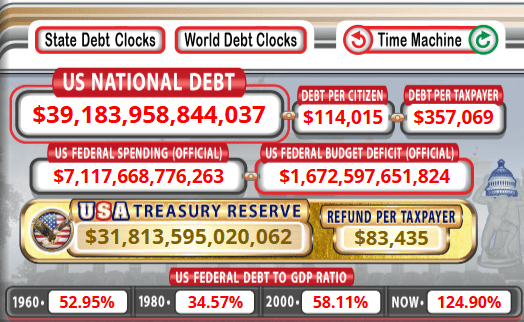
The most pressing concern for the financial sector regarding the house reconciliation ICE CBP funding is its impact on the broader U.S. balance sheet.
Adding to the Deficit When Congress appropriates $70 billion via reconciliation without raising taxes to cover the cost, that money must be borrowed. This adds directly to the national debt. In an era where the U.S. national debt is already a subject of intense global scrutiny, adding tens of billions of dollars in new, un-offset spending raises alarm bells for fiscal conservatives and bond market analysts alike.
The Cost of Borrowing We are currently operating in an economic environment where interest rates are a primary concern. When the federal government issues more Treasury bonds to finance this border security spending, it increases the supply of bonds. To attract buyers, yields generally must rise. Higher Treasury yields can lead to higher borrowing costs across the entire economy—affecting everything from corporate expansion loans to the mortgage rates that everyday Americans rely on to buy homes.
The Offset Debate Because of these fiscal realities, the debate over national debt and federal spending has intensified on Capitol Hill. Many lawmakers—even those who strongly support the goal of border security—are demanding that this massive new spending be offset by equivalent budget cuts in other federal departments.
This creates a high-stakes economic tug-of-war. If $70 billion goes to ICE and CBP, where does it come from? Does it mean cuts to infrastructure, education, or healthcare? Or does it simply get added to the national credit card? The resolution to this debate will shape federal fiscal policy for the rest of the decade.
What This Means for the Everyday Economy and Taxpayers
For the audience at Loan Wise USA, macro-level federal spending ultimately trickles down to micro-level financial realities.
- Taxpayer Burden: Whether financed through immediate taxation or long-term debt issuance, historic surges in agency funding represent an increased liability for the American taxpayer.
- Labor Market Shifts: Pumping billions into federal law enforcement and border infrastructure pulls labor and materials from the private sector. Construction companies winning federal contracts may face labor shortages for private commercial projects, potentially driving up building costs locally.
- Inflationary Pressures: While the outlays are staggered, injecting tens of billions of new dollars into the economy—specifically into defense contracting, construction, and federal payrolls—acts as a localized economic stimulus, which can carry underlying inflationary risks.
Conclusion
The push for house reconciliation ICE CBP funding is much more than a border security initiative; it is a massive fiscal event. By utilizing the reconciliation process to bypass traditional congressional gridlock, lawmakers are attempting to authorize historic levels of capital.
As we track the progress of this $70 billion package, the focus must remain on the long-term economic realities: the widening gap between budget authority and actual outlays, the increasing pressure on the national debt, and the downstream effects on interest rates and taxpayer obligations. Understanding these financial mechanics is vital for navigating the complex intersection of government policy and domestic economic health.