

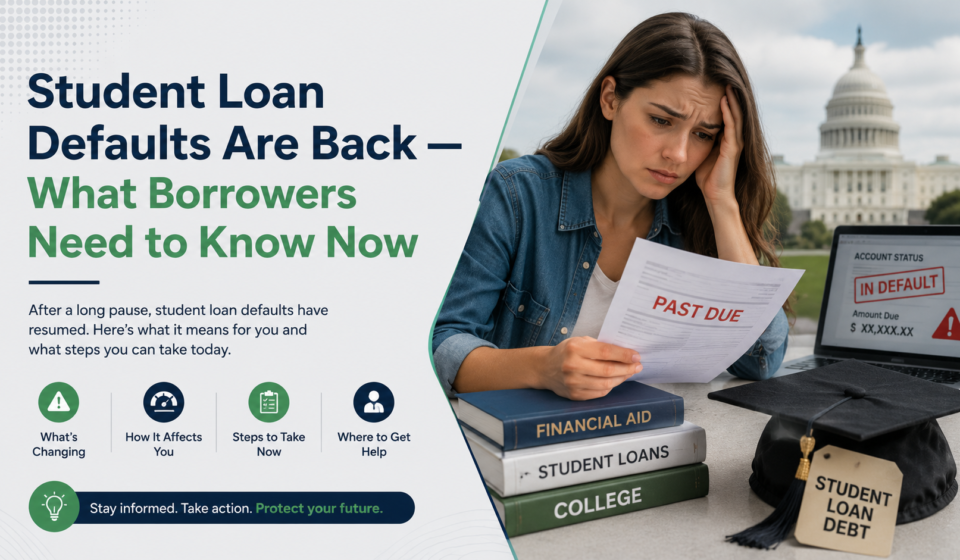

Student loan collections are back in the headlines, and for millions of Americans, this isn’t just news — it’s personal. After a five-year pandemic-era pause, the federal government resumed aggressive collection efforts on defaulted student loans this year, and the numbers involved are staggering: roughly 5.5 million borrowers are currently in default, with another 3.7 million more than 270 days late on payments and 2.7 million in early-stage delinquency — putting nearly 12 million Americans somewhere in the default pipeline.
If you’re behind on federal student loans, or think you might be, here’s exactly what’s happening, what’s changed most recently, and what you can actually do about it.
How We Got Here
Student loan repayments were paused with no interest accruing back in March 2020 under the first Trump administration, as a COVID-19 relief measure. After several extensions during the Biden years, payments were required to resume in October 2023 once Congress blocked any further extensions. But even after payments restarted, actual collections on defaulted loans stayed paused for years — until this year. CBS News
The Trump administration announced in April 2026 that it would resume collection activity on defaulted student loans starting in May, ending years of leniency for borrowers who had fallen behind. That included seizing tax refunds and other federal payments through the Treasury Offset Program — but the next, more serious escalation was wage garnishment.
Wage Garnishment: What Actually Happened
In December 2025, the Department of Education confirmed it would begin garnishing the wages of borrowers in default starting in early 2026, sending notices to approximately 1,000 borrowers during the week of January 7, with the number of notices increasing at an accelerating scale each month after that.
Here’s how the process technically works: once a federal student loan goes into default, meaning it’s been 270 or more days since the borrower’s last payment, the entire remaining loan balance becomes immediately due, and the loan gets transferred from your regular loan servicer over to the Department of Education’s Default Resolution Group or another collections agency, which then begins the formal collection process. If your loan is in default, the Department of Education can order your employer to withhold up to 15% of your disposable income, though you’re generally guaranteed to keep at least $217.50 per week, and you’re required to receive a 30-day notice before garnishment can actually begin.
The Twist: Collections Got Paused Again
Here’s where it gets important for anyone reading this in real time: as of right now, wage garnishment is not actively happening. The Department of Education delayed its involuntary collections, including wage garnishment and Treasury offset, on January 16, 2026, and as of August 2026, it hasn’t announced any date for restarting them.
Why the pause? The Department said the delay was meant to give it time to roll out major student loan repayment reforms under the Working Families Tax Cuts Act, including simplified repayment plans and an additional chance for borrowers to rehabilitate their defaulted loans out of default status. U.S. Department of Education
This is genuinely important context that a lot of headlines miss: the legal authority for garnishment hasn’t disappeared, it still applies to loans already in default, and it can restart with very little warning — the pause is a window of opportunity, not a resolution to the underlying problem.
What’s Changed in Loan Repayment Itself
Beyond collections, the entire federal repayment landscape has shifted dramatically this year. The One Big Beautiful Bill Act (OBBBA) fundamentally reshaped federal student loan repayment — phasing out popular income-driven plans like PAYE and ICR, replacing them with longer, balance-based repayment terms, and introducing a new Repayment Assistance Plan (RAP) with a 30-year horizon. For borrowers who were already struggling, these changes generally mean higher long-term costs and fewer easy off-ramps out of default.
On a more borrower-friendly note, the Act also gives defaulted borrowers a second chance at loan rehabilitation, allowing them to get their loans back on track — something the previous law only permitted once.
Why the Timing Is Especially Painful
Experts have flagged that this collections resumption is landing at a uniquely difficult moment for household budgets. Betsy Mayotte, president of The Institute of Student Loan Advisors, pointed out that garnishment efforts are coinciding with rising healthcare costs, since premium increases for Affordable Care Act insurance are also kicking in around the same time — a combination she said will almost certainly put significant economic strain on low- and middle-income borrowers.
If You’re in Default: Your Three Main Options
If your loans are currently in default, or getting close to it, financial advisors generally point to three paths forward:
- Loan Rehabilitation — This involves making nine affordable, agreed-upon payments over 10 months, after which your loan is restored to good standing. This is often the gentlest path back to normal repayment status, and it typically removes the default from your credit history once completed.
- Loan Consolidation — This combines your defaulted debt into a new Direct Consolidation Loan, paired with an income-driven repayment plan. It’s usually faster than rehabilitation, but be aware that consolidating can affect progress you’ve already made toward Public Service Loan Forgiveness (PSLF) or other income-driven forgiveness programs — so this option needs a careful look before you commit.
- Full Repayment or Settlement — For borrowers who can manage it, paying off the defaulted balance in full (or negotiating a reduced settlement) resolves the default immediately, though this obviously isn’t realistic for most people already struggling to make payments.
What to Do Right Now, Even During the Pause
Just because garnishment is currently paused doesn’t mean it’s smart to wait it out. Here’s what actually protects you:
- Check your loan status today. Log into your StudentAid.gov account — if you’re in default, a warning message will appear in a red box on your dashboard.
- Update your contact information. Make sure the Department of Education and your loan servicer have your current address and phone number, since missing a critical notice could mean missing your window to respond.
- Don’t ignore a wage garnishment notice if you get one. If you receive a notice of proposed wage garnishment, you have the right to object and request a hearing — but you have to act quickly, since the window to respond before an order is sent to your employer is limited.
- Start rehabilitation or consolidation proactively. Waiting for a garnishment notice to force your hand puts you in a weaker negotiating position than starting the process voluntarily.
- Watch for a restart announcement. Since the Department hasn’t ruled out resuming garnishment, and has given no fixed timeline, treat this pause as temporary breathing room, not permanent relief.
The Bottom Line
The return of federal student loan collections marks one of the most significant shifts in the loan landscape since payments first resumed in 2023. With nearly 12 million borrowers somewhere in the default or delinquency pipeline, and a genuinely uncertain timeline for when wage garnishment might restart, this is not a moment to wait and see. Whether you’re already in default or just falling behind, the safest move is the same one advisors keep repeating: check your status, understand your options, and act before a notice forces your hand.



-
-
-
-
-
Show Comments[…] a year, renters are 51.9% more likely to use BNPL than homeowners, and 32.7% of users have a credit score below 620, a rejected credit application, or a delinquent loan — a rate 97% higher than the national […]
[…] a 529 plan, which locks your money into education expenses, a Trump Account has no such restriction — when your child turns 18 and the funds roll out, they […]
[…] you’ve been sitting on private student loan debt and watching interest rate headlines all year, the next few months matter more than most. […]
[…] code — version controlled, peer reviewed, tested before it ships — reduces deployment failures by roughly 40 percent on its own, before AI even enters the picture. Manually configured servers […]
[…] usually wipes out the entire advantage — the same trap that turns a manageable balance into a default problem on any other kind of debt. If you cannot buy it outright, the honest answer is to keep wearing what […]