
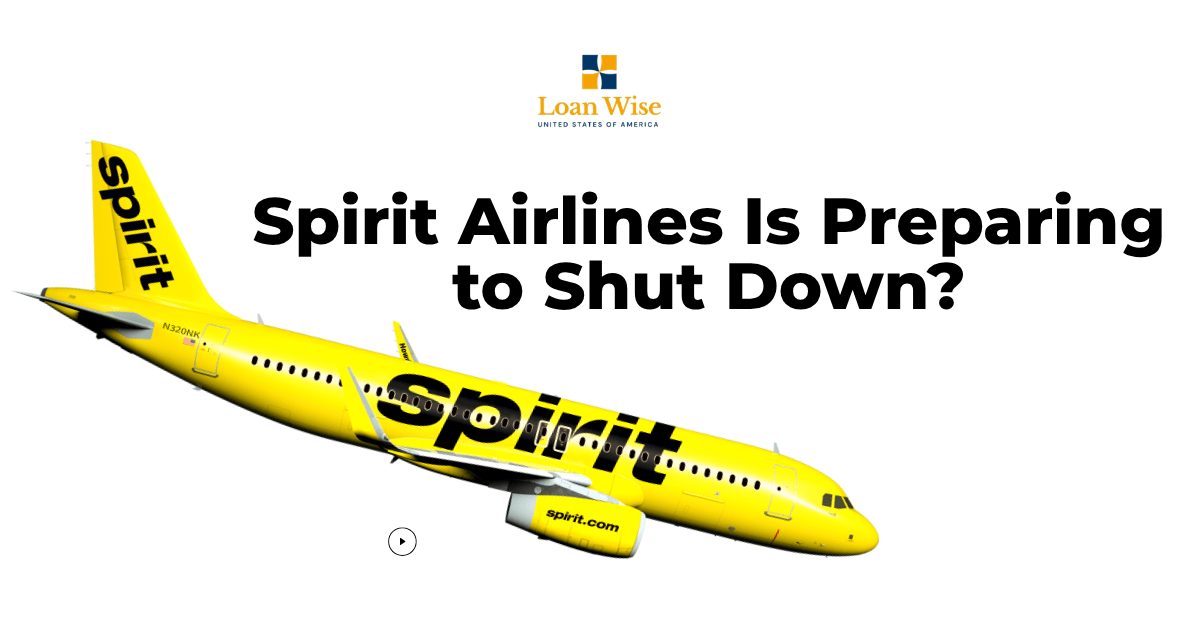
America's most recognizable budget airline, known for its sunshine yellow planes and rock-bottom fares, is now preparing to turn off the lights for good. A last-ditch $500 million government rescue deal has collapsed, creditors cannot agree, and Spirit is running out of cash by the day. This is the full story of how it got here.
Sources: Wall Street Journal, CBS News, The Daily Beast, IBTimes, Trump Oval Office statement
The collapse of the rescue deal
The story everyone saw coming finally arrived. Spirit Airlines is preparing to shut down after a proposed government bailout worth $500 million fell completely apart. According to the Wall Street Journal, which broke the story citing people familiar with the matter, the airline simply could not secure the dual support it needed — from the Trump administration on one side and from its key bondholders on the other.
The proposed deal had a very specific structure. The federal go
vernment would provide a cash infusion to Spirit in exchange for warrants that could convert into a stake of up to 90% of the company. Essentially, the U.S. government would become Spirit’s controlling owner. The plan was floated under the Defense Production Act, using emergency powers to frame the loan as a national security matter, with the airline’s excess capacity potentially used for military transport of troops and cargo.
But the deal never got off the ground. There were reported disagreements inside the Trump administration about whether and how the bailout should be funded. Not all bondholders were willing to accept a structure that would make the government the senior debt holder, meaning the government would be paid back before existing creditors. With no consensus on either end, negotiations stalled — and Spirit’s clock ran out.
“If we could do it, we’d do it. But only if it’s a good deal this weekend, because they haven’t gotten a deal looking at it.” — President Donald Trump, speaking to reporters at the White House
A company that has been in trouble for years
To understand the Spirit Airlines bankruptcy and shutdown, you have to go back further than this week’s headlines. Spirit’s business model was built on an idea that made a lot of sense in theory: strip the flight down to the absolute basics, charge the lowest possible base fare, and then layer on fees for everything else — bags, seat selection, even water on some routes. For a while, it worked.
But the competitive environment shifted underneath them. Legacy carriers and rival low-cost airlines like Frontier, Southwest, and even JetBlue began aggressively matching Spirit’s pricing strategies while offering materially better service. Spirit was losing ground on both ends — its fares were no longer uniquely cheap, and its experience remained uniquely bare. Revenue dried up, losses mounted, and a heavy debt load made recovery almost impossible without outside help.
The airline filed for Chapter 11 bankruptcy protection in November 2024. That was supposed to be the moment it restructured and came out leaner. Instead, it filed a second time in August 2025. Two bankruptcies in under a year is not a restructuring story. It is a survival story that was already going badly.
The failed merger history: Spirit tried to merge its way out of tro
uble. JetBlue Airways attempted a $3.8 billion acquisition before the Biden administration’s Department of Justice sued to block it in 2023, arguing the deal would reduce competition. Frontier Airlines also attempted a buyout. Both deals ultimately failed. The White House has pointed to the DOJ’s JetBlue blockade as a key factor in Spirit’s collapse.
How the Iran war made everything worse

Spirit was already fragile when the geopolitical situation in the Middle East delivered another blow. Beginning in late February 2026, U.S. and Israeli military operations against Iran escalated significantly. Iran’s response included blocking the Strait of Hormuz, the narrow waterway through which roughly one-fifth of the world’s oil and liquefied natural gas passes every single day.
The result was a global energy shock. Jet fuel prices spiked across the industry. For a carrier like Spirit, which operated on paper-thin margins even in good times, that kind of cost surge was catastrophic. Airlines pass fuel costs into fares when they can, but Spirit’s customer base is the most price-sensitive in the industry. Raising fares meant losing passengers. Absorbing the costs meant burning through cash even faster.
CBS News reported that by the time rescue talks were at their most critical stage, Spirit had enough cash to continue operations for a matter of days, not weeks. That is not a negotiating position. That is a deadline, and the deadline passed.
“Spirit is running out of money, planning to sell its fleet of planes, and cease trading.” — The Daily Beast, citing people familiar with the matter
What happens to passengers now
As of the time of writing, Spirit Airlines is still operating. The airline told Yahoo Finance on Friday, “Spirit is operating as usual.” No formal shutdown date has been announced, and no government agency has officially confirmed the collapse of rescue negotiations. But the operative word is “as of now.”
If Spirit does proceed to liquidation, passengers holding future tickets face real exposure. Unlike a bankruptcy reorganization where the airline continues to fly during restructuring, a full liquidation means flights stop. Credit card chargebacks are typically the fastest path to a refund for tickets purchased on cards that offer purchase protection. Travel insurance policies that cover airline default are also worth checking immediately if you have a Spirit booking in the coming months.
Spirit’s relatively young fleet has long been considered an attractive asset for potential acquirers. The planes themselves — a mix of Airbus A320-family aircraft — will likely be sold off as part of any liquidation. Whether another carrier steps in to acquire routes, slots, or aircraft remains to be seen. Frontier Airlines has historically been the most natural acquirer given its similar business model and overlapping network.
The bigger picture: what Spirit’s collapse means for budget air travel
The potential end of Spirit Airlines is not just a corporate story. It is a consumer access story. Spirit, for all its baggage fees and no-frills reputation, genuinely kept fares down on the routes it served. Academic research on the “Spirit effect” has consistently shown that when Spirit entered a market, average fares across all carriers on that route fell. When Spirit exits, fares tend to rise.
With roughly 14,000 jobs at stake according to Trump’s own public statements, and with Spirit serving price-sensitive travelers on hundreds of routes, the downstream effects of a full shutdown will be felt by millions of passengers who never even flew Spirit but benefited from its pricing pressure on competitors.
The ultra-low-cost carrier model in America is now at a genuine crossroads. Frontier remains, but it too has faced losses. The gap that Spirit leaves will not automatically be filled by a competitor willing to accept the same thin margins in the same markets. For budget travelers, particularly those in secondary cities where Spirit was sometimes the only truly affordable option, the math just got harder.
Trump’s final offer: President Trump told reporters Friday that his administration gave Spirit “a final proposal” and expected to make an announcement by that evening or Saturday. As of publication, no deal has been confirmed. Trump said the government offered to help “only if it’s a good deal,” framing the decision as a business judgment rather than a political one.
The bottom line
Spirit Airlines spent years flying on financial fumes, and now the runway has finally run out. Two bankruptcies, a string of failed mergers, a geopolitical shock that sent fuel prices soaring, internal divisions within the Trump administration, and a bondholder class unwilling to be subordinated to the federal government — any one of these alone might have been survivable. Together, they were not.
Whether a last-minute deal materializes over the weekend remains technically possible. But the people closest to these negotiations are describing a company that has already begun planning its wind-down. For the passengers, the employees, and the millions of travelers who benefited indirectly from Spirit keeping fares honest, that is a genuinely bad outcome — no matter what you thought of the yellow planes.